麻醉期间目标导向液体治疗老年患者胃肠手术术后的临床效果
2020-08-31漆启荣李娜黄彦胡英东
漆启荣 李娜 黄彦 胡英东
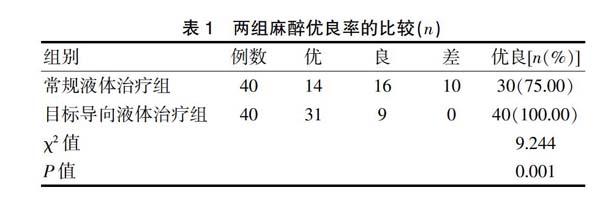

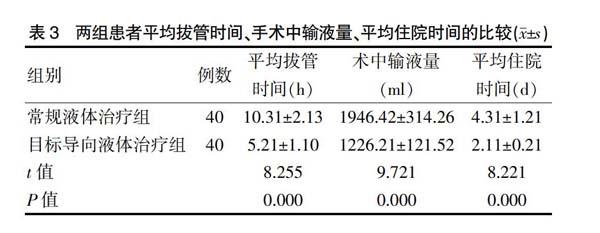
[摘要]目的 探讨麻醉期间目标导向液体治疗对老年患者胃肠手术术后快速康复的影响。方法 选取2017年9月~2019年9月在我院需住院接受胃腸手术治疗的80例老年患者作为研究对象,按照随机数字表法分为常规液体治疗组(40例)和目标导向液体治疗组(40例)。常规液体治疗组采取常规液体治疗,而目标导向液体治疗组采取麻醉期间目标导向液体治疗。比较两组老年患者的麻醉优良率、平均拔管时间、手术中输液量、平均住院时间以及麻醉期间行胃肠手术老年患者的平均心率和平均动脉压、术后并发症。结果 目标导向液体治疗组的优良率高于常规液体治疗组,差异有统计学意义(P<0.05)。目标导向液体治疗组的心率和平均动脉压均低于常规液体治疗组,差异均有统计学意义(P<0.05)。目标导向液体治疗组的平均拔管时间和平均住院时间短于常规液体治疗组,术中输液量少于常规液体治疗组,差异均有统计学意义(P<0.05)。目标导向液体治疗组的并发症总发生率低于常规液体治疗组,差异有统计学意义(P<0.05)。结论 麻醉期间目标导向液体治疗对于老年患者行胃肠手术后的快速康复有着良好的影响,效果确切,并且对于麻醉期间维持老年患者的血流动力学平稳、改善老年患者的脑氧供应、减少术后并发症的发生有着非常重要的作用。
[关键词]麻醉期间目标导向液体治疗;老年患者;胃肠手术;术后快速康复
[中图分类号] R614 [文献标识码] A [文章编号] 1674-4721(2020)7(b)-0146-04
Clinical effect of target-directed fluid in the treatment of elderly patients after gastrointestinal surgery during anesthesia
QI Qi-rong LI Na HUANG Yan HU Ying-dong
Department of Anesthesiology, Huidong County People′s Hospital of Huizhou City in Guangdong Province, Huidong 516300, China
[Abstract] Objective To investigate the influence of target-directed fluid therapy during anesthesia on the rapid recovery of elderly patients after gastrointestinal surgery. Methods From September 2017 to September 2019, 80 elderly patients in our hospital who needed to be hospitalized for gastrointestinal surgery were selected as the research subjects. They were divided into the conventional liquid treatment groups (40 cases) and the target-directed liquid therapy group (40 cases) according to the random number table method. The conventional liquid-treated group took conventional liquid therapy, and the target-directed liquid therapy group took target-directed liquid therapy during anesthesia. The anesthesia excellent rate, average extubation time, intraoperative infusion volume, average hospitalization time, average heart rate and average arterial pressuree of elderly patients undergoing gastrointestinal surgery during anesthesia, postoperative complications were compared between the two groups. Results The excellent and good rate of the goal-directed liquid treatment group was higher than that of the conventional liquid treatment group, and the difference was statistically significant (P<0.05). The heart rate and mean arterial pressure of the target-directed fluid treatment group were lower than those of the conventional fluid treatment group, and the differences were statistically significant (P<0.05). The average extubation time and average hospitalization time in the goal-directed fluid treatment group were shorter than those in the conventional fluid treatment group, and the amount of infusion during the operation in the goal-directed fluid treatment group was less than that in the conventional fluid treatment group, and the differences were statistically significant (P<0.05). The total incidence of complications in the target-directed fluid treatment group was lower than that in the conventional fluid treatment group, and the difference was statistically significant (P<0.05). Conclusion Target-directed fluid therapy during anesthesia has a good effect on the rapid recovery of elderly patients after gastrointestinal surgery, and the effect is accurate, and it also plays an important role in maintaining the hemodynamic stability of the elderly patients, improving the cerebral oxygen supply of the elderly patients and reducing the incidence of postoperative complications.
[Key words] Goal-directed fluid therapy during anesthesia; Elderly patients; Gastrointestinal surgery; Rapid recovery after surgery
麻醉期间,液体治疗方案的选择对于老年患者术后快速康复的影响非常关键。目前,关于围术期液体治疗尚无统一的方案[1],常规的液体治疗方案对于普通患者而言可能影响不大,但是对于合并有多种内科疾病的老年患者而言,不但效果欠佳,而且稍有不慎,即可酿成无法估计的后果。因此,有必要根据老年患者的生理病理特点,在麻醉期间采取一种有针对性的目标导向液体治疗。这种目标导向液体治疗方法是通过PiCCO连续监测患者血流动力学指标反映出患者的心脏前负荷情况,从而指导麻醉医生采取个体化的液体治疗方案,其目的是在提供老年患者生理需要量和保障组织器官灌注的前提下尽量减轻液体治疗的副作用,以最合适的输液量维持老年患者重要脏器功能的稳定,加快老年患者的术后康复。……
