卡前列素氨丁三醇注射液预防和治疗宫缩乏力性产后出血的时机
2020-08-31李杨
李杨
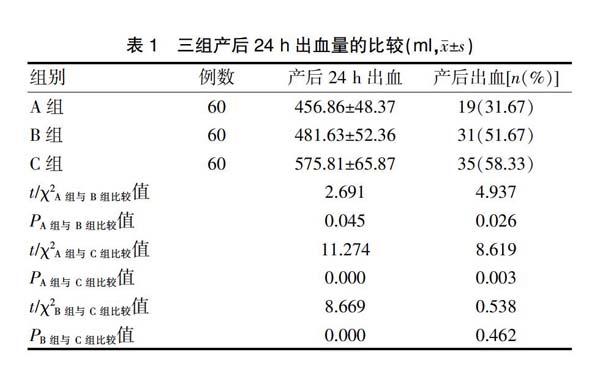

[摘要]目的 探討卡前列素氨丁三醇注射液预防和治疗宫缩乏力性产后出血(PPH)的时机,进而指导临床PPH的预防与治疗。方法 选取2017年8月~2019年8月我院收治的180例有PPH倾向产妇为研究对象,按照随机数字表法分为A、B与C组,每组各60例。A组胎儿娩出后,宫肌注射250 μg卡前列素氨丁三醇注射液,并静滴20 U缩宫素;B组胎儿娩出后,宫肌注射20 U缩宫素,并静滴20 U缩宫素,如出血量达到400 ml,宫肌注射250 μg卡前列素氨丁三醇注射液;C组胎儿娩出后,宫肌注射20 U缩宫素,并静滴20 U缩宫素,出血量达到800 ml时,宫肌注射250 μg卡前列素氨丁三醇注射液。评价三组产后24 h出血量、产后出血发生率、产前与产后血红蛋白及用药期不良反应发生情况。结果 A组产后24 h出血量少于B、C组,B组24 h出血量少于C组,差异均有统计学意义(P<0.05);A组产后出血发生率低于B、C组,差异有统计学意义(P<0.05);B、C组产后出血发生率比较,差异无统计学意义(P>0.05);三组产后24 h血红蛋白水平较产前均下降,差异有统计学意义(P<0.05),A组产后24 h血红蛋白水平高于B、C组,差异有统计学意义(P<0.05),B、C组产后24 h血红蛋白水平比较,差异无统计学意义(P>0.05)。三组治疗期不良反应总发生率比较,差异无统计学意义(P>0.05)。结论 卡前列素氨丁三醇注射液能较好地预防和治疗PPH,尽早为产妇使用卡前列素氨丁三醇注射液,可减少产后出血量,降低产后出血发生率,确保产妇安全,同时有较高的用药安全性,值得推广与应用。
[关键词]卡前列素氨丁三醇注射液;预防治疗;宫缩乏力性产后出血;用药时机;血红蛋白;用药安全
[中图分类号] R714.461 [文献标识码] A [文章编号] 1674-4721(2020)7(b)-0132-04
Timing of Carboprost Tromethamine Injection in prevention and treatment of postpartum hemorrhage due to uterine inertia
LI Yang
Department of Gynecology and Obstetrics, Xingcheng Women′s and Children′s Hospital, Liaoning Province, Xingcheng 125100, China
[Abstract] Objective To investigate the timing of prevention and treatment of postpartum hemorrhage of uterine contractions (PPH) by Carbendazim Aminobutanol Injection, and then to guide the prevention and treatment of PPH. Methods A total of 180 cases of PPH tendency treated in our hospital from August 2017 to August 2019 were selected as the study subjects, and they were divided into group A, group B and group C according to the random digital table method, 60 cases in each group. group A: after the delivery of the fetus, the uterine muscle was injected with 250 μg of Carbendazim Injection and intravenous drip of 20 U Oxytocin. Group B: after deliver, drop 20 U Oxytocin, if the bleeding amount reached 400 ml, the uterine muscle was injected with 250 μg of Carbendazim Triol Injection. Group C:after delivery of the fetus, the uterine muscle was injected with 20 U Oxytocin and intravenous drip of 20 U Oxytocin, when the bleeding amount reached 800 ml, the uterine muscle was injected with 250 μg of Carbendazim Triol Injection. The incidence of 24 h postpartum hemorrhage, postpartum hemorrhage, prenatal and postnatal hemoglobin and adverse reactions during medication in the two groups were evaluated. Results The amount of postpartum hemorrhage in group A was less than that in group B and group C, and that in group B was less than that in group C, with statistical differences (P<0.05); the incidence of postpartum hemorrhage in group A was lower than that in group B and group C, with statistical difference (P<0.05). There was no significant difference in the incidence of postpartum hemorrhage in group C and group B (P>0.05). The hemoglobin level of the three groups at 24 hours after delivery was lower than that before delivery, with statistical differences (P<0.05), the level of 24 h hematocrit in group A was higher than that in group B and group C, with statistical difference (P<0.05). There was no significant difference in the incidence of adverse reactions among the three groups (P>0.05). Conclusion Carbendazim Tributanol Injection can prevent and treat the PPH better, using Carbendazim Tributanol Injection as early as possible to reduce the amount of postpartum hemorrhage, reduce the incidence of postpartum hemorrhage and ensure the safety of parturient.
[Key words] Carbendazim Aminobutanol Injection; Preventive treatment; Uterine contractions postpartum hemorrhage; Timing of medication; Hemoglobin; Medication safety
產后出血是造成产妇死亡的主要原因之一,明确产后出血原因并采取有效的预防干预措施对保证产妇分娩安全具有重要的现实意义[1]。临床文献报道指出胎盘异常、凝血功能异常及子宫收缩乏力均可引起出血,其中宫缩乏力性产后出血(PPH)是产后出血最主要原因,其表现为胎盘娩出后出血多[2-3]。目……
