探讨EBV-DNA定量检测在鼻咽癌放疗后复发转移患者中的临床意义
2020-08-31王海兰谭洪文杨志龙李彩花余双
王海兰 谭洪文 杨志龙 李彩花 余双

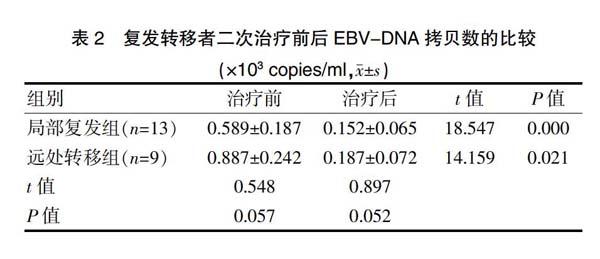
[摘要]目的 探討EBV-DNA定量检测在鼻咽癌放疗后复发转移患者中的临床意义。方法 选取吉安市中心人民医院2019年1~11月就诊并经治疗后临床缓解的60例鼻咽癌患者作为研究对象,按照放疗后疗效分为持续缓解组38例、局部复发组13例、远处转移组9例。所有患者均采用EB病毒核酸扩增(PCR)荧光定量检测全血中EBV-DNA基因拷贝数,比较三组患者的EBV-DNA阳性检出率和EBV-DNA拷贝数,进一步比较复发或转移者二次治疗前后EBV-DNA拷贝数的变化情况。结果 局部复发组和远处转移组EBV-DNA阳性检出率及EBV-DNA拷贝数均高于持续缓解组,差异有统计学意义(P<0.05);局部复发组和远处转移组EBV-DNA阳性检出率及EBV-DNA拷贝数比较,差异无统计学意义(P>0.05);局部复发组和远处转移组治疗后EBV-DNA拷贝数均低于治疗前,差异有统计学意义(P<0.05);局部复发组和远处转移组治疗前后EBV-DNA拷贝数比较,差异无统计学意义(P>0.05)。结论 不同放疗预后患者血浆EBV-DNA定量检测结果存在显著差异,血浆EBV-DNA定量检测能够作为监测鼻咽癌放疗后复发转移的可靠肿瘤标志物。
[关键词]鼻咽癌;放疗;复发;转移;EBV-DNA定量检测
[中图分类号] R739.63 [文献标识码] A [文章编号] 1674-4721(2020)7(b)-0106-04
Exploration on the clinical significance of EBV-DNA quantitative detection in patients with recurrence and metastasis of nasopharyngeal carcinoma after radiotherapy
WANG Hai-lan1 TAN Hong-wen1 YANG Zhi-long2 LI Cai-hua1 YU Shuang3
1. Department of Oncology, Ji′an Central People′s Hospital, Jiangxi Province, Ji′an 343000, China; 2. Intensive Care Unit, Ji′an Hospital of Shanghai Oriental Hospital, Jiangxi Province, Ji′an 343000, China; 3. Department of Oncology, Yichun People′s Hospital, Jiangxi Province, Yichun 336000, China
[Abstract] Objective To explore the clinical significance of EBV-DNA quantitative detection in patients with recurrence and metastasis of nasopharyngeal carcinoma after radiotherapy. Methods A total of 60 patients with nasopharyngeal carcinoma treated in Ji′an Central People′s Hospital from January to November 2019 were selected as the research objects. According to the curative effect after radiotherapy, they were divided into three groups: continuous remission group (38 cases), local recurrence group (13 cases) and distant metastasis group (9 cases). EBV-DNA gene copies in whole blood were detected by PCR in all patients. The positive detection rate of EBV-DNA and the copy number of EBV-DNA were compared among the three groups, and the changes of EBV-DNA copies before and after the second treatment were further compared. Results The positive detection rate of EBV-DNA and the copy number of EBV-DNA in the local recurrence group and the distant metastasis group were higher than those in the continuous remission group, and the differences were statistically significant (P<0.05); the positive detection rate of EBV-DNA and the copy number of EBV-DNA in the local recurrence group and the distant metastasis group were not significantly differents (P>0.05); the copy number of EBV-DNA in the local recurrence group and the distant metastasis group after treatment were lower than those before treatment, the difference was statistically significant (P<0.05). There were no significant differences in the number of EBV-DNA copies between local recurrence group and distant metastasis group before and after treatment (P>0.05). Conclusion There are significant differences in the results of quantitative detection of plasma EBV-DNA in patients with different radiotherapy prognosis. Quantitative detection of plasma EBV-DNA can be used as a reliable tumor marker to monitor the recurrence and metastasis of nasopharyngeal carcinoma after radiotherapy.
[Key words] Nasopharyngeal carcinoma; Radiotherapy; Recurrence; Metastasis; Quantitative detection of EBV-DNA
[基金项目]江西省吉安市科学技术局项目(吉市科计字[2019]8号(19))
鼻咽癌是临床发病率较高的一种头颈部恶性肿瘤,其发病具有明显的地域特色,中国南方、东南亚和北非等国家和地区是该病的高发区域[1]。放疗是临床治疗鼻咽癌的主要手段,能有效控制患者病情进展,但复发率仍较高。调查研究显示,40%~50%的鼻咽癌完全缓解者放疗后仍会出现复发或转移的情况,导致治疗失败[2]。如何早期监测复发和转移是采取治疗干预、延长患者生存时间的关键。……
