探究妇产科护理中例性化护理的运用分析
2020-08-09吴峰
吴峰
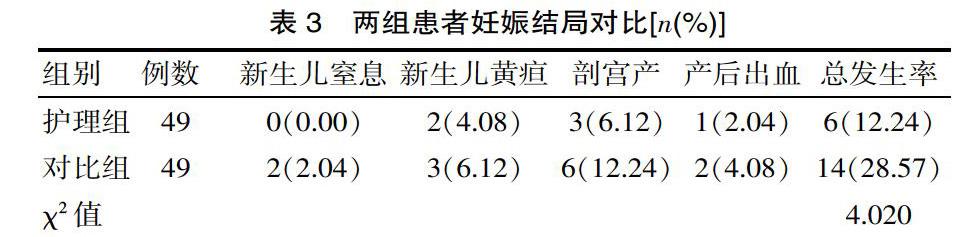
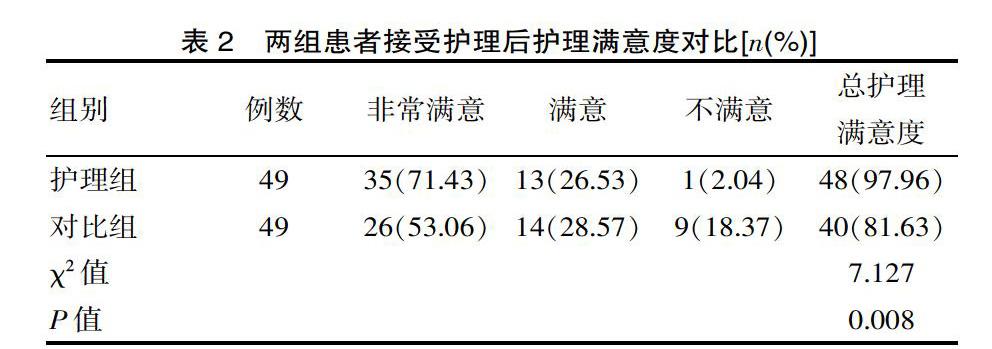
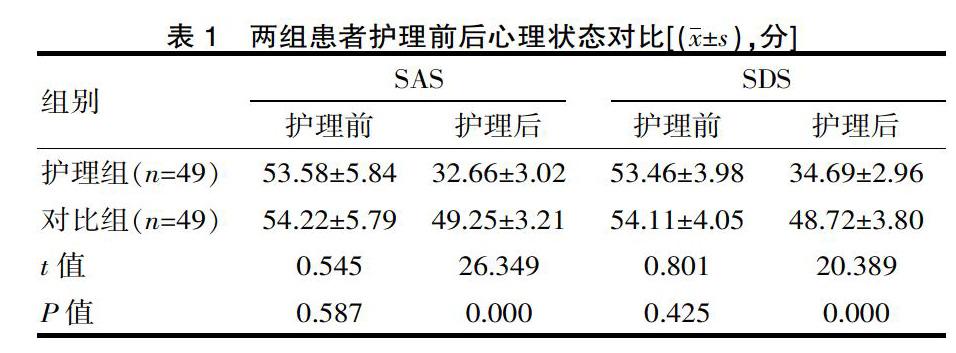
[摘要] 目的 研究和分析如何將人性化护理应用于妇产护理。方法 随机选取该院在2018年4月—2019年5月收治的98例患者作为该次课题研究对象,将其分为护理组和对比组,每组患者49例,护理组患者采用人性化护理模式干预,对比组患者采用常规护理方法进行干预,对比两组患者接受护理后的最终护理效果。结果 对比两组患者护理前后的焦虑自评量表(SAS)和抑郁自评量表(SDS),护理组患者评分低于对比组,且两组患者数据之间差异有统计学意义(t=26.349、20.389, P=0.000<0.05);对比两组患者接受护理后的护理满意度,发现护理组患者的总护理满意度为97.96%,对比组患者的总护理满意度为81.63%,两组患者数据对比后发现护理组数据较高,差异有统计学意义(χ2=7.123,P=0.008<0.05);对比分析两组患者最终妊娠结局,护理组患者中出现不良妊娠情况总发生率为12.24%,对比组患者出现不良妊娠情况的发生率为28.57%,两组患者相比护理组患者情况更好,并且数值差异有统计学意义(χ2=4.020, P=0.045<0.05)。 结论 在妇产科护理当中应用人性化护理有着良好的护理效果,产妇的心理状况得到了明显改善,另外,采用人性化护理模式的护理组产妇对于医护人员的护理满意度更高,新生儿出现黄疸以及窒息等现象较少,因此值得将人性化护理模式应用于妇产科护理当中。
[关键词] 妇产科护理;人性化护理;应用效果
[Abstract] Objective To study and analyze how to apply personalized nursing to maternity care. Methods A total of 98 patients admitted in the hospital from April 2018 to May 2019 were randomly selected as the research object of this project. They were divided into a nursing group and a comparison group, each group of 49 patients. Intervention of nursing mode intervention, the patients in the comparison group were intervened with conventional nursing methods, and the final nursing effect of the patients in the two groups were compared. Results The anxiety self-assessment scale (SAS) and depression self-assessment scale (SDS) before and after nursing were compared between the two groups of patients. The scores of patients in the nursing group were lower than those in the comparison group,the difference was statistically significant(t=26.349, 20.389, P=0.000,0.000<0.05); comparing the satisfaction of the two groups of patients after receiving care, it was found that the total satisfaction of the patients in the nursing group was 97.96%, and the total of patients in the comparison group Satisfaction was 81.63%. After comparing the data of the two groups of patients, it was found that the data of the nursing group was higher and the difference was statistically significant (χ2=7.123,P=0.008<0.05). The final pregnancy outcome of the two groups of patients was compared and analyzed. The overall incidence of adverse pregnancy in patients in the nursing group was 12.24%, and the incidence of adverse pregnancy in patients in the comparison group was 28.57%. The patients in the two groups were better than the patients in the nursing group, and the difference was statistically significant (χ2=4.020, P=0.045<0.05). Conclusion The application of humanized nursing in obstetrics and gynaecology nursing has good nursing effect, the psychological condition of the mother has been significantly improved. In addition, the nursing group adopting the humanized nursing mode has higher satisfaction with the nursing staff and fewer neonatal jaundice and suffocation, so it is worth applying the humanized nursing mode to the gynecological and obstetric care.
[Key words] Obstetrics and Gynecology Nursing; Humanized Nursing; Application Effect
在现代社会,随着人们生活水平的提升以及现代先进技术的进步,国民对于身体健康的需求与日俱增,优生优育的观念也已经深入人心。另外,人们对于产妇在分娩过程中产妇自身以及新生儿的生命安全重视程度得到了极大提升,同时医院也已经对产妇护理予以了高度重视[1-2]。当今,越来越多的医院已经将人性化护理应用于妇产科护理中。所谓的人性化护理工作原理就是将现代医学与心理学和生物学等多个学科进行结合的一种新型护理方法。根据相关学者研究发现,在妇产科应用科学有效的护理方案对于降低产妇不良妊娠结局以及缓解产妇心理不良情绪有着促进作用。为了能够提升产妇和新生儿的健康,该文对该院在2018年4月—2019年5月收治的98例患者妇产护理中应用人性化护理进行详细分析,现报道如下。
1 资料与方法
1.1 一般资料
随机选……