经鼻双水平正压通气治疗新生儿呼吸窘迫综合征疗效分析
2020-08-09杨瑞新于宁马桂云张立明
杨瑞新 于宁 马桂云 张立明
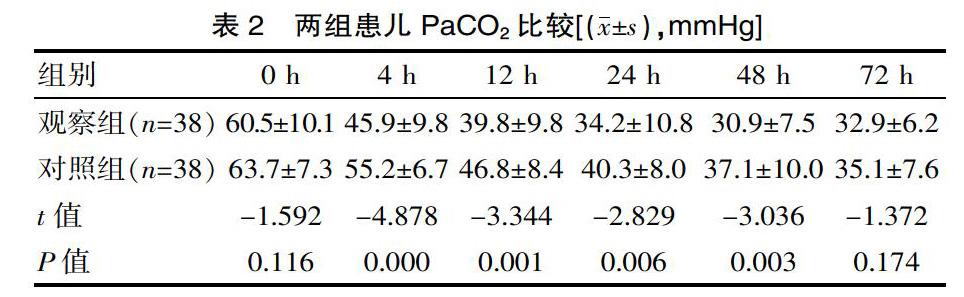
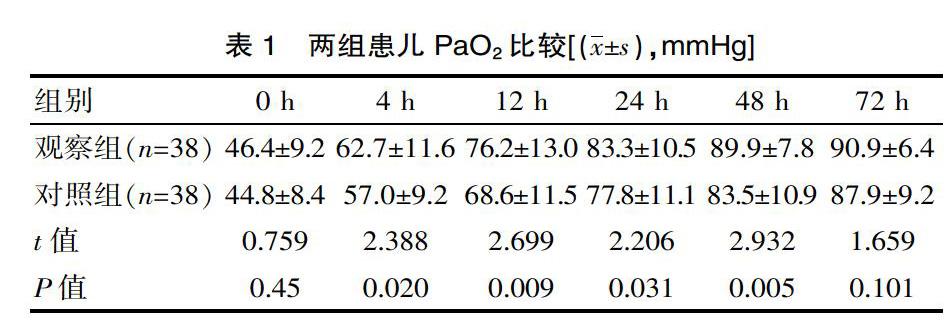
[摘要] 目的 探討经鼻双水平正压通气( nDuoPAP )在新生儿呼吸窘迫综合征( NRDS )治疗中的疗效。 方法 回顾性分析该院2016年 1月— 2017年 12月间患有 NRDS 的 76 例早产儿,38例给予经鼻持续气道正压通气(NCPAP)作为对照组,另外的 38 例给予 nDuoPAP 通气作为观察组,主要观察并记录两组患儿使用无创呼吸支持治疗前及治疗后 4、12、24、 48、72 h 动脉血气二氧化碳分压(PaCO2)、氧分压(PaO2)。 结果 观察组患儿无创呼吸支持治疗后 4 h评估动脉血气PaCO2[(62.7±11.6)mmHg vs(57.0±9.2)mmHg]、12 h评估动脉血气PaCO2[(76.2±13.0)mmHg vs(68.6±11.5)mmHg]、24 h评估动脉血气PaCO2[(83.3±10.5)mmHg vs(77.8±11.1)mmHg]、48 h评估动脉血气PaCO2[(89.9±7.8)mmHg vs(83.5±10.9)mmHg] ,差异有统计学意义(t=2.388、2.699、2.206、2.932 ,P<0.05);4 h评估动脉血气 PaO2[(45.9±9.8) mmHg vs(55.2±6.7) mmHg]、12 h评估动脉血气 PaO2[(39.8±9.8) mmHg vs(46.8±8.4) mmHg]、24 h评估动脉血气PaO2[(34.2±10.8)mmHg vs(40.3±8.0)mmHg];48 h评估动脉血气PaO2[(30.9±7.5) mmHg vs(37.1±10.0)mmHg]与对照组比较有明显改善,差异有统计学意义(t=-4.878、-3.344、-2.829、-3.036,P<0.05)。结论 与对照组相比,观察组应用nDuoPAP进行NRDS 初始呼吸支持治疗可明显改善氧合,更实用和安全。
[关键词] 新生儿呼吸窘迫综合征; 经鼻持续气道正压通气;疗效分析
[Abstract] Objective To investigate the effect of nasal bilevel positive pressure ventilation (nDuoPAP) in the treatment of neonatal respiratory distress syndrome (NRDS). Methods A retrospective analysis was performed on 76 preterm infants with NRDS from January 2016 to December 2017. Thirty-eight patients were given nasal continuous positive airway pressure (NCPAP) as a control group, and 38 were given nDuoPAP ventilation as the observation group, the two groups of children were mainly observed and recorded the arterial blood gas carbon dioxide partial pressure (PaCO2) and oxygen partial pressure (PaO2) before and after 4, 12, 24, 48, and 72 h of non-invasive respiratory support treatment. Results In the observation group, arterial blood gas PaCO2[(62.7±11.6)mmHg vs (57.0±9.2) mmHg]was evaluated 4 hours after noninvasive respiratory support treatment, and arterial blood gas PaCO2[(76.2±13.0)mmHg vs(68.6±11.5)mmHg]was evaluated 12 hours. Blood gas PaCO2[(83.3±10.5)mmHg vs(77.8±11.1)mmHg] and 48-hour evaluation of arterial blood gas PaCO2[(89.9±7.8)mmHg vs(83.5±10.9)mmHg], the differences were statistically significant( t=2.388,2.699,2.206,2.932 ,P<0.05); 4 hours to evaluate arterial blood gas PaO2[(45.9±9.8) mmHg vs(55.2±6.7) mmHg], 12 hours to evaluate arterial blood gas PaO 2[(39.8±9.8) mmHg vs(46.8±8.4) mmHg], and 24 hours to evaluate arterial blood gas PaO2[(34.2±10.8)mmHg vs(40.3±8.0)mmHg]; PaO2[(30.9±7.5) mmHg vs(37.1±10.0)mmHg]of arterial blood gas evaluated at 48 hours has a significant improvement compared with the control group, the difference was statistically significant (t=-4.878,-3.344,-2.829,-3.036,P<0.05). Conclusion Compared with the control group, the application of nDuoPAP for NRDS initial respiratory support treatment can significantly improve oxygenation, which is more practical and safer.
[Key words] Neonatal respiratory distress syndrome; Nasal continuous positive airway pressure;Efficacy analysis
新生儿呼吸窘迫综合征是因肺发育不成熟而至呼吸困难[1]。患儿在出生后的数小时内,会出现呼吸急促,甚至合并呼吸衰竭致患兒死亡,病死率较高[2]。 因此, 该院选取2016年1月—2017年12月收治的新生儿呼吸窘迫患者76例对其采用nDuoPAP治疗NRDS治疗方式进行治疗,旨在找到一种有效治疗措施,从而为临床提供更为科学的治疗方案,现报道如下。
1 资料与方法
1.1 一般资料
回顾性分析该院收治的新生儿呼吸窘迫患者76例,所有患者均符合相关诊断标准。纳入标准为:①胎龄 28~36 周;②日龄<24 h;③患儿伴有呼吸急促、吸气三凹征等临床症状,且存在低氧现象,呼吸困难,病情逐渐加重;④该次研究经过伦理委员批准,患者及家属均同意参与该次研究,并已在知情同意书上签字。排除标准:①出生胎龄<28 周,或出生体重<1 000 g;②合并其他严重并发症例如:青紫形心脏病等给予 无创通气的38例呼吸窘迫患儿作为对照组,给予nDuoPAP治疗的38例NRDS 患儿设为观察组。两组患儿胎膜早破等情况比较差异无统计学意义(P>0.05)。
1.2 方法
①对照组和观察组分别采用NCPAP通气和 nDuoPAP 通气;两组干预标准使用头罩或双腔鼻导管吸氧方式患者仍会出现呼吸窘迫现象,且血氧饱和度不达标,在85% 以下。
②具体参数设定NCPAP 和nDuoPAP分别采用新西兰 Fisher Paykel CPAP 呼吸机:采用瑞士菲萍(Fabian)新生儿及小儿呼吸机,前者Flow 8~10 L/min , PEEP 6~8 cmH2O,FiO2 0.3~0.5;nDuoPAP:后者PIP 12~15 cmH2O,PEEP 4~6 cmH2O,Ti 0.4~0.5 s,FiO2 0.3~0.5 。根据血气分析、血氧饱和度……