PEB模型在同步核磁?脑电源定位中的应用
2020-08-03刘茵姜忠义邹凌毕卉张蔚
刘茵 姜忠义 邹凌 毕卉 张蔚

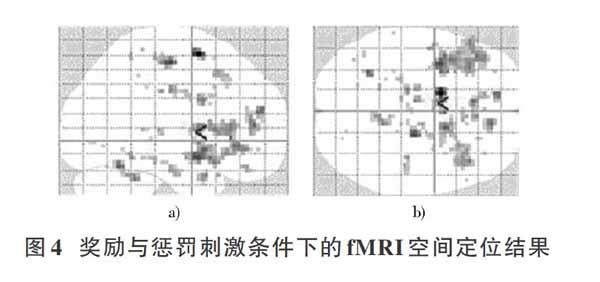

摘 要: 利用腦电(Electroencephalographic,EEG)和功能性磁共振成像(functional Magnetic Resonance Imaging,fMRI)时间和空间上的互补性可以获得大脑的电源活动。为了获得经典奖惩任务中脑区的激活情况,同步采集fMRI?EEG数据,使用以fMRI空间作为约束的参数经验贝叶斯(Parametric Empirical Bayesian,PEB)模型进行了脑电源活动分析。同时,结合稀疏求解的方法,提取更集中的神经电活动,进一步突出激活强度高的脑区。实验结果表明,在奖惩结果呈现后的200~350 ms内,奖赏刺激能够诱发出反馈相关负波(Feedback Related Negativity, FRN)。fMRI空间定位显示前额叶、眶额叶等奖赏相关脑区出现激活,EEG源定位提取到了前额叶脑区的激活,但是这些激活区域均分散在脑区的各个部位。相比于单一模态fMRI空间定位和EEG源定位结果,同步源定位提取的脑区更集中,获得的模型证据也更大,更准确地描绘了脑区激活情况。
关键词: 脑电; 功能磁共振成像; 参数经验贝叶斯模型; 同步采集; 稀疏求解; 结果分析
中图分类号: TN712?34; TP399 文献标识码: A 文章编号: 1004?373X(2020)06?0156?04
Application of PEB model in synchronization fMRI?EEG source localization
LIU Yin1,2, JIANG Zhongyi1,2, ZOU Ling1,2, BI Hui1,2, ZHANG Wei1,2
(1. College of Information Science and Engineering, Changzhou University, Changzhou 213164, China;
2. Changzhou Key Laboratory of Biomedical Information Technology, Changzhou 213164, China)
Abstract: The complementarity of time and space of electroencephalographic (EEG) and functional magnetic resonance imaging (fMRI) is utilized to capture power activity of the brain. The fMRI?EEG data is collected synchronously, and the brain power activity is analyzed by means of the parametric empirical Bayesian (PEB) model taking fMRI space as the constraint, so as to obtain the activation of brain regions in the classic reward and punishment. The more concentrated neural electrical activity is extracted in combination with the method of sparse solution, to further highlight the brain regions with high activation intensity. The experimental results show that the reward stimulation can induce feedback related negativity (FRN) within 200~350 ms after the reward and punishment results are presented; the spatial location of fMRI presents activation of reward?related brain regions such as the prefrontal lobe and orbitofrontal cortex, and the EEG source localization is adopted to extract the activation in the prefrontal lobe brain region, but these regions are all scattered everywhere in the brain region. In comparison of the results of the single mode fMRI spatial localization and EEG source localization, the brain regions extracted with the synchronous source localization are more concentrated, and the obtained model evidences are also larger, which represents the activation of brain regions more accurately.
Keywords: EEG; fMRI; PEB model; synchronous acquisition; sparse solution; result analysis
0 引 言
奖惩任务是研究情感决策问题的经典范式[1]。情感决策能力能够反映个体对社会的适应能力。存在情感决策障碍的个体对收益和损失不敏感,很难做出对未来有利的选择。情感决策的研究有利于理解影响神经信号产生的因素,为临床诊疗提供辅助信息。
目前情感决策神经机制的研究主要是利用单一模态的fMRI或EEG两种成像技术,在时间或空间上的分辨率有待进一步提高。fMRI研究情感决策的主要方法是空间定位分析[2]。EEG用于研究情感决策的方法有事件相关电位(Event Related Potential,ERP)分析及EEG源定位分析。……