髌骨倾斜角动态变化分析对髌股关节不稳定症的诊断价值
2020-06-08谭珊玲
谭珊玲
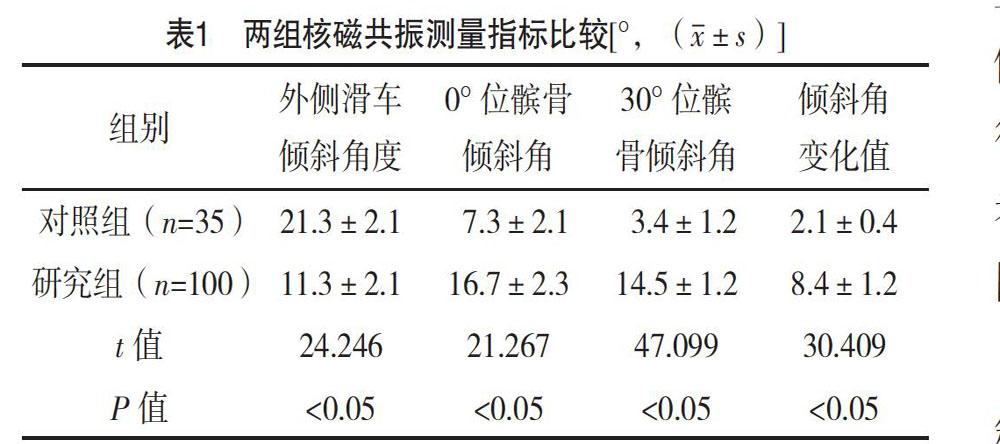
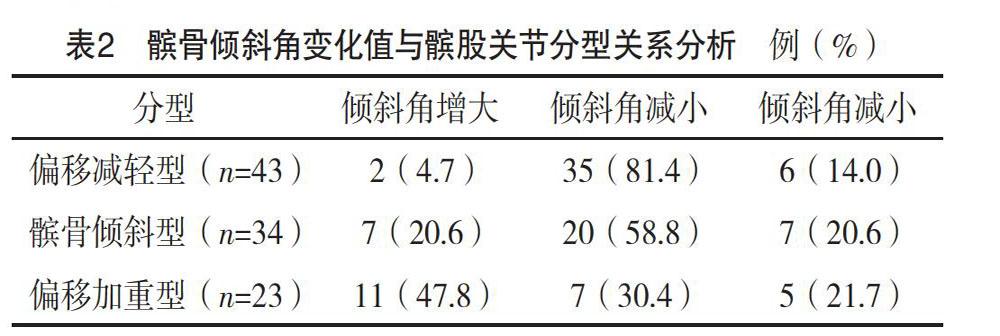
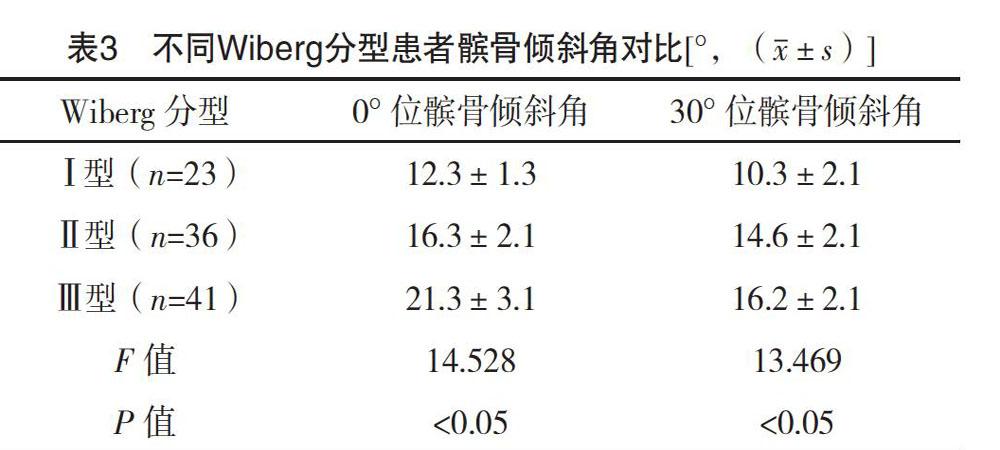
【摘要】 目的:探讨髌骨倾斜角动态变化分析对髌股关节不稳定症的诊断价值。方法:选取2018年1月-2019年12月本院收治的髌股关节不稳定症患者100例作为研究组,并选取本院同期接受健康体检者35例作为对照组,对所有入组人员进行核磁共振检查,记录横轴位、矢状位以及膝关节屈膝0°和30°时的髌骨倾斜角。结果:研究组外侧滑车倾斜角度小于对照组(P<0.05),研究组0°髌骨倾斜角、30°髕骨倾斜角以及倾斜角变化值均大于对照组(P<0.05);偏移加重型患者出现倾斜角增大概率均明显高于髌骨倾斜型与偏移减轻型患者(P<0.05),髌骨倾斜型患者出现倾斜角增大概率明显高于偏移减轻型(P<0.05);Wiberg分型Ⅲ型患者0°位髌骨倾斜角、30°位髌骨倾斜角均大于Wiberg分型Ⅰ、Ⅱ型患者(P<0.05)。结论:在髌骨关节不稳定症的诊断中,对髌骨倾斜角变化值进行分析具有较高的临床价值,可以结合髌骨外移比值对患者进一步诊断。
【关键词】 髌骨倾斜角动态变化 髌股关节不稳定症 诊断价值 髌骨外移比值
[Abstract] Objective: To explore the diagnostic value of dynamic changes of patellofemoral tilt angle for patellofemoral instability. Method: From January 2018 to December 2019, 100 patients with patellofemoral instability treated in our hospital were selected as the study group, and 35 patients who received physical examination in our hospital at the same time were selected as the control group. MRI was performed on all participants, and the patellar inclination angle was recorded at the horizontal axis, sagittal position and knee joint bending angle of 0° and 30°. Result: The incline angle of the lateral pulley in the study group was smaller than that in the control group (P<0.05), and the changes of the incline angle of the 0° patella, 30° patella and the incline angle in the study group were larger than those in the control group (P<0.05). The increase probability of inclination angle in patients with offset and severe disease were significantly higher than those of patients with patellar inclination type and offset relief type (P<0.05). The increase probability of inclination angle in patients with patellar inclination type was significantly higher than that of patients with offset and relief type (P<0.05). Wiberg parting Ⅲ patients with 0° and 30° patellar tilt angle were greater than those of Wiberg parting Ⅰ, Ⅱ patients (P<0.05). Conclusion: In the diagnosis of patellar instability, the analysis of the change of patellar tilt angle has a high clinical value, which can be combined with the ratio of patellar displacement for further diagnosis.
髌股关节不稳定症是目前临床比较多发的疾病,可以由多种因素导致,患者在发病后往往会伴有软骨、骨以及软组织病理改变情况,主要临床表现为髌骨外倾或外移程度在膝关节伸曲活动时增大[1]。进而导致患者出现膝关节功能活动障碍或膝关节疼痛情况,髌股关节不稳定症会导致患者出现髌股关节骨性关节炎或髌骨软骨软化等疾病[2]。对于进行体格检查时发现存在髌骨脱位患者急需进行髌股关节不稳定症诊断,而对于体格检查无阳性,无法明确提供髌骨脱位史的患者,则诊断难度有明显提升,导致漏诊、误诊[3]。髌股关节不稳定症在运动活跃度强的青少年群体中较易发病,且相比女性患者,男性发病率更高[4]。对于青少年髌股关节不稳定症患者及时进行准确诊断,从而制定良好治疗措施,可以有效纠正患者髌股关节解剖结构,恢复生物力学,避免多种并发症[5]。目前临床关于髌股关节不稳定症诊断的影像学方式较多,如X线片、磁共振以及计算机断层扫描等,因诊断方式不同,在对患者疾病诊断时也存在一定差异[6]。……