光动力联合自制中药方剂浸泡治疗跖疣的效果及对患者血清TGF-β、IFN-γ、CD28及CD40水平的影响
2020-05-25孙焱
孙焱
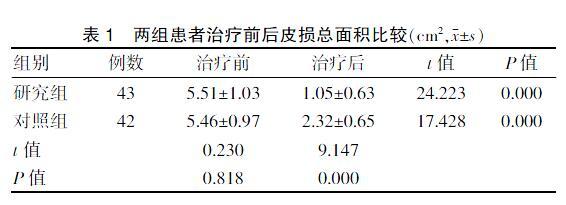
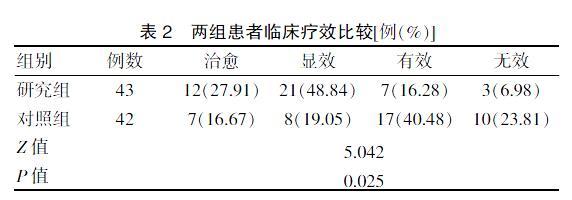

[摘要] 目的 觀察光动力联合自制中药方剂浸泡治疗跖疣的效果及对患者血清转化生长因子-β(TGF-β)、γ-干扰素(IFN-γ)、白细胞表面分化抗原28(CD28)及白细胞表面分化抗原40(CD40)水平的影响。 方法 选取2018年3月~2019年3月河北省廊坊市人民医院收治的跖疣患者85例,采用抽签方式将其分为对照组(42例)和研究组(43例)。对照组采用光动力治疗,研究组在对照组的基础上采用自制中药方剂浸泡治疗。比较两组治疗前后皮损总面积,评估临床疗效,比较两组治疗前后血清TGF-β、IFN-γ水平及CD28、CD40占比,比较两组副作用、复发情况。 结果 两组治疗后皮损总面积均小于治疗前,且研究组小于对照组,差异有统计学意义(P < 0.05)。研究组临床疗效优于对照组,差异有统计学意义(P < 0.05)。两组治疗后血清TGF-β水平低于治疗前,且研究组低于对照组,差异有统计学意义(P < 0.05);两组治疗后血清IFN-γ水平高于治疗前,且研究组高于对照组,差异有统计学意义(P < 0.05)。两组治疗后血清CD28占比低于治疗前,且研究组低于对照组,差异有统计学意义(P < 0.05);两组治疗后血清CD40占比高于治疗前,且研究组高于对照组,差异有统计学意义(P < 0.05)。两组副作用发生率比较差异无统计学意义(P > 0.05)。随访3个月,研究组复发率低于对照组,差异有统计学意义(P < 0.05)。 结论 光动力联合自制中药方剂浸泡治疗跖疣,可缩小皮损面积,减轻炎性反应,改善免疫功能,复发率低,疗效明显优于单纯光动力治疗。
[关键词] 光动力;自制中药方剂浸泡;跖疣;转化生长因子-β;γ-干扰素;白细胞表面分化抗原28;白细胞表面分化抗原40
[中图分类号] R752.5 [文献标识码] A [文章编号] 1673-7210(2020)04(c)-0192-05
Effect of photodynamic therapy combined with self-made traditional Chinese medicine in the treatment of verruca plantaris and its influence on the levels of serum TGF-β, IFN-γ, CD28 and CD40 in patients
SUN Yan
Department of Dermatology and Venereology, the People′s Hospital of Langfang City, Hebei Province, Langfang 068000, China
[Abstract] Objective To observe effect of photodynamic therapy combined with self-made traditional Chinese medicine in the treatment of verruca plantaris and its influence on the levels of serum TGF-β, IFN-γ, CD28 and CD40 in patients. Methods Eighty-five cases of verruca plantaris admitted to Langfang People′s Hospital in Hebei Province from March 2018 to March 2019 were divided into control group (42 cases) and study group (43 cases) by drawing lots. Control group was treated with photodynamic therapy, and study group was treated with self-made traditional Chinese medicine on the basis of control group. Total area of skin lesions before and after treatment was compared between two groups, clinical effect was evaluated, the levels of serum TGF-β, IFN-γ, the proportion of CD28 and CD40 before and after treatment were compared between two groups, and the side effects and recurrence of two groups were compared. Results The total area of skin lesions in two groups after treatment was smaller than that before treatment, and study group was smaller than control group, the differences were statistically significant (P < 0.05). Clinical effect of study group was better than that of control group, the difference was statistically significant (P < 0.05). After treatment, the serum TGF-β level in two groups was lower than that before treatment, which in study group was lower than that in control group, the differences were statistically significant (P < 0.05). After treatment, the serum IFN-γ level of two groups was higher than that before treatment, which of study group was higher than that of control group, the differences were statistically significant (P < 0.05). The percentage of CD28 in two groups after treatment was lower than that before treatment, which in study group was lower than that in control group, the differences were statistically significant (P < 0.05). The percentage of serum CD40 in two groups after treatment was higher than that before treatment, which in study group was higher than that in control group, the differences were statistically significant (P < 0.05). There was no significant difference in incidence of side effects between two groups (P > 0.05). Follow up for 3 months, the recurrence rate of study group was lower than that of control group (P < 0.05). Conclusion Photodynamic therapy combined with traditional Chinese medicine can reduce the area of skin lesions, reduce the inflammatory reaction, improve the immune function, and reduce the recurrence rate. The curative effect of photodynamic therapy is significantly better than that of photodynamic therapy alone.
[Key words] Photodynamic; Self-made traditional Chinese medicine; Verruca plantaris; Transforming growth factor-β; Interferon-γ; Leukocyte surface differentiation antigen 28; Leukocyte surface differentiation antigen 40
跖疣为寻常疣常见类型,发病率高,具有传染性[1],起病初期为发亮、细小丘疹,后逐渐扩大,表面角化、粗糙,部分患者自觉疼痛,影响正常行走。目前,临床中治疗跖疣的常用手段有高频电灼、冷冻、微波、二氧化碳激光及光动力等。光动力疗法应用5-氨基西酮戊酸(ALA)选择性进入已感染人类乳头瘤病毒(HPV)的宿主细胞,ALA在体内转化为原卟啉Ⅸ,原卟啉Ⅸ借助特定光源产生光化学反应,释放出活性氧,进而诱导宿主细胞凋亡或坏死,但光动力疗法治疗后,仍有部分患者易复发,治疗总有效率有待提高[2-3]。中医认为[4],跖疣的发生与气血凝滞、热毒聚结有关,治疗关键为调和气血,散结化瘀,清热凉血。……