优质护理对颅脑损伤合并糖尿病患者术后恢复效果的影响
2020-05-21蒋灿
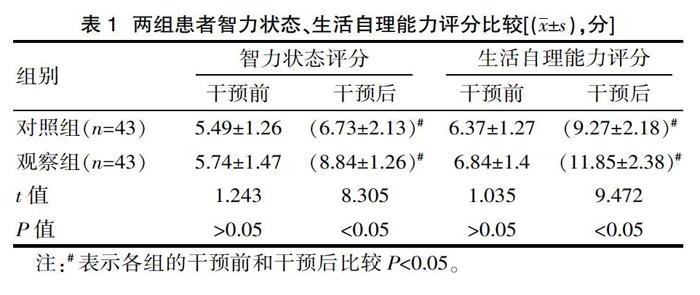

[摘要] 目的 通过对颅脑损伤合并糖尿病患者实施不同护理方案,观察其临床应用特点。方法 从2017年1月—2019年2月到该院诊治的颅脑损伤合并糖尿病患者中随机抽取86例,分为对照组和观察组,分别实施常规护理和优质护理,观察两组患者的智力状态、生活自理能力评分、血糖水平。结果 观察组患者干预后智力状态评分为(8.84±1.26)分,生活自理能力评分为(11.85±2.38)分均高于对照组(P<0.05);观察组干预后空腹血糖水平为(6.16±2.18)mmol/L,餐后2 h血糖水平为(9.26±2.32)mmol/L均低于对照组(P<0.05)。结论 优质护理可有效提高颅脑损伤合并糖尿病患者的智力状态评分和生活自理能力,降低血糖水平,值得临床推广应用。
[关键词] 优质护理;糖尿病;颅脑损伤
[中图分类号] R473 [文献标识码] A [文章编号] 1672-4062(2020)02(a)-0159-02
Effect of Quality Nursing on Postoperative Recovery of Patients with Craniocerebral Injury and Diabetes
JIANG Can
Department of General Surgery, Section Three, Tengnan Hospital, Zaozhuang Mining Group, Weishan, Shandong Province, 277600 China
[Abstract] Objective To observe the clinical application characteristics of patients with craniocerebral injury combined with diabetes by implementing different nursing schemes. Methods From January 2017 to February 2019, 86 patients with craniocerebral injury and diabetic patients diagnosed and treated in the hospital were randomly selected and divided into control group and observation group. Routine and high-quality care were performed respectively, and the intelligence, self-care score, blood glucose level of the two groups of patients was observed. Results After the intervention, the patients in the observation group had an intelligence score of (8.84±1.26)points. The score of self-care ability was(11.85±2.38)points, which were higher than those in the control group(P<0.05). The fasting blood glucose level in the observation group after the intervention was(6.16±2.18)mmol/L. The 2 h postprandial blood glucose level was(9.26±2.32)mmol/L, which were lower than those in the control group(P<0.05). Conclusion High-quality care can effectively improve the intelligence status score and self-care ability of patients with craniocerebral injury combined with diabetes, and reduce blood glucose levels, with clinical application.
[Key words] High-quality care; Diabetes; Craniocerebral injury
顱脑损伤在临床较为常见,受到严重损伤,常因外界暴力所引起,该类疾病病情发展较为迅速,具有突变性、多变性等,危害患者生命健康,死亡率较高[1]。颅脑损伤患者常伴随糖尿病等并发症,在治疗期间,不仅要治疗颅脑损伤症状还要适当控制血糖水平,避免并发症的发生[2]。从2017年1月—2019年2月到该院诊治的颅脑损伤合并糖尿病患者中随机抽取86例,分为两组,分别实施常规护理和优质护理,获得效果差异显著。报道如下。
1 资料与方法
1.1 一般资料
从到该院诊治的颅脑损伤合并糖尿病患者中随机抽取86例,其中有女性40例,男性46例,年龄范围在30~75岁,平均年龄为(50.26±4.26)岁。通过随机数字法将86例患者随机分为对照组43例:女性20例,男性23例,平均年龄为(51.64±4.84)岁;观察组43例:其中有女性20例,男性23例,平均年龄为(51.36±4.85)岁。该研究经过该院伦理委员会同意并批准,获得所有研究对象的知情同意书。两组患者的基本资料统计分析结果为,差异无统计学意义(P>0.05),可以进行比较。