基于空间网格的体外预应力连续钢构铁路桥的计算分析
2019-10-21姚南


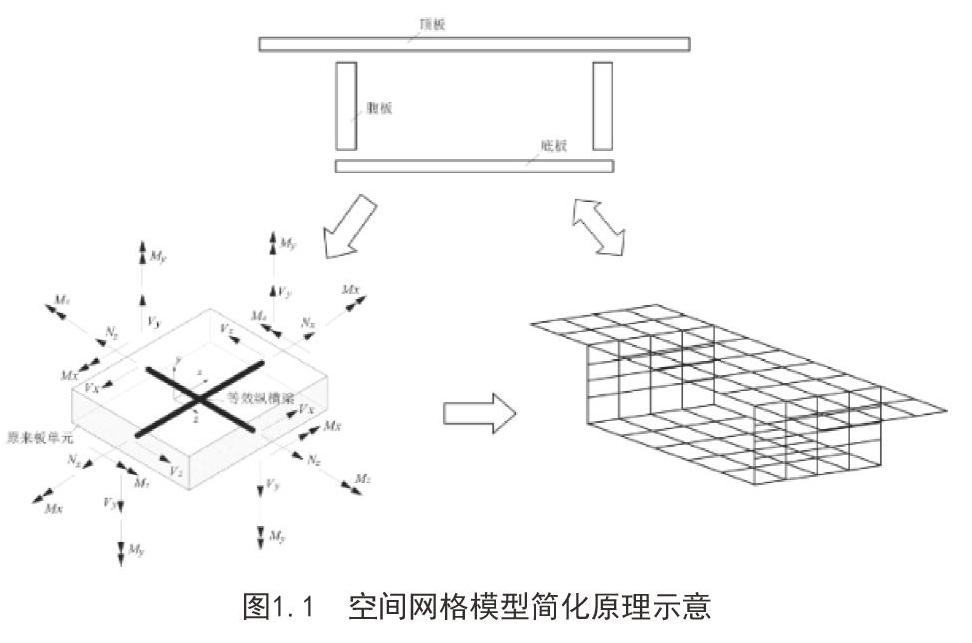
摘 要 目前铁路桥梁设计中多采用空间杆系模型、平面梁格模型和实体模型相结合的计算分析方法。但是,空间杆系模型缺乏空间效应精细化分析;平面梁格法在等效原理上的近似性,不能準确反映箱形梁的剪应力分布和顶底板局部受力;实体模型很难和总体计算相结合。实用精细化分析和空间网格模型已写入2018版《公路钢筋混凝土及预应力混凝土桥涵设计规范》,空间网格模型能够完整地反映所有的验算应力,是最为全面实用的精细化模型。通过介绍空间网格模型和三层应力,利用空间网格模型模拟体外预应力连续钢构铁路桥在主力加附加力组合下的应力状态,计算得到该桥的各项完整验算应力,进一步为大跨铁路桥设计计算提供更准确的分析依据。
关键词 空间网格模型;完整验算应力;体外预应力;连续钢构桥
Abstract At present,the computational analytical method mainly adopts the spatial bar system model、plane beam grillage model or solid model in railway bridge designs.However,the spatial bar system model is lack of refinement analysis on the space effect. Due to the similarity of the plane beam grid method in the equivalence principle,the shearing stress distribution and local stress of the top and bottom plates of the box type composite beam cannot be reflected.The solid model is very difficult to combine with the overall calculation. Practical precise analysis and spatial grid model have been included in《Specifications for Design of Highway Reinforced Concrete and Prestressed Concrete Bridge and Culverts》of 2018 edition. The spatial grid model can reflect all the integrity analysis and is the most comprehensive and practical precise modelling. By introducing the principle of spatial grid model and three layers of stress, and which is used to calculate the stress state of “the combination of main force and additional force” of external prestressed continuous rigid frame railway bridge, the complete checking stresses has been calculated, which provides more accurate analysis basis for the design and calculation of long-span railway bridge.
Key words Spatial grid model; Complete checking stresses; External prestressing; Continuous rigid frame bridge
引言
由于受桥梁结构设计规范建立时结构特点的影响,早期规范的配束配筋计算体系是针对柔细梁的,与规范相关的验算应力一般仅为三个,即截面上缘正应力、截面下缘正应力和腹板主应力,即着重于顶底板的拉压受力和腹板的弯剪受力分析。实际上,这三个验算应力仅是针对一根薄腹窄梁的,并不能反映现代复杂桥梁结构的真实受力情况。为保证桥梁结构的耐久和完全,需要增加更为完整、精细的验算内容[1]。本文利用精细化分析模型,即空间网格模型,应用到国内首座体外预应力铁路桥中,进一步为设计计算提供更准确的分析依据。……