融合短语知识的神经机器翻译方法
2019-10-21刘璐叶娜
刘璐 叶娜
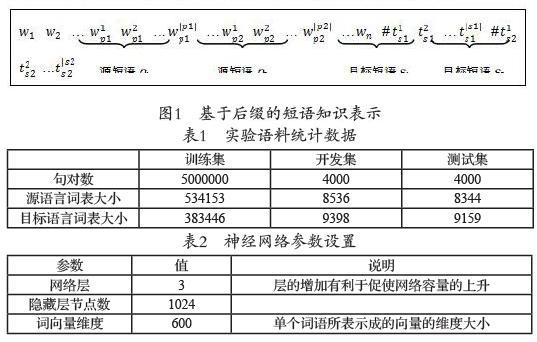

摘 要:神经机器翻译是直接利用神经网络实现源语言文本到目标语言文本映射的一种机器翻译方法,翻译过程中不再需要人工设计特征。但神经机器翻译研究单元以词为基础,导致神经机器翻译的翻译模型对短语建模不充分。针对以上问题,本文提出融合短语知识的方法,利用传统机器翻译训练所得的短语表和句法分析结果,对翻译文本进行短语对抽取,将抽取的目标语言短语以后缀的形式添加到源语言端末尾。通过改变翻译语料的知识表示方式,使编码产生的句向量中包含更多有利于生成正确译文的信息,从而提升最终的翻译效果。实验结果表明,本文提出的方法相较于基线系统,BLEU值得到了提升。
关键词:神经机器翻译 短语知识 句法分析
Abstract: Neural machine translation is a kind of machine translation method that directly uses neural network to realize text mapping from source language to target language, and arti?cial design features are no longer needed in the translation process. However, the Neural machine Translation Research Unit is based on words, which leads to the translation model of Neural machine translation, which is not fully modeled on phrases. In view of the above problems, this paper proposes a method to fuse the knowledge of phrases, using the phrase table and syntactic analysis results obtained from traditional machine translation training, to extract the phrase pairs of translated text, and to add the form of the extracted target language phrase to the end of the source language end. By changing the knowledge representation of the translation corpus, the sentence vectors produced by the encoding contain more information which is conducive to generating the correct translation, thus improving the ?nal translation effect. Experimental results show that the BLEU value of the proposed method is improved compared with that of the baseline system.
中图分类号:TP391文献标识码:A文章编号:1003-9082(2019)10-0200-02
一、引言
神经机器翻译方法作为近年来受到广泛关注与运用的新型机器翻译方法,通常由编码器、解码器构成,编码器将源语句编码为实数向量表示,解码器基于源语言表示逐词生成对应的目标语言句子,在平行语料翻译任务上可以实现端到端的训练,大量实验数据显示其在机器翻译领域的极大优势。与传统的统计机器翻译相比,神经机器翻译通常会产生更流利的翻译译文,但由于神经机器翻译对短语建模效果不佳,会导致部分短语的翻译结果存在不足。针对神经机器翻译对短语建模效果不理想的问题,目前研究人员大多从解码角度提出改进方式,但这些方法均存在着原理复杂、实现困难的问题。……