俯卧位通气在ARDS患者中应用的护理效果观察
2019-09-02王红娟胡慧杨丽艳龚美红
王红娟 胡慧 杨丽艳 龚美红
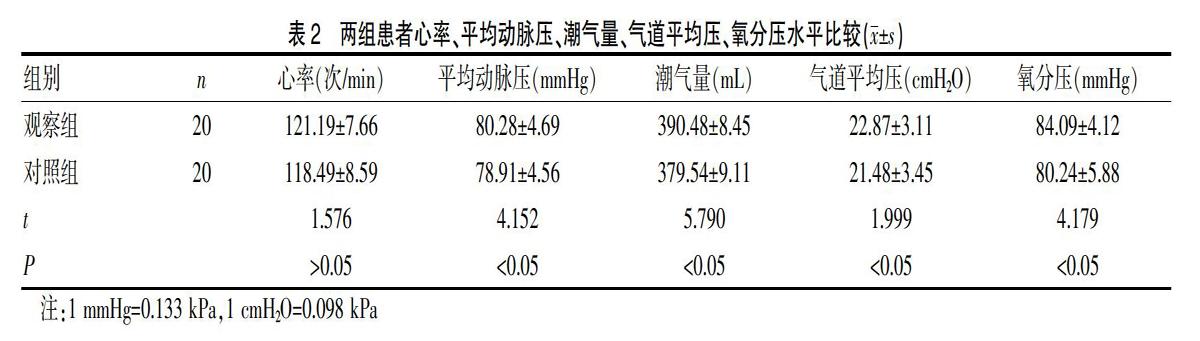

[摘要] 目的 探讨俯卧位通气在ARDS患者中应用的护理效果。 方法 收集2016年1月~2018年6月在我院进行治疗的40例患者的临床资料。按照治疗方案不同分为观察组20例和对照组20例。对照组:仰卧位通气。观察组:俯卧位通气。观察舒适度评分、心率、平均动脉压、潮气量、气道平均压、氧分压水平变化情况。结果 观察组GCQ总分、生理维度、心理维度评分均高于对照组,差异显著(P<0.05),观察组平均动脉压、潮气量、气道平均压、氧分压水平均高于对照组,差异显著(P<0.05)。观察组镇静程度RASS评分为(-3.04±0.15)分,低于对照组的(0.14±0.04)分,差异显著(P<0.05)。 结论 俯卧位通气在ARDS患者中应用的护理效果较好,患者舒适度较高,RASS评分改善较好。
[关键词] 俯卧位通气;ARDS;舒适状况;氧分压;护理
[中图分类号] R473.5 [文獻标识码] B [文章编号] 1673-9701(2019)19-0141-03
[Abstract] Objective To investigate the nursing effect of prone position ventilation in patients with ARDS. Methods The clinical data of 40 patients who were treated in our hospital from January 2016 to June 2018 were collected. According to different treatment options, the patients were divided into observation group(n=20) and control group(n=20). The control group was treated with supine position ventilation. The observation group was treated with prone position ventilation. The changes in comfort score, heart rate, mean arterial pressure, tidal volume, mean airway pressure, and oxygen partial pressure were observed. Results The scores of GCQ, physiological dimension and psychological dimension of the observation group were higher than those of the control group, and the difference was significant(P<0.05). The mean arterial pressure, tidal volume, mean airway pressure and oxygen partial pressure were higher in the observation group than those of the control group, and the difference was significant(P<0.05). The sedation RASS score of the observation group was(-3.04±0.15), which was lower than that of the control group(0.14±0.04), and the difference was significant(P<0.05). Conclusion The prone position ventilation has better nursing effect in patients with ARDS. The patient comfort is higher, and the RASS score is better.
[Key words] Prone position ventilation; ARDS; Comfort condition; Oxygen partial pressure; Nursing
急性呼吸窘迫综合征(ARDS)是由肺内原因和/或肺外原因引起的,以顽固性低氧血症为显著特征。ARDS因高的病死率而受到极大的关注。ARDS病因繁多,不同病因所致ARDS发病机制也各有不同。临床表现多呈急性起病、呼吸窘迫以及难以用常规氧疗纠正的低氧血症等。ARDS是由严重创伤、休克、大手术、严重感染、误吸等多种原因引起的顽固性低氧血症为特征的综合征,各种病因引起的ARDS发生率达2.0%~48.8%,病死率高达40%~70%[1-2]。俯卧位通气可明显改善ARDS患者的氧合功能,降低吸入的氧浓度及呼吸末正压水平,从而提高ARDS患者治愈率[4-5]。我院开展了俯卧位通气在ARDS患者中应用的护理研究,并探讨其干预效果,现报道如下。
1 资料与方法
1.1 一般资料
收集2016年1月~2018年6月在我院进行治疗的40例患者的临床资料。按照治疗方案不同分为观察组20例和对照组20例。观察组男18例,女2例,年龄40~70岁,平均(58.47±8.67)岁;体重44~70 kg,平均(55.49±5.27)kg;临床诊断:创伤4例,肺部感染10例,慢性阻塞性肺疾病4例,H7N1 1例,H7N9 1例。……