TLR4受体在妊娠期缺氧子代大鼠动脉粥样硬化的研究
2019-08-19蒋海彬
蒋海彬
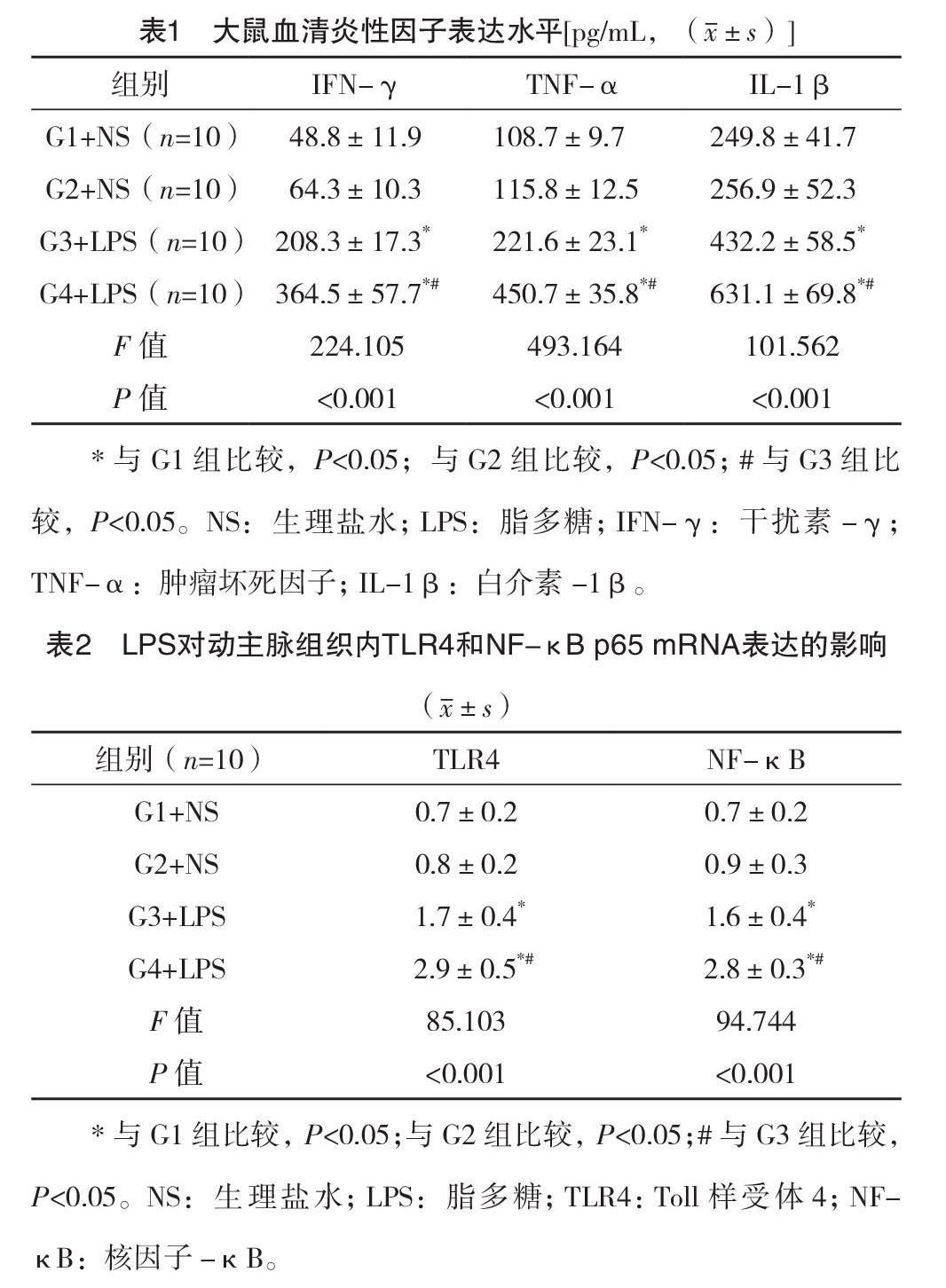
【摘要】 目的:在妊娠期缺氧子代SD大鼠应用脂多糖,以研究TLR4受体在动脉粥样硬化中的作用。方法:将20只鼠龄8月妊娠期缺氧雄性子代大鼠分为两组(G2)和(G4),每组10只,分别给予腹腔注射生理盐水(等容积)或脂多糖(2.5 mg/kg),将20只妊娠期缺氧空白对照雄性子代大鼠(G1)和(G3)作相应处理,每周2次,连续注射8周。于12月龄后处死大鼠。采用ELISA检测大鼠血清中炎症相关因子IFN-γ、TNF-α、IL-1β的水平,Real time-PCR检测大鼠主动脉组织中NF-κB p65与TLR4 mRNA表达。结果:G3和G4组炎症相关因子IFN-γ、TNF-α、IL-1β水平升高(P<0.05),主动脉组织中TLR4、NF-κBp65 mRNA的表达明显升高(P<0.05),并且G4最高(P<0.05)。结论 脂多糖可以引起主动脉炎症反应。通过TLR4/NF-κB信号途径的激活,TLR4受体在动脉粥样硬化中起到了重要的作用。
【关键词】 Toll样受体4; 动脉粥样硬化; 核因子-κB; 妊娠期缺氧
【Abstract】 Objective:To investigate the pathologic mechanisms of TLR4 in atherosclerosis after TLR4 agonists(LPS)were administered to offspring rats from hypoxia during pregnancy.Method:Twenty female offspring rats from hypoxia during pregnancy aged 8 months were randomized into two groups(G2)and(G4)with 10 in each group. Saline(isovolumic normal saline)and LPS(2.5 mg/kg)were administered respectively by intraperitoneal injection,twice a week. Corresponding interventions were given to offspring rats(G1)and(G3),from control group during pregnancy and compared with offspring rats from hypoxia during pregnancy. After treatment 8 weeks,the ELISA was used to measure the IFN-γ,TNF-α,IL-1β of serologic inflammatory cytokines,and the real time-PCR was used to measure the TLR4 and NF-κB p65 mRNA expressions in aortic sinus specimens aortic sinus.Result:The levels of immune inflammatory mediators(IFN-γ,TNF-α,IL-1β)rose significantly in group G3 and G4(P<0.05). Simultaneously,TLR4 and NF-κB p65 mRNA expressions in the aorta tissue of group G3 and G4 were enhanced(P<0.05).In addition,the above-mentioned parameters were more obvious in group G4(P<0.05).Conclusion:Inflammatory response occurred in the aorta tissue in rats after LPS exposure. TLR4 receptor revealed an important role in inflammatory injury of the aorta tissue after LPS stimulation by the activation of TLR4/NF-κB signal pathway.
【Key words】 Toll-like receptor 4; Atherosclerosis; Nuclear factor-kappa B; Hypoxia during pregnancy
First-authors address:NO.2 Hospital Affiliated to Xiamen Medical College,Xiamen 361000,China
doi:10.3969/j.issn.1674-4985.2019.10.002
目前,心血管疾病等慢性病對人类健康造成了重大影响,既往大量研究表明吸烟、高血压、肥胖等为其确定的危险因素,但上述原因并不能完全解释心血管疾病的流行。有研究表明,在排除后天社会行为的因素的前提下,产前营养不良、出生体重低、产后营养状况与冠心病也存在较强的相关性[1],上述研究表明产前与早期出生后相关因素也是心血管疾病的危险因素。作为心血管疾病的主要病理生理学基础,动脉粥样硬化(atherosclerosis,AS)被认为是一种“炎性疾病”。炎症伴随着AS的发展,其一个常见特征是细胞因子上调。作为一组Ⅰ型跨膜模式识别受体(transmembrane pattern-recognition receptors,PRRs)[2],Toll样受体是(Toll-like receptors,TLRs)的特异配体包括脂多糖(lipopolysaccharide,LPS)。当细胞受LPS刺激时,LPS-LPS结合蛋白(LBP)复合物结合到细胞表面CDl4/TLRs受体,通过髓样分化蛋白88(Myeloid differentiation protein 88,MyD88)依赖或非依赖MyD88信号转导途径,激活核因子-κB(Nuclear factor-kappa B,NF-κB)和活化蛋白激酶信号通路进而各种炎性细胞因子基因表达上调[3-4],炎性介质水平上调[5-6]。……