基于功率控制的认知无线网络能效研究
2019-06-08韩宾邓冬梅江虹
韩宾 邓冬梅 江虹

摘 要:针对Underlay频谱共享模式下的认知无线网络的能量效率问题,提出了一种双重改进的粒子群功率控制优化算法(Dual Improved Particle Swarm Optimization, DIPSO),通过最小化约束条件下认知用户的发射功率以实现网络能量效率优化.在仿真过程中,以保证认知用户基本通信的同时不对主用户正常通信构成影响为基本前提,对信道衰落及噪声干扰进行了综合考虑,搭建出多约束条件下的网络能量效率函数,实现认知无线网络中认知用户发射功率的最小化.仿真结果表明:该算法可有效提升无线网络的能量效率.
关键词:认知无线电;DIPSO;功率控制;能效优化
中图分类号:TN915.5 文献标志码:A
Study on Energy-efficient of Cognitive Wireless
Networks Based on Power Control
HAN Bin1,2, DENG Dongmei2, JIANG Hong2
(1. State Key Laboratory of Environment-friendly Energy Materials,Southwest University of Science
and Technology,Mianyang 621010,China;
2. School of Information Engineering,Southwest University of Science and Technology,Mianyang 621010,China)
Abstract:Aiming at the problem of cognitive wireless network energy efficiency under underlay spectrum sharing mode,a double improved particle swarm optimization algorithm(DIPSO) for power control was proposed. The optimization of network energy efficiency was realized by recognizing the transmitted power of users under the condition of minimizing constraints. In the simulation process,under the circumstance of considering channel fading and noise interference,the fuction of network energy efficiency and relevant constraints were constructed on the premise where the normal communication of main users was not affected,the basic communication of users was guaranteed, and the transmission power of cognitive users in the cognitive wireless network was minimized. The simulation shows that the proposed algorithm can effectively improve the energy efficiency of wireless network.
Key words:cognitive wireless radio;dual improved particle swarm optimization(DIPSO);power control;energy-efficient optimization
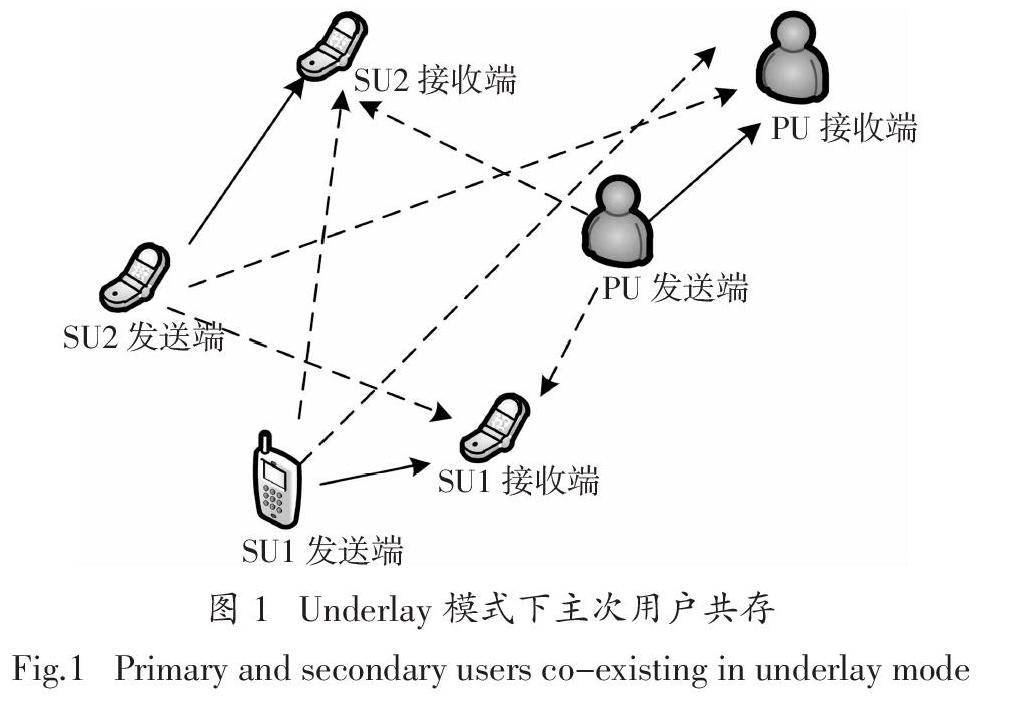
隨着无线网络应用和需求的不断发展,无线网络对提升通信速率、提高频谱利用率的要求也日益增强.同时,通信网络的能耗也已成为必须考虑的问题,网络能量效率更是成为衡量通信网络能耗的一项重要指标[1].认知无线电技术的发展,将传统无线网络中的用户按用频优先权的不同分为:1)对频谱具有绝对优先使用权限的主用户(Primary User,PU);2)利用频谱感知与判决结果伺机而动共享主用户频谱的认知用户(Second User,SU)[2].认知用户利用动态频谱接入技术,实现与主用户共享频谱,以提高频谱资源紧缺背景下频谱资源的利用率.频谱共享方式目前主要分为Overlay(覆盖式)及Underlay(共存式)两种.Overlay中主用户和认知用户在同一时隙中不共存,认知用户只能在主用户不占用信道时才能伺机接入并使用其信道……