临床全面护理干预对全膝关节置换术患者功能恢复的影响
2019-02-13罗莹
罗莹
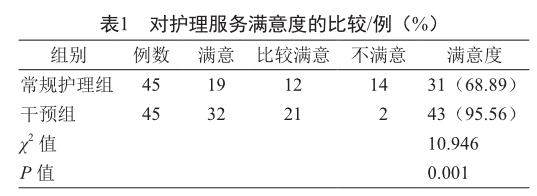
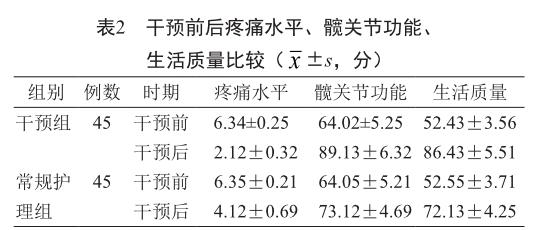
摘 要 目的:探讨临床护理干预对全膝关节置换术患者功能恢复的影响。方法:将90例全膝关节置换术患者以数字表法分组,对照组进行常规化护理干预,干预组进行临床全面护理干预。比较两组患者对护理服务的满意度;功能康复锻炼依从性;干预前后疼痛水平、髋关节功能、生活质量。结果:干预前两组疼痛水平、髋关节功能、生活质量相近。干预组对护理服务的满意度,功能康复锻炼依从性,疼痛水平、髋关节功能、生活质量均优于对照组(P<0.05)。结论:临床全面护理干预在全膝关节置换术护理中的应用效果确切,可减轻疼痛,改善髋关节功能和生活质量,提升满意度。
关键词 临床全面护理干预 全膝关节置换术患者 功能恢复
中图分类号:R473.6; R687.42 文献标志码:B 文章编号:1006-1533(2019)01-0050-02
Effect of clinical comprehensive nursing intervention on functional recovery of patients with total knee arthroplasty
LUO Ying
(the Second Department of Orthopedics, the Peoples Hospital of Zhengzhou, Zhengzhou 450053, China)
ABSTRACT Objective: To explore the effect of clinical nursing intervention on functional recovery in patients with total knee arthroplasty. Methods: Ninety patients with total knee arthroplasty were divided into a control group (undergoing routine nursing) and an intervention group (undergoing clinical comprehensive nursing) by digital table. The satisfaction of nursing service, the compliance of functional rehabilitation exercise, the pain level before and after intervention, hip function and quality of life were compared between the two groups. Results: The pain level, hip function and quality of life were similar in the two groups before the intervention, however, the compliance of functional rehabilitation exercise, pain level, hip function and quality of life were much better in the intervention group than the control group after intervention (P<0.05). Conclusion: Clinical comprehensive nursing intervention for the treatment of patients with total knee arthroplasty is effective, can reduce pain and improve hip function, quality of life and satisfaction.
KEy WORDS clinical comprehensive nursing intervention; total knee arthroplasty; functional recovery
全膝关节置换术是一种常见的手术方式,可有效治疗膝骨性关节炎等疾病,重建膝关节功能、改善患者生活质量,但全膝关节置换术属于强烈的应激源,患者可产生极强不安、紧张情绪,影响手术的顺利进行,也影响术后康复,因此需选择有效的护理方法[1-2]。
1 資料与方法
1.1 一般资料
选取2016年6月—2017年1月在郑州人民医院骨二科行全膝关节置换术患者90例,以数字表法分为:干预组45例,男29例,女16例,年龄52~79岁,平均(65.21±2.21)岁,发病时间1~6年,平均(4.11±0.31)年;常规护理组45例,男28例,女17例,年龄51~79岁,平均(65.46±2.25)岁,发病时间1~6年,平均(4.12±0.35)年。两组一般资料比较无统计学差异(P>0.05)。
1.2 方法
常规护理组进行常规化护理干预,术前行常规仪器准备和患者生理准备,术后行常规生命体征监测,及时发现异常情况并处理。
干预组采取的护理措施是临床全面护理干预:①术前护理。……
