常规护理配合阶段性认知行为干预对肺癌化疗的影响
2018-12-21王海媛
王海媛
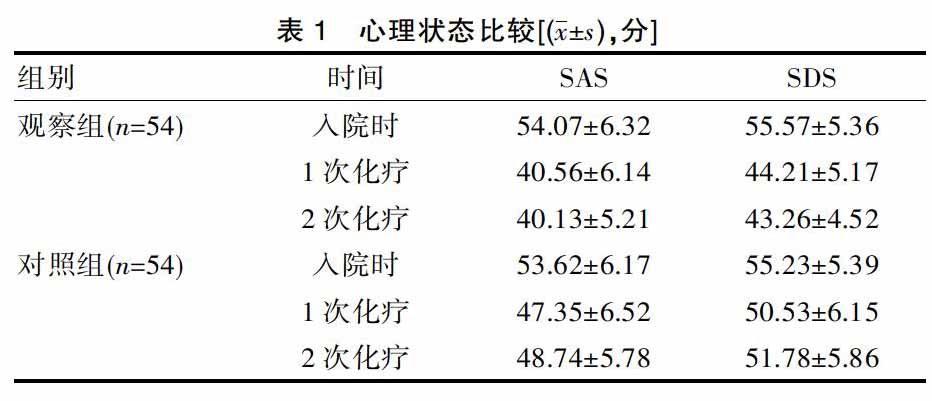

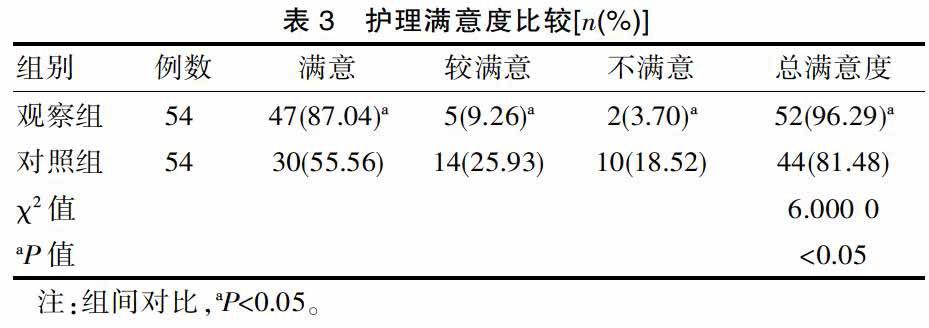
[摘要] 目的 分析肺癌化疗应用常规护理配合阶段性认知行为干预的效果。 方法 方便选取2016年1月—2018年1月在该院接受化疗医治的108例肺癌患者临床资料,按不同护理方案分2组,每组54例,对照组行常规护理,观察组在其基础展开阶段性认知行为干预,比较两组心理状态、生活质量及护理满意度。 结果 观察组1次、2次化疗后的SAS及SDS评分比入院时低,且低于对照组,差异有统计学意义(P<0.05);观察组护理后躯体(81.03±10.24)分、情感(85.14±10.88)分、认知(87.26±11.02)分、角色(82.31±13.14)分、社会(80.56±11.15)分评分均比对照组高(t=5.063 5、t=6.433 2、t=7.172 8、t=2.776 3、t=3.737 9,P<0.05);觀察组护理总满意度96.29%比对照组81.48%高(P<0.05,χ2=6.0000)。 结论 肺癌化疗患者在常规护理基础展开阶段性认知行为干预能缓解负面情绪,减轻焦虑、抑郁,并改善生活质量,提升护理满意度,效果显著。
[关键词] 肺癌;化疗;认知干预;行为干预
[中图分类号] R473.73 [文献标识码] A [文章编号] 1674-0742(2018)08(c)-0148-03
Effects of Routine Nursing and Staged Cognitive Behavioral Intervention on Lung Cancer Chemotherapy
WANG Hai-yuan
Department of Oncology, Zibo Integrative Medicine Hospital, Zibo, Shandong Province, 255000 China
[Abstract] Objective To analyze the effect of routine nursing and staged cognitive behavioral intervention in the treatment of lung cancer. Methods The clinical data of 108 patients with lung cancer who received chemotherapy in the hospital from January 2016 to January 2018 were convenient selected and divided into 2 groups according to different nursing plans. 54 patients in each group. The control group received routine nursing care. The observation group was carried out on its basis staged cognitive behavioral interventions, compare the psychological status, quality of life, and care satisfaction of the two groups. Results The SAS and SDS scores were lower in the observation group after 1 and 2 cycles of chemotherapy than those in the control group (P<0.05) and in the observation group (81.03±10.24)points and emotion (85.14±10.88)points in the observation group, cognition (87.26±11.02) points, roles (82.31±13.14) points, and social scores (80.56±11.15)points were higher than those of the control group (t=5.063 5, t=6.433 2, t=7.172 8, t=2.776 3, t=3.737 9,P<0.05); 96.29% of the total care satisfaction in the observation group was higher than 81.48% in the control group (χ2=6.000 0,P<0.05). Conclusion Patients with lung cancer undergoing cognitive therapy at the stage of routine nursing can relieve negative emotions, relieve anxiety and depression, improve quality of life, and improve nursing satisfaction. The results are significant.
[Key words] Lung cancer; Chemotherapy; Cognitive intervention; Behavioral intervention
肺癌作为全球性恶性肿瘤,其患病率、病死率逐年递增,威胁着患者的健康、生命。肺癌临床以低热、咳嗽、咯痰、胸痛、胸闷及痰血等症状为主,治疗多用化疗手段[1]。无论是针对早期或晚期肺癌,化疗效果在一定程度上均受到临床肯定。化疗在杀灭癌细胞过程中,亦会损伤体内正常细胞,从而致患者发生恶性、呕吐、疲乏等躯体不适症,引起患者不良心理情绪,延缓康复进程[2]。近年来,认知行为作为一种护理干预手段,能有效减轻心理负面应激,缓解压力,并在宫颈癌、膀胱癌、肝移植等领域得以广泛应用,取得满意效果[3]。为此,该院针对2017年1月—2018年1月收治的108例肺癌化疗患者为研究对象,旨在探究阶段性认知行为干预的效果,现将报道如下。
1 资料与方法
1.1 一般资料
方便选取在该院接受化疗医治的108例肺癌患者资料,纳入标准:经胸部CT或MRI、病理学、细胞学等检查证实患有肺癌,初次行化疗,自愿参与此研究,签署同意书。……
