个体化护理干预对肿瘤患者放疗后睡眠障碍的 改善效果分析
2018-10-21马冰雪李淑华
马冰雪 李淑华
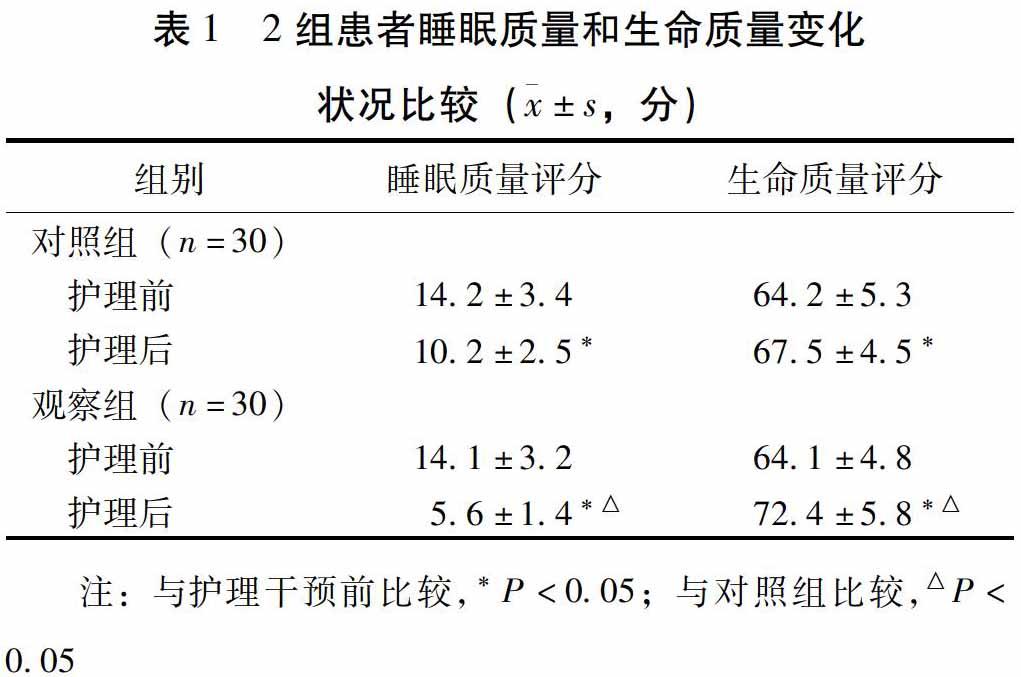
摘要 目的:探讨实施个体化护理干预对肿瘤患者放疗后睡眠障碍的影响。方法:选取2017年1月至2018年5月蚌埠医学院第一附属医院收治的肿瘤放疗患者60例,按照随机数表法分为观察组和对照组,每组30例。对照组采用常规护理,观察组采用个体化护理干预,分析2种护理方法对患者的影响。结果:观察组护理后睡眠质量评分、生命质量评分明显优于对照组( P <0.05)。结论:肿瘤患者实施个体化护理干预可改善患者放疗后睡眠障碍及生命质量。
关键词 肿瘤;个体化护理干预;放疗;睡眠障碍
中图分类号:R73 文献标识码:A doi: 10.3969/j.issn.2095-7130.2018.10.046
Effect of Individualized Nursing Intervention on the Improvement of Sleep Disorders in Patients with Cancer After Radiotherapy
Ma Bingxue,Li Shuhua
(The First Affiliated Hospital of Bengbu Medical College,Bengbu,233004)
Abstract Objective: To explore the effect of individualized nursing intervention on the sleep disorder after radiotherapy in patients with cancer. Methods: A total of sixty patients with tumor radiotherapy(implemented between January 2017 and May 2018)were divided into routine group( n =30,routine care)and individualized group( n =30,individuals)according to the random number table 3 method.The nursing intervention)analyzes the impact of the two nursing methods on the patient. Results: The post-treatment sleep quality score and quality of life score were significantly better in the individualized group than in the conventional group( P <0.05). Conclusion: Individualized nursing intervention in patients with cancer can improve sleep disorders and quality of life after radiotherapy.
Key Words Tumor;Individualized nursing intervention;Radiotherapy;Sleep disorder
腫瘤是目前威胁人类健康和生命的常见疾病,及早治疗是改善患者预后的关键。放疗是临床治疗肿瘤的重要方式,放疗对多种肿瘤疾病可达到良好的治疗效果,但放疗过程中不良反应较多,常引起患者出现身心创伤。当前临床报道显示肿瘤患者放疗过程中极易出现睡眠障碍,但睡眠障碍的出现将会影响患者的疾病恢复状况及生命质量,如何改善肿瘤放疗和治疗后患者睡眠障碍状况,是临床护理中亟待解决的问题。本研究在肿瘤放疗患者中运用个体化护理干预,取得较好效果,现报道如下。
1 资料与方法
1.1 一般资料 选取2017年1月至2018年5月我院收治的肿瘤放疗患者60例,按照随机数表法分为观察组和对照组,每组30例。对照组中男18例,女12例;年龄28~73岁,平均年龄(50.9±10.3)岁;肿瘤类型:鼻咽癌5例,食管癌9例,脑癌4例,淋巴癌2例,肺癌10例;病程3个月至2年,平均病程(1.2±0.6)年;观察组中男19例,女11例;年龄30~73岁,平均年龄(50.8±11.1)岁;肿瘤类型:鼻咽癌6例,食管癌8例,脑癌3例,淋巴癌2例,肺癌11例;病程3个月至2年,平均病程(1.1±0.6)年。……