集束化护理在全身麻醉患者中的应用效果
2018-02-22邱健春
邱健春
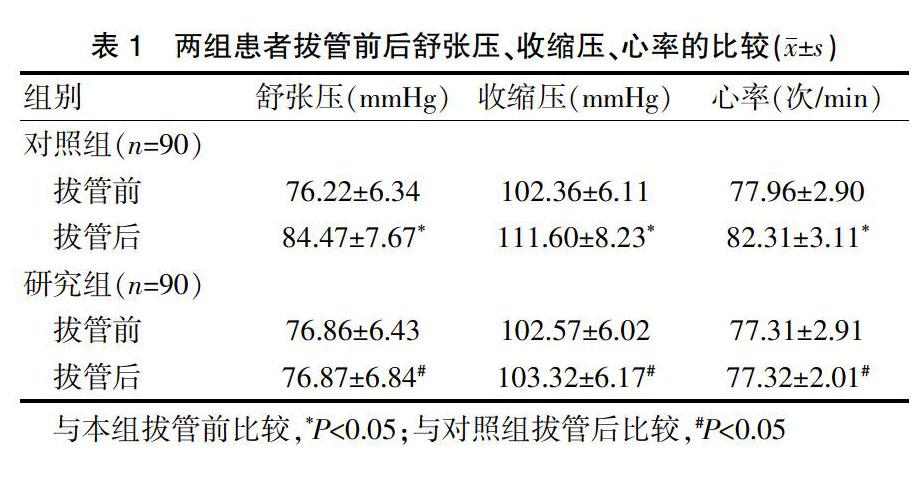

[摘要]目的 研究集束化护理管理在全身麻醉患者中的应用。方法 选取2017年1月~2018年1月在我院接受治疗的180例全身麻醉患者进行研究分析。按照随机数字表法将其分为对照组和研究组,每组各90例。对照组患者进行常规护理,研究组患者进行集束化护理。比较两组患者围拔管期的血压、心率、并发症总发生率。结果 两组患者拔管前的心率、血压比较,差异无统计学意义(P>0.05)。拔管后,对照组患者的血压和心率高于拔管前,差異有统计学意义(P<0.05),研究组患者的心率和血压与拔管前比较,差异无统计学意义(P>0.05)。研究组患者拔管后的血压和心率低于对照组,差异有统计学意义(P<0.05)。研究组患者的并发症总发生率(26.67%)低于对照组(61.11%),差异有统计学意义(P<0.05)。结论 使用集束化护理在全身麻醉患者围拔管期护理中具有较好的临床效果,保持心率和血压稳定,使不良反应和意外事件的发生率降低。
[关键词]全身麻醉;集束化护理;围拔管期
[中图分类号] R614 [文献标识码] A [文章编号] 1674-4721(2018)12(c)-0210-03
[Abstract] Objective To study the application of intensive care management in general anesthesia patients. Methods A total of 180 cases of general anesthesia patients treated in our hospital from January 2017 to January 2018 were selected for study and analysis. According to the random number table method, it was divided into the control group and the research group, 90 cases in each group. The control group received routine care and the research group received intensive care. Blood pressure, heart rate, total incidence of complications were compared between the two groups during perioperative period. Results There were no statistically significant differences in heart rate and blood pressure between the two groups before extubation (P>0.05). After extubation, the blood pressure and heart rate of the control group were higher than those before extubation, and the differences were statistically significant (P<0.05). There was no statistically significant difference between heart rate and blood pressure before extubation in the study group (P>0.05). The blood pressure and heart rate of the study group after extubation were better than those of the control group, and the differences were statistically significant (P<0.05). The total incidence of unexpected events and adverse reactions in the study group (26.67%) was lower than that in the control group (61.11%), and the difference was statistically significant (P<0.05). Conclusion Intensive nursing has a good clinical effect in the perioperative nursing of general anesthesia patients, it can keep heart rate and blood pressure stable and reduce the incidence of adverse reactions and accidents.
[Key words] General anesthesia; Intensive care; Around the time of decannulation
全身麻醉是手术中常见的手术麻醉方法,患者在术后围拔管期由于全身麻醉药仍有残留及手术带来的创伤,各器官依然处于不稳定状态,这就会引起消化系统、循环系统、神经系统和呼吸系统方面的并发症,对患者的预后存在很不利的影响,因此应该对全身麻醉后围拔管期产生的不良反应积极进行有效干预[1-2]。集束化干预是在患者进行治疗时,使用的一系列有效合理的干预方法的集合[3]。目前,集束化干预在重症监护室中广泛使用,具有较好的临床效果,但是其内容不是一成不变的[4]。为了研究全身麻醉患者采用集束化护理管理在其围拔管期护理中的应用效果,本研究选取在我院接受治疗的180例全身麻醉患者进行研究分析,现报道如下。
1资料与方法
1.1一般资料