体质辨识在老年女性肌少症筛查中的应用
2017-10-22方圆乔子婴沈玉婧郑熙
方圆+乔子婴+沈玉婧+郑熙
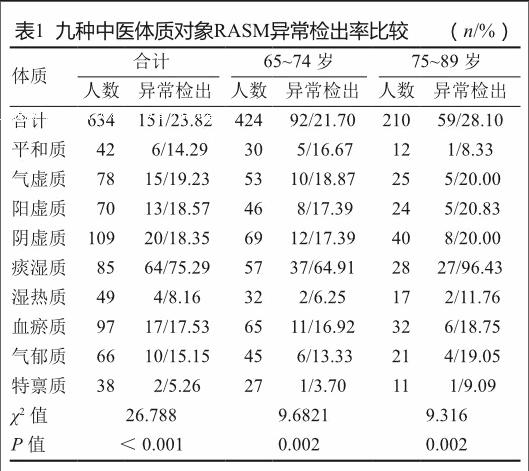
摘 要 目的:探索老年女性中医体质与肌少症关系,以及体质辨识技术在肌少症筛查中的适用性。方法:选取2015年1月至2016年6月期间在“治未病”门诊就诊的65岁以上女性患者共计634例,平均年龄(72.21±6.20)岁。采用《中医体质量表》辨识其体质类型,采用双能X线骨密度仪测定四肢骨骼肌质量,计算相对骨骼肌指数(RASM)。参考2014年亚洲肌少症工作组诊断标准中相对骨骼肌指数,以女性≤5.4kg/m2为截值,比较9种体质组RASM异常检出率。结果:痰湿质组老年女性的RASM异常检出率为75.29%,高于其余8种体质组(P<0.05)。结论:痰湿体质的老年女性是肌少症高危对象,运用体质辨识技术进行肌少症的初筛,有利于提高后续诊断的效率与精准性。
关键词 体质辨识;肌少症;筛查
中图分类号:R592 文献标志码:A 文章编号:1006-1533(2017)18-0041-03
Application of syndrome differentiation of constitution in the screening of sarcopenia in the elderly women
FANG Yuan, QIAO Ziying, SHEN Yujing, ZHENG Xi
(Jiangwan Community Health Service Centre of Hongkou District, Shanghai 200434, China)
ABSTRACT Objective: To study the relationship between sarcopenia and TCM constitution, and the applicability of syndrome differentiation of constitution in sarcopenia screening. Methods: A total of 634 female patients over 65 were selected from the outpatient clinic of “prevention of disease” from January 2015 to June 2016 and the average age was (72.21±6.20) years. TCM constitution scale was used to identify its physical types and the appendicular skeletal muscle mass of limbs was measured by dual energy X-ray absorptiometry to calculate the relative appendicular skeletal muscle mass (RASM). Referring to the relative skeletal muscle index in the diagnostic criteria for the Asian muscular deficiency group in 2014, and less than or equal to 5.4kg/m2 of the female as the cut-off value, the detection rates of RASM abnormalities in 9 groups were compared. Results: The abnormal detection rate of RASM of phlegm dampness group was 75.29% in the aged women, which was higher than those of the other eight groups(P<0.05). Conclusion: The elderly women with phlegm dampness constitution are the high-risk objects of sarcopenia. The preliminary screening of sarcopenia with physical identification technique is helpful to improve the efficiency and accuracy of follow-up diagnosis.
KEY WORDS syndrome differentiation of constitution; sarcopenia; screening
1989年Irwin[ 1 ]首次提出“Sarcopenia”一詞(译为“少肌症”、“骨骼肌减少症”或“肌肉衰减征”)。1997年美国Tufts大学Rosenberg[ 2 ]提议采用“肌肉减少症”即“肌少症”来描述这种增龄相关性肌肉量减少的临床综合征。之后国内外关于“肌少症”与老年人机体活动能力下降、意外跌倒以及失能甚至死亡的关联性研究文献日益增多。肌少症的发病机制、筛查与诊断、临床干预已成为老年医学研究的热点之一。尤其老年女性,与增龄相关的骨骼肌纤维数量减少以及横截面积减小更为明显,肌少症罹患率显著上升,需要予以关注[ 3 ]。国内在肌少症筛查方面工作经验与相关数据尚处于积累阶段。根据亚洲肌少症工作组的建议以日常步速和握力作为筛查指标[4]。本研究通过分析老年女性不同中医体质之间骨骼肌质量水平与差异,初步评价中医体质辨识技术在肌少症筛查中的应用价值。……
