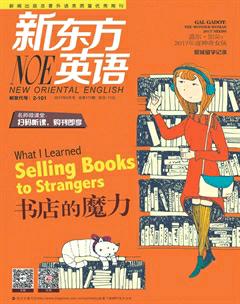
书店的魔力
2017-08-10李梓
李梓
在網上书店的冲击下,实体书店纷纷倒闭,但也有些书店留了下来,成为城市中一处不可多得的人文风景。作为买书之人,虽喜欢网上书店的高效和便捷,但在很多人心里,实体书店仍是一种美好的所在。在这里,我们与人相遇、别离,触碰到生命中的点滴感动;在这里,我们觉得自己不再是数字世界的一个符号,而是活生生的人。
The week before Christmas last year, the bookstore I worked for ran out of All the Light We Cannot See, the most buzzed-about book of the holiday season. It was back-ordered1), and we couldnt get it in the store until December 29th.
“What am I supposed to get my wife?” a man demanded. “Thats what she wanted.”
Get her another book, I wanted to suggest, but instead I apologized from my perch behind the counter, explaining that the publisher hadnt printed enough copies.
“I want to support local bookstores, but you people are really making me want to go to Amazon,” he said.
“The book is backordered on Amazon too,” I told him, as politely as I could. “They cant get it to you before Christmas either.”
Nothing about this conversation was unusual. Customers regularly threaten booksellers with Amazon, like its a weapon they can deploy2) to get what they want from us. “I could get this much cheaper on Amazon,” people tell me when checking out.
These book buyers want to feel good about themselves for shopping in a bookstore, but they want special credit for it too, as if the bookstore should give out gold star stickers along with receipts. People love the ease, anonymity and convenience of shopping on Amazon, but many do feel guilty about shopping for books online—we know bookstores are where real live authors hold events and where little kids can go to a story hour on Saturdays. We know that the money spent in bookstores sustains a lively town center; it doesnt go to buy Jeff Bezos another rocket ship.
So readers congratulate themselves when they make it to a bookstore, but are annoyed when its not a perfect transaction. The books are more expensive than they are online, and sometimes theres a line to check out. And man, do customers hate waiting in line. We have become a culture that refuses to wait for books.
We want shopping in person to be as quick and easy as shopping online is. It is not, and last year, during the holiday rush, I began to understand the value of this slowness.
I took a job at my local bookstore in order to supplement money I earned from a fellowship, but bookselling quickly became something much more than rent money to me. It was a job Id been training for my entire life, a job that required knowing more about books than the average person. I had always read more and read faster than most people I knew. But no one can read everything, and in my years as a bookseller, Ive learned to listen to NPR in the morning because someone will almost always come in later that day wanting a book that they heard about on the way to work. I remember one customer in particular: “I dont know the author or the title, but it has something to do with World War II and love letters.”
“I heard that on the radio too,” I told him, and went off to fetch the book.
I had other customers get so excited when I found the book they wanted based only on some very vague descriptions (“Blue cover, I think its about Italy?”) that they hugged me.
“Whats cool about that—the blue cover, Italy thing—is thats really hard for a computer,” my husband told me. He studies artificial intelligence, and he loves Amazon. Other than the fact that Id complain about it, I dont think he would miss bookstores much if they were gone.
What he doesnt seem to understand is the thing Ive come to learn: There are people who really need bookstores, people who I have come to know well. There is a therapist who works next door, and he buys and reads more novels than I would think is humanly possible or financially responsible. When one of our booksellers was snowed in overnight at work, the therapist let her sleep on his couch. There is a man who wears a leather cowboy hat, and he told me he almost never leaves his apartment except to come into the store. He always tips his hat to me before he leaves (really). And every Saturday, a father and his young son come in to buy a new Geronimo Stilton3) book, which is a series about an adventurous mouse. I eventually learned that the father was going through a divorce, and the bookstore was one of the things that both he and the little boy really looked forward to.
Last December, a customer in a wheelchair told me that he was dying. He explained: “I need a book to give to my family that helps them to understand that Im the same person, even though I dont look the way I used to. Im so tired of them treating me differently, like theyre afraid of me.” He wanted a book to help them let him go. We talked for some time about what he really wanted from the book, and I told him wed special order a few books for him. The bookstore owner and I brainstormed and researched, and we ordered 10 books. When the man came back a few days later to see what wed found, he bought a few. He said simply: “Thank you for listening to me.”
Bookstores are for people who arent always listened to, or for people who dont always have someone to talk to. Bookstores often attract people who are otherwise introverted, or people who dont realize how much they need a social connection. Its a comforting environment to socialize, an easy place to strike up a conversation. Theres always something to talk about: books, of course, but we also talk about our families, the weather, the good restaurants around here. We give directions to the bank and to the coffee shop. We talk about our love of dogs (its a dog-friendly store), and we even talk about politics.
But the day when I most clearly understood what bookstores really offer us occurred last year when in the midst of the holiday chaos, my high school history teacher came in to shop and I almost cried when I saw him. He didnt remember me at all, but it didnt matter. Mr. Cho was the first teacher I had in high school to make me feel smart, to make me feel worthy, a way I hadnt felt in years, not since elementary school. After the first test in his class, Mr. Cho wrote me a postcard about how smart and capable he believed I was, and that he knew I could do well. This was the same year my English teacher told my parents that he thought I was “such a pretty girl, Im surprised when she opens her mouth and says something smart.”
Mr. Cho is still very young now, so he must have been a really young teacher when I had him, maybe 24 or 25 then. In the bookstore more than 10 years later, I told him what a profound impact he had on me. I told him I believed he had changed the course of the rest of my life.
“Really?” he said. “I was such an asshole back then.”
I laughed, and assured him he wasnt an asshole, at least never to me.
That Christmas, I realized we may never know the value of the gifts we give to others every day. And it is at bookstores, at actual physical places, that we make connections with other people, where we give and receive small ordinary gestures of humanity. If I had run into Mr. Cho on the street, I might not have said anything. He didnt recognize me or remember me, so I might have let him walk on by. It was because we were at the bookstore, a place where I feel confident and knowledgeable, that I said hello and we connected. And that was the moment I understood why we all keep coming to these places that some might call obsolete: that it is in such places that we can still feel like more than a confirmation number, that we can still feel like a person in the world.
去年圣诞节前一周,我打工的书店卖光了《所有我们看不见的光》这本假日季人们谈论最多的书。书暂时缺货,我们要到12月29号才能补到货。
“那我该给妻子送什么?”一位先生逼问道,“她就想要那本书。”
送她另外一本吧,我本来想这么建议,但却没说。相反,我坐在柜台里的高脚凳上向他致歉,解释说是因为出版商印刷的册数不够。
“我想支持本地书店,但是你们这些人真是让我想去亚马逊买书。”他说。
“这本书在亚马逊也缺货,”我尽可能礼貌地对他说,“他们也没法让您在圣诞节前拿到书。”
这样的对话时有发生。顧客们经常用亚马逊来威胁传统书店,仿佛那是一种他们能用来让自己得偿所愿的武器似的。“我如果在亚马逊买这个可以便宜很多。”人们在结账的时候这样告诉我。
这些购书者想让自己在书店买书的时候自我感觉良好,但他们还想为此获得特殊荣誉,好像书店应该在给他们收据的同时附上金星贴花似的。人们喜欢在亚马逊购书的轻松、匿名和便利,但是许多人又觉得网络购书很有罪恶感——我们知道传统书店是活生生的作者们会举办活动的地方,是孩子们周六能参加一小时故事活动的地方。……