维持性血液透析患者精神心理状况分析及其与神经营养因子水平的相关性研究
2017-08-09殷军波刘彬董继承
殷军波+刘彬+董继承
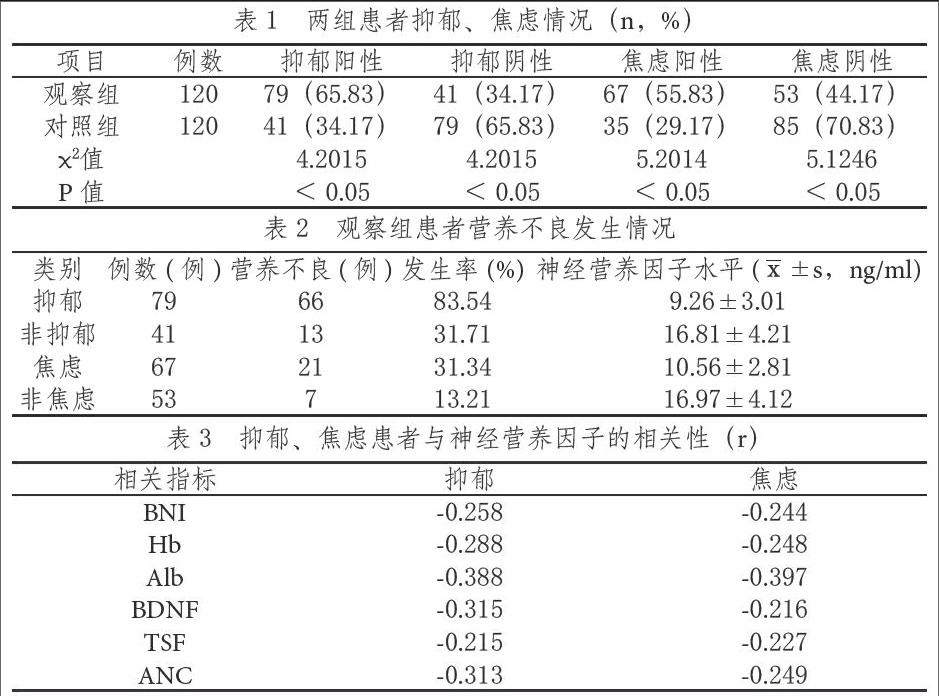
【摘要】目的:探讨维持性血液透析患者精神心理状况及其与神经营养因子水平的相关性。方法:选择2015年4月-2017年4月期间于某医院维持性血液透析患者120例为观察组,选取同期的120例无终末期肾脏病患者为对照组,对两组患者进行精神心理状况及神经营养因子水平检查,分析比较两组患者抑郁、焦虑情况、营养不良发生情况、抑郁、焦虑患者与神经营养因子的相关性。结果:观察组患者的抑郁阳性率为65.83%、焦虑阳性率为55.83%相比于对照组的34.17%和29.17%,观察组明显更高,组间比较,差异存在统计学意义(P<0.05);观察组患者中抑郁患者、非抑郁患者、焦虑患者、非焦虑患者的营养不良发生率和神经营养因子水平进行比较,差异存在统计学意义(P<0.05);抑郁、焦虑患者与神经营养因子水平的降低存在负相关性。结论:维持性血液透析患者易出现焦虑、抑郁等负面情绪,进而使得患者的神经营养因子水平下降,产生营养不良症状,应给予重点关注。
【关键词】维持性血液透析;精神心理状况;神经营养因子水平;相关性研究
[Abstract] Objective:To investigate the mental state of patients with maintenance hemodialysis and its correlation with the level of neurotrophic factor. Methods: in April 2015 - April 2017 in a hospital during the period of maintenance hemodialysis patients, 120 cases as the observation group, selected in the same period 120 cases of patients with end-stage kidney disease (CKD) as the control group, the two groups of patients with mental status and level of neurotrophic factor inspection, analysis and comparison of two groups of patients with depression, anxiety, patients with malnutrition occurrence, depression, anxiety, and the correlation of neurotrophic factors. Results: the observation group of patients with depression positive rate was 65.83%, anxiety, positive rate was 55.83% compared with the control group were 34.17% and 29.17%, observation group obviously higher, comparison between groups, there are statistically significant difference (P < 0.05); Depressed patients in observation group of patients, the patients with depression, anxiety, patients, the incidence of malnutrition in patients without anxiety and neurotrophic factor level, there is statistical significance difference (P < 0.05); There was a negative correlation between depression and anxiety and decreased levels of neurotrophic factor. Conclusion: patients with maintenance hemodialysis is easy to appear the negative emotions such as anxiety, depression, thus makes the patient's level of neurotrophic factor decreased, malnutrition, focus on the should.
【中图分类号】R473.5 【文献标识码】A 【文章编号】2095-6851(2017)07-0-01
维持性血液透析是治疗终末期肾衰竭患者的常见手段,此时患者的病情非常严重,需要重点关注,病死率非常高,只有对患者实施维持性血液透析,才能有效的维持患者的生存,维持性血液透析取代了患者的肾脏功能的作用,维持患者的體液酸碱平衡,进而达到维持患者生命的作用,临床上,针对维持性血液透析患者的治疗,应密切观察患者的精神心理状况,改善负面情绪,提高患者的神经营养因子水平,达到提高患者治疗效果的目的[1]。本文为探讨维持性血液透析患者精神心理状况及其与神经营养因子水平的相关性。报道如下。
1.资料与方法
1.1 一般资料
选择2015年4月-2017年4月期间于某医院维持性血液透析患者120例为观察组,选取同期的120例无终末期肾脏病患者为对照组,其中,对照组患者男55例,女65例,年龄在26-76岁的范围,平均年龄为(57.24±2.15)岁,病程在2-12年,平均病程为(8.21±0.45)年;……
