败酱及墓头回基原的沿革与变迁
2017-07-31相英龙梅桂林罗汉方文韬彭华胜方
相英龙+梅桂林+罗汉+方文韬+彭华胜+方成武+杨青山+李翔宇+张言朋


[摘要] 败酱和墓头回均为传统中药材,市售基原和入药部位混杂,为探究败酱和墓头回基原与入药部位的沿革与变迁,该文通过查阅历代本草书籍有关败酱和墓头回的记载,进行系统整理。发现明代之前败酱来源于败酱属开黄花植物的“根”,明清时期败酱来源于白花败酱Patrinia villosa的“带根全草”;明代时墓头回开始药用,来源于败酱属开黄花植物的“根”,其基原与明代之前败酱基原相同,均为败酱属开黄花的植物。因此应把墓头回并入败酱之类,以败酱属植物败酱P. scabiosaefolia和异叶败酱P. heterophylla的“根”与其“地上部分”作为败酱正品来源。
[关键词] 败酱;墓头回;基原;沿革与变迁
[Abstract] Both Patrinia Herba and Patrinia Radix are traditional Chinese herbal medicines. The herbal source and medicinal part of them are confusing in the herbal medicine market of China. To explore the evolution and transition of the herbal source and medicinal part of Patrinia Herba and Patrinia Radix, this paper systematically summarizes the record of the herbal source and medicinal part of them in ancient classics of herbal medicine in China. According to the findings, before Ming Dynasty, Patrinia Herba originated from the radix of the plants with yellow flowers of Patrinia. In Ming and Qing Dynasty, Patrinia Herba originates from the whole plant (including the radix)of the plant with white flowers of Patrinia. In Ming Dynasty, Patrinia Radix, stemming from the radix of the plants with yellow flowers of Patrinia, started to be used as a traditional Chinese herbal medicine, which had the same herbal source with that of Patrinia Herba before Ming Dynasty. Therefore, Patrinia Herba and Patrinia Radix can be seen as the same traditional Chinese herbal medicine, and the genuine of Patrinia Herba should be the radix and the whole herba of P. scabiosaefolia and P. heterophylla.
[Key words] Patrinia Herba;Patrinia Radix;sources;evolution and transition
敗酱和墓头回均来源于败酱科败酱属的常用中药。败酱具有清热解毒活血排脓的功效,主治肠痈、肺痈、痈肿,痢疾,产后瘀滞腹痛[1]。其名始见于春秋时期的《范子计然》[2],至今已有2 000多年的药用历史。由于历史上同名异物、同物异名的原因导致市售败酱品种混伪品较多,市场所售败酱有菊科植物苣荬菜、苦荬菜及十字花科植物菥蓂和败酱科斑花败酱等3科9植物种[3-4],加之目前国家药典没有败酱相关的质量要求,地方习用品又较多,加剧市场流通败酱药材的混乱。
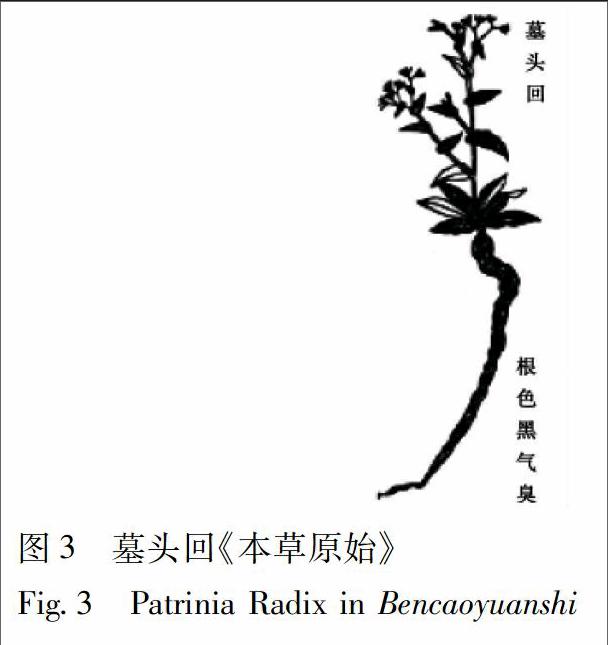
墓头回具有清热解毒,燥湿止带,收敛止血的功效,用于赤白带下,崩漏,泄泻痢疾,肠痈[1]。始载于《救荒本草》[5],名曰地花菜,又名墓头灰,已有400多年的药用历史。明清本草记载的墓头回基原植物各不相同,现代有关墓头回的记载以及市售墓头回药材也比较混乱。……