医疗失效模式与效应分析在预防老年患者导尿管相关尿路感染管理中的应用
2017-07-29王东萍杨志华邱春霞
王东萍+杨志华+邱春霞
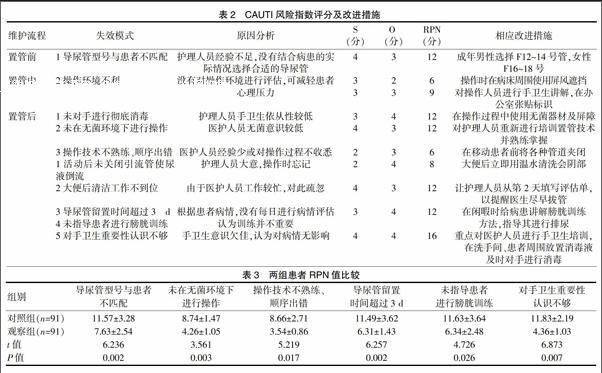
[摘要]目的 探究医疗失效模式与效应分析(HFMEA)在预防老年患者导尿管相关尿路感染(CAUTI)管理中的应用。方法 选取2016年4月~2017年6月我院住院留置导尿管患者182例,将患者分为HFMEA管理组(观察组)和传统方法经验护理组(对照组),每组91例。对照组采用常规留置导尿管护理模式,观察组采用HFMEA模式,对比两组患者高风险系数值(RPN)及CAUTI发生率、护理满意度评分。结果 观察组患者RPN值均降低,差异有统计学意义(P<0.05);观察组患者CAUTI发生率低于对照组,差异有统计学意义(P<0.05);与对照组相比,观察组患者出院后对护理满意度评分较高,差异有统计学意义(P<0.05)。结论 HFMEA应用于老年患者CAUTI管理中,能够降低CAUTI发生率提高护理滿意度。
[关键词]医疗失效模式与效应分析;留置导尿管;感染发生率;风险指数
[中图分类号] R472.9+2 [文献标识码] A [文章编号] 1674-4721(2017)06(c)-0124-04
[Abstract]Objective To explore the application of hospital failure mode and effect analysis(HFMEA)in the prevention of catheter associated urinary tract infection(CAUTI)in elderly patients.Methods 182 cases of indwelling catheter from April 2016 to June 2017 in our hospital were selected and divided into HFMEA management group (observation group) and traditional nursing group(control group),91 cases in each group,routine indwelling catheter nursing mode was used in the control group,HFMEA model was used in observation group.The high risk factor(RPN) value and the incidence of CAUTI,nursing satisfaction score were compared between two groups of patients.Results Compared with the control group,the RPN values of the patients in the observation group were all reduced,CAUTI in the observation group was lower,the nursing satisfaction scores were higher than those in the control group after observation group patients discharge,the difference was statistically significant(P<0.05).Conclusion HFMEA of medical treatment can reduce CAUTI and improve the nursing satisfaction in the management of urinary catheter associated CAUTI in elderly patients.
[Key words]Hospital failure mode and effect analysis;Indwelling catheter;Infection rate;Risk index
留置导尿管是临床上用于患者排尿困难、引流尿液的护理操作,但此项操作易引起腔内、腔外尿路感染[1]。据统计尿路感染的发生率较高,仅次于呼吸道感染,大部分由于导尿管留置引发[2]。导尿管留置引起的感染为导尿管相关性尿路感染(Catheter-associated urinary tract infection,CAUTI),对患者的生活质量和预后产生很大的影响,分析和确认尿路感染的危险因素并采取有效的护理对策是该问题的关键[3]。医疗失效模式及效应分析(hospital failure mode and effect analysis,HFMEA)是一种评估系统流程法,通过分析根本原因及进行流程改进,以减少缺陷发生[4]。本研究将HFMEA应用于老年患者导尿管相关尿路感染管理中,取得了良好效果,现报道如下。
1资料与方法
1.1一般资料
选取2016年4月~2017年6月我院住院留置导尿管的患者182例,其中男98例,女84例,年龄46~79岁,平均(52.49±17.33)岁,患者留置导尿管时间平均(3.86±0.47) d,将患者分为HFMEA管理组91例(观察组)和传统方法经验型护理组91例(对照组),两组患者在性别、年龄、留置导尿管时间方面差异无统计学意义(P>0.05),具有可比性。……