血浆甲状腺素水平和阿尔茨海默病发病的相关性分析
2017-07-13王玉梅龙文
王玉梅++龙文
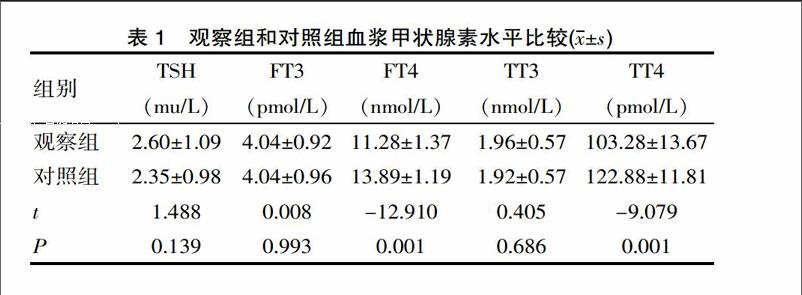
[摘要] 目的 探讨血浆甲状腺素水平和阿尔茨海默病发病的相关因素。方法 方便选取2014年9月一2016年9月在该院住院治疗的80例阿尔茨海默病患者作为观察组和80名同期在该院体检的健康老年人作为对照组,两组均采集血样测定血清促甲状腺激素、总T3、总T4、游离T3、游离T4;并采用非条件Logistic回归分析,分析血浆甲状腺素水平和阿尔茨海默病发病的相关性。结果 观察组患者总T4水平(103.28±13.67)pmol/L,游离T4水平(11.28±1.37)nmol/L;对照组总T4水平(122.88±11.81)pmol/L,游离T4水平(13.89±1.19)nmol/L;观察组均明显低于对照组,两组比较差异有统计学意义(P<0.05)。结果显示总T4水平、游离T4水平的降低是发生AD的独立危险因素(OR=4.659,P<0.01;OR=5.159,P<0.01)。结论 阿尔茨海默病患者血浆甲状腺素水平呈低水平状态,血浆甲状腺素水平降低与阿尔茨海默病发生有明显相关性。
[关键词] 阿尔茨海默病;血浆甲状腺素;相关性
[中图分类号] R749 [文献标识码] A [文章编号] 1674-0742(2017)05(b)-0036-03
[Abstract] Objective To study the correlation between the plasma thyroid hormone level and onset of alzheimer's disease. Methods Convenient selection 80 cases of patients with alzheimer's disease treated in our hospital from September 2014 to September 2016 were selected and 80 cases of healthy physical examination in our hospital were selected as the control group, and the serum thyroid stimulating hormone, total T3, total T4, free T3 and free T4 in blood samples were collected and the correlation between the plasma thyroid hormone level and onset of alzheimer's disease was analyzed by the unconditional Logistic regression. Results The total T4 level and free T 4 level in the observation group were obviously lower than those in the control group[(103.28±13.67)pmol/L, (11.28±1.37)nmol/L vs (122.88±11.81)pmol/L, (13.89±1.19)nmol/L], and the differences were statistically significant(P<0.05), and the result showed that the decrease of the total T4 and free T4 levels were the independent risk factors of AD(OR=4.659,P<0.01;OR=5.159, P<0.01). Conclusion The plasma thyroid hormone level shows a low state of patients with alzheimer's disease, and the decrease of plasma thyroid hormone level is obviously related to the occurrence of alzheimer's disease.
[Key words] Alzheimer's disease; Plasma thyroid hormone; Correlation
随着人口老龄化,阿尔茨海默病(AD)的发病率呈逐年上升趋势。阿尔茨海默病是老年痴呆的常见类型,多发于老年或老年前期。该病是一种进行性发展的致死性神经退行性疾病,起病隐匿,多伴有记忆障碍、失语、失认、执行功能障碍以及人格和行为改变为特征的痴呆表现[1]。由于AD的慢性进展性加重特点,病程不可逆,现有的治疗措施均不能逆转其发展,长此以往,AD患者逐渐丧失各种日常生活能力,给家庭、社会增添了很多精神上和物质上的负担,危害老年人的身心健康并影响生存质量,是人口老龄化面临的严峻问题。AD迄今病因不明,是一组与遗传、环境等多种因素相关的原发性退行性脑变性疾病。甲状腺素(TH)能促进一般组织细胞物质与能量代谢,提高兴奋性,对神经系统的发育及功能调节至关重要,并与智能、认知关系密切[2]。……