该不该向机器人征税?
2017-07-12ByJohnNaughton
By+John+Naughton
If the robots are coming for our jobs, make sure they pay their taxes.如果機器人抢了我们的工作,那么必须向它们征税。
The problem with the future is that its unknowable. But of course that doesnt stop us trying to second-guess1 it. At the moment, many people—and not just in the tech industry—are wondering about the impact of automation on employment. And not just blue-collar employment—the kind of jobs that were eliminated in the early phase of automating car production, for instance—but also the white-collar jobs that hitherto2 seemed secure.
Economists found that because computers could now be substituted for low-skill workers performing routine tasks (book-keeping, clerical work and repetitive production and monitoring activities) we were going to see a “hollowing-out” of middle-skilled, middle-wage jobs and “a corresponding rise in employment at both the high and low ends of the skills spectrum3”. And in a 2015 study, two Oxford researchers took the 702 categories that the US Labour Department uses to classify jobs and tried to estimate which of them might be vulnerable to automation using the “smart” technologies that are now commonplace. Their conclusion: almost half (47%).
If these predictions are accurate, then there is trouble ahead because the existence of a stable middle class seems to be a prerequisite4 for a liberal democracy. But because of the aforementioned problem with the future, we dont know how immediate the threat of high-end automation is. It could be that getting to this particular future will take a lot longer than the technologys boosters and Cassandras5 think. But no one doubts that it will happen.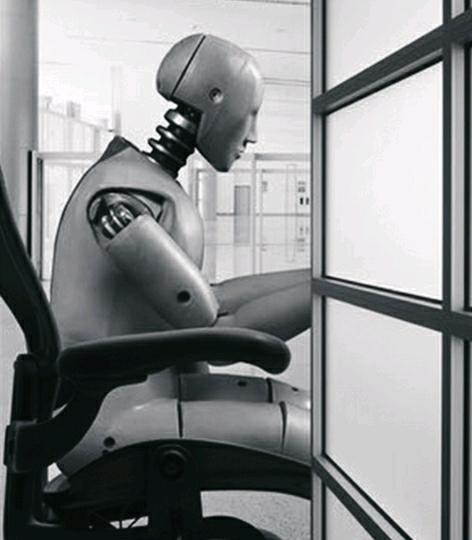
The standard riposte to concerns about automation is to pooh-pooh them.6 This is an old story, sceptics7 contend. Anxiety about the rise of the machines goes back to Elizabeth I and the stocking frame8. And each time the fears have been overblown: the new technology did indeed destroy jobs; but the new industries that it enabled eventually created even more jobs. So calm down: it will come good in the end.
And maybe it will. But theres still a problem. What both the boosters and the sceptics ignore is that waves of automation have always involved periods of traumatic disruption. In a fascinating recent article the economist Tyler Cowen pointed out the problem with blithe9 assumptions about a better future—they miss out on the history of what actually happened in the great industrial transformations of the past. “The shift out of agricultural jobs,” he writes, “while eventually a boon10 for virtually all of humanity, brought significant problems along the way. This time probably wont be different, and thats why we should be concerned.”
Estimates for private per-capita consumption from 1760 to 1831, for example, suggest that it rose only by about 22%. And Cowen cites estimates by the economic historian Gregory Clark that “English real wages may have fallen about 10% from 1770 to 1810, a 40-year period. Clark also estimates that “it took 60 to 70 years of transition, after the onset of industrialisation, for English workers to see sustained real wage gains at all”.
Translate that to the present and you can see the dangers. If the people hitherto known as middle-class were to experience this kind of income suppression, we would expect political trouble. Yet, says Cowen, that may be the track the US is on. Median11 household income is down since 1999, and median male wages were probably higher in 1969 than they are today. His conclusion: transition costs from automation will be higher than many economists—and everyone in the tech industry—like to think.
Then there is the question—also avoided by the tech industry—of who pays those transition costs. Conventional thinking says that the owners of the machines should reap the rewards, while the state picks up the costs of the ensuing human wreckage.12 So when Bill Gates pitched into the debate recently with a proposal that robots should be taxed, just like human workers are, you can imagine the splutters of outrage from the neoliberal fortresses of Silicon Valley.13 “Right now,” he said, “the human worker who does, say,$50,000 worth of work in a factory, that income is taxed and you get income tax, social security tax, all those things. If a robot comes in to do the same thing, youd think that wed tax the robot at a similar level.” And the money raised should be used to retrain people the robots have replaced, with “communities where this has a particularly big impact” first in line for support. I never thought Id write this, but here goes: good for you, Mr Gates.
未來的问题就在于其不可知性,但这当然不会阻止我们去预测未来。当下,许多人——不止技术界人士——都在试图探究自动化对就业的影响:不仅仅是蓝领工作岗位——在汽车生产自动化初期就被淘汰的那类工作——还有迄今为止似乎未被殃及的白领工作岗位。
经济学家发现,由于计算机目前可以替代那些负责日常工作(记账、行政工作以及重复性的生产与监控活动)的低技能工作人员,我们会看到中等技能、中等收入的工作岗位被“掏空”以及“分布在高端与低端技术这两极的工作机会的相应增长”。在2015年的一项研究中,两名牛津大学的研究人员依照美国劳工部分类的标准选取了702个工作类别,并试图估计哪些工作可能更容易受到当下常见的“智能”技术自动化带来的冲击。他们的结论是:接近一半(47%)。
如果这些预测准确的话,那么未来就有麻烦了,因为拥有稳定的中产阶级似乎是一个自由民主国家存在的前提。但由于未来的不可知,我们无法得知高端自动化的威胁会在哪一刻降临。也许这一天的到来还需要相当长的时日,远比技术拥护者以及卡桑德拉式的先知们预计的还要久。但没有人会怀疑这一天的到来。
对于自动化的担忧,通常的对策就是对其嗤之以鼻。这是老生常谈了,怀疑派如此反驳。对于机器崛起的忧虑可以追溯到伊丽莎白一世与织袜机时期。而每次担忧都被过度夸大:新技术确实会让一些工作岗位消失;……