前总统也能过上幸福生活?
2017-07-12ByBarbaraBradley
By+Barbara+Bradley
In 1912, after he lost his bid for reelection, William Howard Taft mused about what the country should do with its expresidents once they leave the White House.1“A dose of chloroform,” he proposed, to protect the nation“from the troublesome fear that the occupant could ever come back.”2 Today, the Twenty-Second Amendment3 limits how often a president may come back. The question concerning Barack Obama4 is not what should be done with him, but rather, what should he do with himself? For most of our history, ex-presidents who were not independently wealthy had to work—not until 1958 did Congress pass a law granting them a pension.5 George Washington6 became the countrys largest whiskey producer. John Quincy Adams won a seat in the House of Representatives and fought slavery.7 And William Howard Taft! Good thing no one took him up on the chloroform.8 Nine years after he left office, he was appointed chief justice of the Supreme Court, a position that the presidential historian Doris Kearns Goodwin says gave him “probably the happiest decade of his life.”9 At 55, Obama will be one of the youngest ex-presidents, and also—a popular one. He is in good health and could easily live for another four decades, which is a long time to be exanything.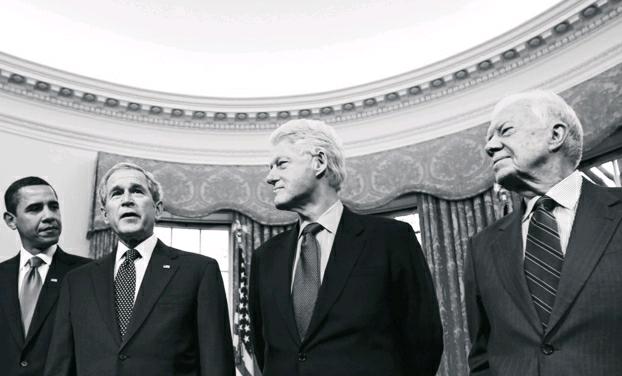
What can he learn from Jimmy Carter, Bill Clinton, and George W. Bush, who likewise walked out of the White House as vigorous middle-aged men?10
The downshift from presidency to post-presidency has bewildered quite a few former White House residents.11 Having lost in a landslide to Ronald Reagan in 1980,12 Jimmy Carter left Washington an unpopular one-term president. When he and Rosalynn returned to Plains, Georgia,13 they found the family peanut business $1 million in debt, and their house in need of repairs. The former first couple spent their first weeks back home hacking away at the overgrowth and making the house habitable.14
The chore was an apt metaphor for Carters predicament as, at age 56, he sought a path forward.15“He said, ‘Look, the actuarial tables16 said Im going to live another 20 to 25 years. I want to stay productive and figure out something else I can do with myself,” says Phil Wise, a vice president at the Carter Center17.
The particulars of a given presidency also come into play, of course.18 Did he feel satisfied with his legacy, or haunted19 by unfinished business? For his part, Carter sought to build on his greatest presidential triumph, the peace accord he brokered between Israel and Egypt at Camp David.20 To that end, he created the Carter Center, an institution from which he could act as a freelance diplomat and launch further global pursuits.21
Bill Clinton began thinking about his post-presidency the day he became president, according to Joe Conason, the author of Man of the World, a biography of Clinton. But nothing prepared him for his first day out of office. Newly resettled in Chappaqua, New York, Clinton ventured to the local deli for a cup of coffee.22 A crowd of reporters surrounded him, demanding to know why, on his last day in office, he had pardoned the fugitive financier Marc Rich.23
“Suddenly, there was no phalanx24 between him and the media and the public,” Conason says. “He felt powerless.” And alone. Hillary Clinton was starting her new job as the junior senator from New York, Conason notes.25 “So he holed up26 in his house, not knowing exactly what to do.” After a few desultory months, the Marc Rich controversy faded, and Clinton ventured back into the spotlight.27
Through the Clinton Foundation, he got sugary drinks out of public schools and funded relief programs after the tsunami of 2004 and Hurricane Katrina in 2005.28 He poured money into hospitals in Africa, particularly in Rwanda. Bill Clinton was also, of course, the first to fully realize the post-presidencys promise as a global moneymaking operation. Since 2001, he has earned some $150 million for speaking and writing books—prompting Michael Duffy to observe:29 “Being president is a good career move.”
If Jimmy Carter and Bill Clinton seemed to cling to the vestiges of the presidency,30 George W. Bush happily shook them off. In a 2010 interview with Texas Monthly, he told that when he woke up in Crawford, Texas, on January 21, 2009, he opened the newspapers and was delighted to realize that the stories inside were no longer his problems: “So I gathered up my two dogs, got in the pickup truck, drove over to my office, and started writing anecdotes for my book.”31
Today, Bush mostly stays close to home, taking part in activities he enjoyed before his political life—barbecues with his neighbors,golfing, riding his mountain bike32. He has occasionally traveled to Africa, where his institute has renovated health clinics and expanded programs to fight cervical cancer.33 “He seems content because he is content,” says Peter Wehner, a former speechwriter for Bush who stays in touch with his former employer.
Indeed, Bush could be the poster child for a happy second act.34 Uninterested in either burnishing his legacy or remaining at the center of the political swirl, he has discovered what midlife researchers suggest is the secret to fulfillment: shifting away from ambition and acquisition and toward activities that have lasting and intrinsic worth, such as investing in important relationships and causes or hobbies that give joy and meaning to ones life.35
On January 21, what can Barack Obama expect? For reasons of temperament and popularity, Obama may be spared the anxieties that dogged some of his predecessors.36 Douglas Brinkley, a presidential historian, says that while the history may have rejected some of Obamas policies, it has not rejected him. He compares Obamas situation to that of Dwight D. Eisenhower, who left office a popular two-term president, even though his intended successor, Vice President Richard Nixon,37 had lost the 1960 election. Barack Obamas response to leaving the White House is perhaps most likely to recall Bushs, friends and observers say. In part, thats because, despite their vastly different politics and personalities, the two men have a similar relationship with the presidency: They dont need it.
Unlike so many politicians before him, Obama did not aspire38 to the presidency early on. For years, points out David Maraniss, who has written biographies of Obama and Clinton, Obama did not settle on a particular career path. Rather, he engaged in a “struggle to figure himself out” as a mixed-race man in America, a struggle that included traveling to Kenya, organizing poor residents on Chicagos South Side,39 and writing a literary memoir. “Hes just an unusual character to be president,” observes Doris Goodwin.“The fact that hes a writer means that he looks at himself from the outside in. Theres a self-awareness and a reflection that is not common among politicians.”
Which isnt to say that Obama is likely to spend the rest of his days bodysurfing40. He will undoubtedly spend some time raising money for his presidential library in Chicago, and writing his presidential memoir, for which he is expected to receive a multimillion-dollar advance.41
But what else?
For several years, Obama has ruminated about his next phase with dinner guests including Steven Spielberg and Reid Hoffman, a co-founder of LinkedIn.42 Before November, the possibilities seemed endless, ranging from addressing racism or criminal-justice reform or gun control or climate change, to buying a basketball team, to teaching law, to joining a tech firm. Advancing the social and environmental issues close to his heart may be harder now—but he may also view the effort as more important.43
Regardless, he will have to manage a challenge more quotidian, but hardly simple—an emptying nest.44“Family is everything to Obama,” David Maraniss says. “His whole young life was a search for home—for a sense of family, place, and identity.” A man who grew into adulthood without a father, he seems to define himself as much by his constancy as a dad as by his political achievements.45 Most nights that he is in Washington, he walks upstairs at 6:30 to dine with his family. When politics at home and war abroad created minute-by-minute upheaval, his family was his anchor.46
Now, in an inevitable cruelty of midlife, his girls say they prefer sleepovers47 with friends to movies with Dad. “They break my heart,” Obama has said. He wore sunglasses to Malias graduation from Sidwell Friends School in June,48 so no one would see him cry. The prospect of losing his girls to adulthood, friends say, saddens him more than leaving the White House.49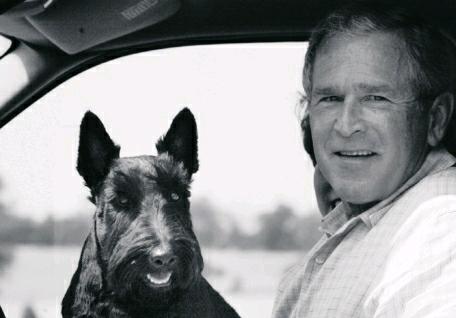
1. bid: 企图,努力;William Howard Taft: 威廉·霍华德·塔夫特(1857—1930),第27任美国总统,卸任后于1921年被任命为美国首席大法官;muse: 沉思,反复思考。
2. 他提议道,“来一剂氯仿吧”,省得人民“总是担心这个人怎么又回来了”。chloroform: 氯仿,常用作麻醉剂;occupant:(工作、职位等的)占有者,占据者。
3. Twenty-Second Amendment: 美国宪法第二十二修正案,于1951年生效,主要规定了美国总统最多只能连任两届,且不能隔一个任期后再次參选。
4. Barack Obama: 贝拉克·奥巴马(1961— ),第44任美国总统,是美国第一位非裔总统。
5. grant: 给予,准予;pension: 养老金,退休金。
6. George Washington: 乔治·华盛顿(1732—1799),美国国父,第一任美国总统。在两任期满后,华盛顿拒绝竞选连任,并回到弗农山庄园,创办了当时美国最大的一家威士忌酒厂。
7. John Quincy Adams: 约翰·昆西·亚当斯(1767—1848),美国第六任总统,他在1828年竞选连任失败后被选为国会众议员,是唯一一位当选美国众议员的卸任总统;House of Representatives: 美国众议院。
8. 谢天谢地,总算没人采纳他那“来一剂氯仿”的建议。take sb. up on sth.: 接受……的建议。
9. 卸任后的第九年,他被任命为美国最高法院的首席大法官。专门研究总统史的历史学家多丽丝·卡恩斯·古德温说,在这个职位上的十年“可能是他人生中最快乐的十年”。chief justice of the Supreme Court: 美国首席大法官。
10. Jimmy Carter: 吉米·卡特(1924— ),美国第39任总统,卸任后在亚特兰大埃默里大学任名誉教授;Bill Clinton: 比尔·克林顿(1946— ),美国第42任总统,克林顿基金会主席;George W. Bush: 乔治·W. 布什(1946— ),美国第43任总统,人称小布什,以区别于其父老布什总统(第41任美国总统);vigorous: 精力充沛的,充满活力的。
11. downshift: 工作降格,改选闲适生活方式;bewilder: 使迷惑,使迷茫;resident: 住户,这里指美国总统。
12. landslide: 一边倒的胜利,(竞选中)一方选票占压倒性多数;