2001~2011年中国东部农村急性心肌梗死住院患者血管紧张素转化酶抑制剂和血管紧张素受体抑制剂的应用及影响因素
2017-05-11关文池霍西茜白雪珂刘佳敏李静郑
关文池+霍西茜+白雪珂+刘佳敏+李静+郑昕+李希+张海波+蒋立新
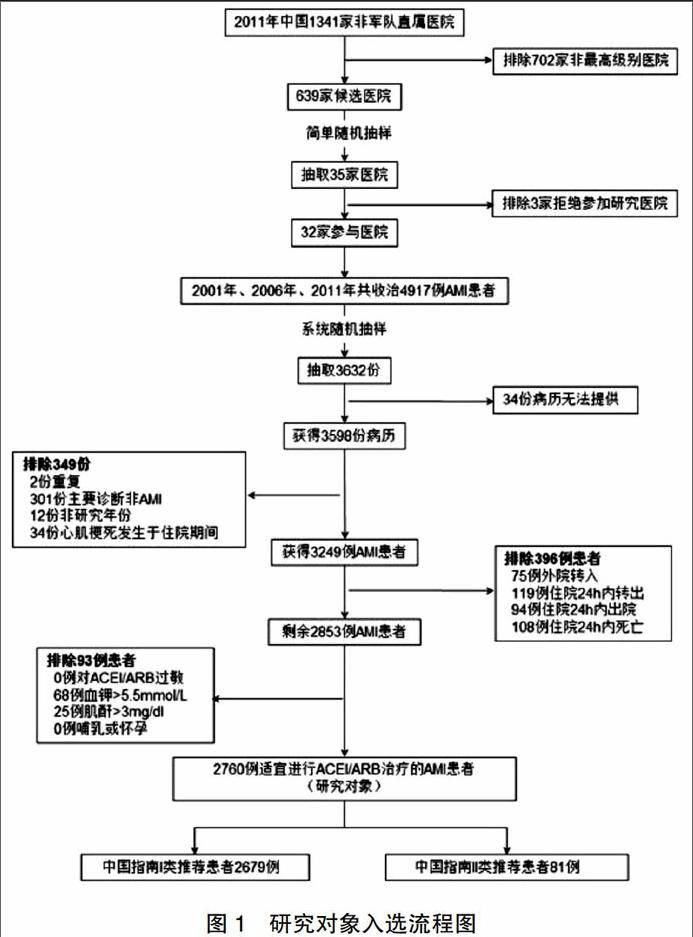


[摘要] 目的 描述中國东部农村急性心肌梗死(AMI)患者血管紧张素转化酶抑制剂(ACEI)和血管紧张素受体阻滞剂(ARB)2001~2011年间的使用趋势,并探讨其影响因素。 方法 采用两阶段随机抽样获得2001、2006、2011年具有东部农村代表性的AMI患者样本。对每年数据相应加权,以评估东部农村整体ACEI/ARB使用率和变化趋势,采用广义估计方程的多水平Logistic回归模型分析影响其使用的因素。 结果 研究共纳入32家医院的2760例AMI病历,其中,中国指南Ⅰ类推荐组2679例,指南Ⅱa类推荐组81例。2001、2006年和2011年,指南Ⅰ类推荐患者ACEI/ARB使用率分别为58.9%,68.3%和70.9%(趋势P值 < 0.01),呈上升趋势;指南Ⅱa类推荐患者为26.0%,53.2%和40.7%(趋势P值> 0.05),随时间无明显改变。多因素分析显示,合并糖尿病(OR=1.42,95%CI 1.13~1.80)、高血压(OR=2.20,95%CI 1.69~2.85)、入院收缩压≥140 mmHg(1 mmHg=0.133 kPa)(OR=1.78,95%CI 1.43~2.22)、左室射血分数≤40%(OR=3.95,95%CI 2.12~7.33)的患者更倾向于使用ACEI/ARB(均P < 0.01);就诊于教学医院的患者ACEI/ARB使用率高于非教学医院就诊的患者(OR=3.82,95%CI 1.56~9.38,P < 0.01)。 结论 过去的十年间,我国东部农村AMI住院患者中,Ⅰ类指征人群ACEI/ARB使用率呈逐年上升趋势,Ⅱa类人群中无明显变化。ACEI/ARB临床应用与指南推荐仍存在差距。应采取措施提高ACEI/ARB使用率,提高医疗服务质量。
[关键词] 急性心肌梗死;血管紧张素转化酶抑制剂;血管紧张素受体阻滞剂;医疗质量
[中图分类号] R543 [文献标识码] A [文章编号] 1673-7210(2017)03(c)-0050-05
ACEI/ARB use in patients hospitalized with acute myocardial infarction in eastern rural China from 2001 to 2011 and its influence factor
GUAN Wenchi HUO Xiqian BAI Xueke LIU Jiamin LI Jing ZHENG Xin LI Xi ZHANG Haibo JIANG Lixin
China Oxford Centre for for International Health Research, State Key Laboratory of Cardiovascular Disease, National Clinical Research Center of Cardiovascular Diseases, Fuwai Hospital, National Center for Cardiovascular Diseases, Chinese Academy of Medical Sciences and Peking Union Medical College, Beijing 102308, China
[Abstract] Objective To evaluate patterns of angiotensin-converting enzyme inhibitors/angiotensin receptor blockers (ACEI/ARB) use in patients with acute myocardial infarction (AMI) in eastern rural China from 2001 to 2011, and identify factors affecting ACEI/ARB use. Methods A representative sample of AMI patients in eastern rural China was created from a two-stage random sampling. Regional weights were applied to estimate the rates and trend of ACEI/ARB use in eastern rural China. Multilevel Logistic regression model with generalized estimating equations was used to identify factors associated with ACEI/ARB use. Results In total, 32 hospitals were sampled and 2760 patients were included, of which 2679 were eligible for Class Ⅰ indication by Chinese guidelines and 81 were eligible for Class Ⅱa indication. In 2001, 2006 and 2011, the use rates of ACEI/ARB for patients with Class Ⅰ indication were 58.9%, 68.3% and 70.9%, respectively (P for trend < 0.01); meanwhile, there was no significant change among those with Class Ⅱa indication (26.0%, 53.2%, and 40.7%, P for trend > 0.05). In Logistic regression, patients with diabetes (OR=1.42, 95%CI 1.13-1.80), hypertension(OR=2.20, 95%CI 1.69-2.85), systolic blood pressure ≥140 mmHg (1 mmHg=0.133 kPa) at admission (OR=1.78, 95%CI 1.43-2.22), and those with an left ventricular ejection fraction ≤40% (OR=3.95, 95%CI 2.12-7.33) were more likely to be treated with ACEI/ARB (all P < 0.01). Those admitted to a teaching hospital had a higher likelihood to be treated with ACEI/ARB compared with those admitted to a non-teaching hospital (OR=3.82, 95%CI 1.56-9.38, P < 0.01). Conclusion During the past decade in eastern rural China, the use of ACEI/ARB has increased among patients with Class Ⅰ indication, but has not changed much for Class Ⅱa indications. Gaps still persists in clinical practice. Initiatives promoting the use of ACEI/ARB should be implemented to improve quality of care.
[Key words] Acute myocardial infarction; Angiotensin-converting enzyme inhibitors; Angiotensin receptor blockers; Quality of care
中国面临着日益沉重的心血管病负担。既往十余年间,中国急性心肌梗死(acute myocardial infarction,AMI)所致死亡翻了一番,2015年农村地区死亡率高达105.37/10万[1],且疾病负担高于城市[2]。既往多项大规模临床试验表明,血管紧张素转换酶抑制剂(angiotensin converting enzyme inhibitors,ACEI)和血管紧张素受体阻滞剂(angiotensin receptor blockers,ARB)可显著降低AMI患者死亡率及主要心血管事件发生率[3-5];中美指南均一致推荐AMI患者应尽早使用[6-11]。该类药物每月约需花费6元人民币[12],且市场供应充足,农村地区使用也并无制约因素。我国东部农村地区人口占全国的1/5,但其AMI患者院内ACEI/ARB治疗情况尚属未知。为此,本……
