城市建设强度与热岛的相关性
2016-11-30韩贵锋蔡智谢雨丝曾卫
韩贵锋 蔡智 谢雨丝 曾卫

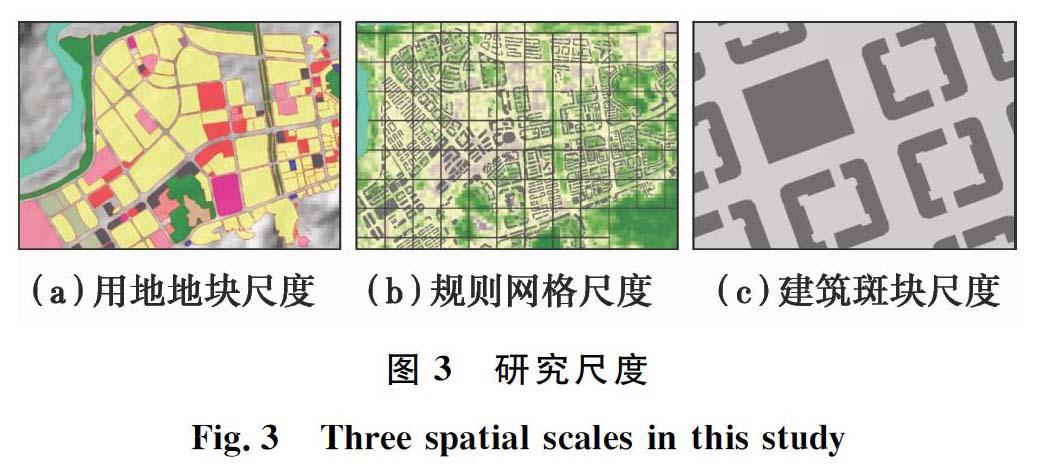
摘 要:城市建设强度是城市热岛形成与演变的主要驱动因素,为了揭示两者之间的量化关系,以重庆市开州区为例,在用地地块、规则网格和建筑斑块3个空间尺度上,使用ArcGIS提取地表温度(LST)与建设强度指标,利用SPSS分析其相关性并构建多元回归模型。结果表明:用地地块尺度上,LST与绿化率、建筑密度和容积率之间均呈现显著的负相关,与建筑底面积和总建筑面积之间均呈现显著的正相关。规则网格尺度序列上,LST与建设强度各指标之间的相关性系数随网格面积的增大而增大,在840 m网格时达到最大值;总体上LST与绿化率之间呈显著的负相关,与建筑密度和容积率之间呈显著的正相关。建筑斑块的尺度上,LST与建筑层数之间有显著的负相关关系,与总建筑面积之间有显著的正相关关系。城市建设强度直接或间接影响了城市热岛的形成与演变,而相关分析发现,建设强度指标并非都与LST之间呈正相关关系,这表明城市热岛除受建设强度的影响外,还受区域气候、城市形态、城市性质、交通方式以及建筑材质与色彩等多种因素的协同影响,是一个非线性的复杂过程。
关键词:城市规划;土地利用;城市热岛;容积率;建筑密度
中图分类号:TU984
文献标志码:A文章编号:1674-4764(2016)05-0138-10
Abstract:Urban construction was an important driving factor result in the urban heat island. In order to reveal the relationships between urban construction and urban heat island, taking Kaizhou District, as an example, land surface temperatures (LST) and urban construction index were extracted using ArcGIS spatial analysis tools, and the relationship between the two was analyzed in SPSS on three spatial scales: land patch, regular grid and building lot. The results showed that LST varied greatly from land use type, and the correlations between LST and urban construction index were different among three scales. On land patch scale, there were significantly negative correlations between LST and greening ratio (GR), floor area ratio (FAR) and building density (BD) respectively and there were significantly positive correlations between LST and building bottom area (BBA) and total construction area (TCA) respectively. On regular grid scales, the correlations between LST and urban construction index increased along with the increase of grid area, and almost all correlation coefficients reached maximum values on the 840-meter grid scale. The LST was negatively correlated with GR and was positively correlated with BD and FAR respectively. Then the multiple regression model was established between LST and BD and GR. On building lot scale, there were significantly positive correlations between LST and BD and FAR respectively. However, there were significantly negative correlations between LST and building floors (BF) and strong positive correlations between LST and TCA. Although, urban construction index had great influence on urban heat island, not all urban construction index were positively correlated with LST. The results implied that urban heat island intensity and its spatial distribute were also affected by other various factors including topography, local climate, urban morphology, designated function of city, urban transportation and building material and color. Furthermore, the impact of various factors on urban heat island may be a nonlinear complicated and dynamic process.
Keywords:urban planning; land use; urban heat island; floor area ratio; building density
中国正处于高速城市化阶段,2014年城镇化率已达到54.77%。随着国家新型城镇化规划的实施,未来几年将有1亿左右的农业转移人口和其他常住人口在城镇落户[1]。城市人口增加和空间扩张是城市化的基本表征。……