CCU护理干预对心脏骤停行心肺复苏患者预后的影响
2016-08-03陆婉晖
陆婉晖
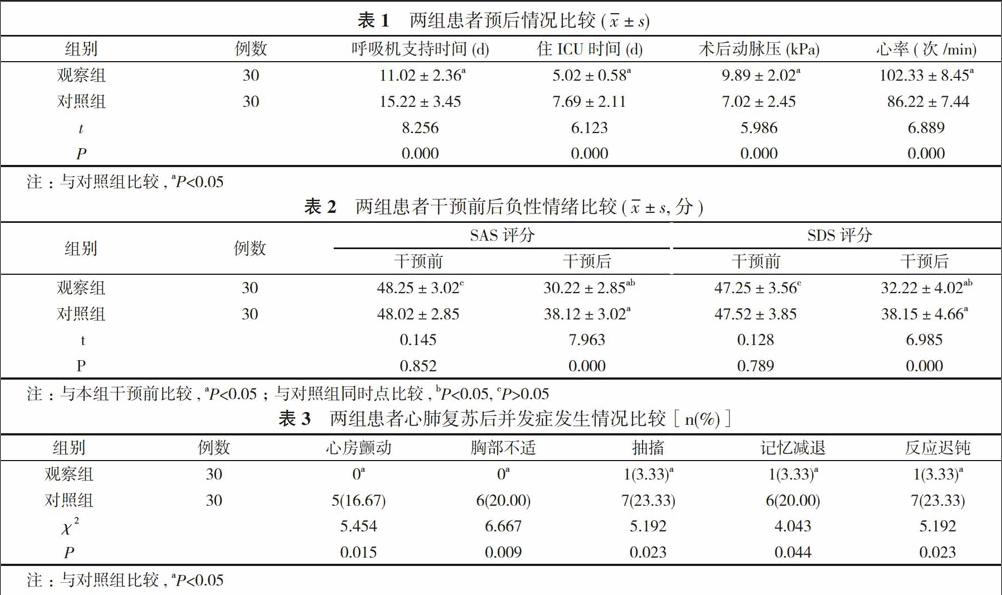
【摘要】 目的 探讨CCU护理干预对心脏骤停行心肺复苏患者预后的影响。方法 60例心脏骤停行心肺复苏患者, 随机分为观察组与对照组, 每组30例。对照组心肺复苏期间行常规性护理, 观察组心肺复苏期间应用急诊护理干预。比较分析两组患者的临床护理效果。结果 观察组术后呼吸机辅助支持时间(11.02±2.36)d、住CCU时间(5.02±0.58)d短于对照组的(15.22±3.45)d、(7.69±2.11)d (P<0.05), 观察组术后动脉压(9.89±2.02)kPa、心率(102.33±8.45)次/min高于对照组的(7.02±2.45)kPa、(86.22±7.44)次/min(P<0.05)。观察组干预后焦虑症状量表(SAS)评分(30.22±2.85)分及抑郁症状量表(SDS)评分(32.22±4.02)分低于对照组(38.12±3.02)分、(38.15±4.66)分(P<0.05)。观察组心房颤动、胸部不适、抽搐、记忆减退、反应迟钝发生率分别为0、0、3.33%、3.33%、3.33%, 均低于对照组的16.67%、20.00%、23.33%、20.00%、23.33%(P<0.05)。结论 CCU护理干预能有效减轻心脏骤停心肺复苏后焦虑、抑郁症状, 改善患者血气指标及心脏功能, 降低心肺复苏过程中并发症, 有利于促进患者预后。
【关键词】 护理干预;心脏骤停;心肺复苏;预后
DOI:10.14163/j.cnki.11-5547/r.2016.18.146
【Abstract】 Objective To investigate influence by CCU nursing intervention on prognosis of sudden cardiac arrest patients receiving cardiopulmonary resuscitation. Methods A total of 60 sudden cardiac arrest patients receiving cardiopulmonary resuscitation were randomly divided into observation group and control group, with 30 cases in each group. The control group received conventional nursing during cardiopulmonary resuscitation, and the observation group received emergency nursing intervention during cardiopulmonary resuscitation. Clinical nursing effects were compared between the two groups. Results The observation group had shorter postoperative ventilator auxiliary support time as (11.02±2.36) d and CCU stay time as (5.02±0.58)d than (15.22±3.45) and (7.69±2.11) d of the control group (P<0.05). The observation group had higher postoperative arterial pressure as (9.89±2.02) kPa, heart rate as (102.33±8.45)times/min than (7.02±2.45)kPa and (86.22±7.44) times/min than the control group (P<0.05). The observation group had lower self-rating anxiety scale (SAS) score after intervention as (30.22±2.85) points and self-rating depression scale (SDS)score as (32.22±4.02) points than (38.12±3.02) and (38.15±4.66) points of the control group (P<0.05). The observation group had incidences of auricular fibrillation, chest discomfort, convulsion, hypomnesia and slow in reacting respectively as 0, 0, 3.33%, 3.33%, 3.33%, which were all lower than 16.67%, 20.00%, 23.33%, 20.00%, 23.33% of the control group (P<0.05). Conclusion CCU nursing intervention can effectively reduce anxiety and depression after cardiopulmonary resuscitation for sudden cardiac arrest. This method is helpful to accelerate prognosis by improving blood gas indexes, cardiac function and reducing complications during cardiopulmonary resuscitation.
【Key words】 Nursing intervention; Sudden cardiac arrest; Cardiopulmonary resuscitation; Prognosis
心肺复苏是心脏骤停患者最常用的急救方法, 对心脏骤停患者及时有效进行心肺复苏对挽救患者生命非常重要[1]。然而, 目前急诊救治工作特点是病种多样、情况紧急、病情多样化、不稳定因素较多, 因此患容易出现各种并发症, 患者死亡率及致残率较高[2]。在复苏过程中对患者进行积极的处理及护理干预可降低患者并发症, 促使患者顺利康复, 并能有效改善患者心肌功能[3]。护理干预是指对患者救治过程中而进行的一系列心理及生理干预措施[4]。本文探讨CCU护理干预对心脏骤停行心肺复苏患者预后的影响, 现报告如下。
1 资料与方法
1. 1 一般资料 选取本院急诊科2010年1月~2015年12月收治的60例行心肺复苏的心脏骤停患者为研究对象, 纳入标准:①年龄≥18岁;②均符合心脏骤停诊断标准;③患者或其家属均签署知情同意书。排除标准:①入ICU时距离心源性心脏骤停时间>24 h;②患有癫痫、精神障碍者;③患有脑血管意外及严重颅脑外伤者;④存在明显凝血功能障碍及血管大出血者。根据随机数字表将患者分为观察组与对照组, 每组30例。……