围手术期综合血液管理在心脏手术中的应用
2016-07-22陈振航蒋密邵孟平
陈振航+蒋密+邵孟平
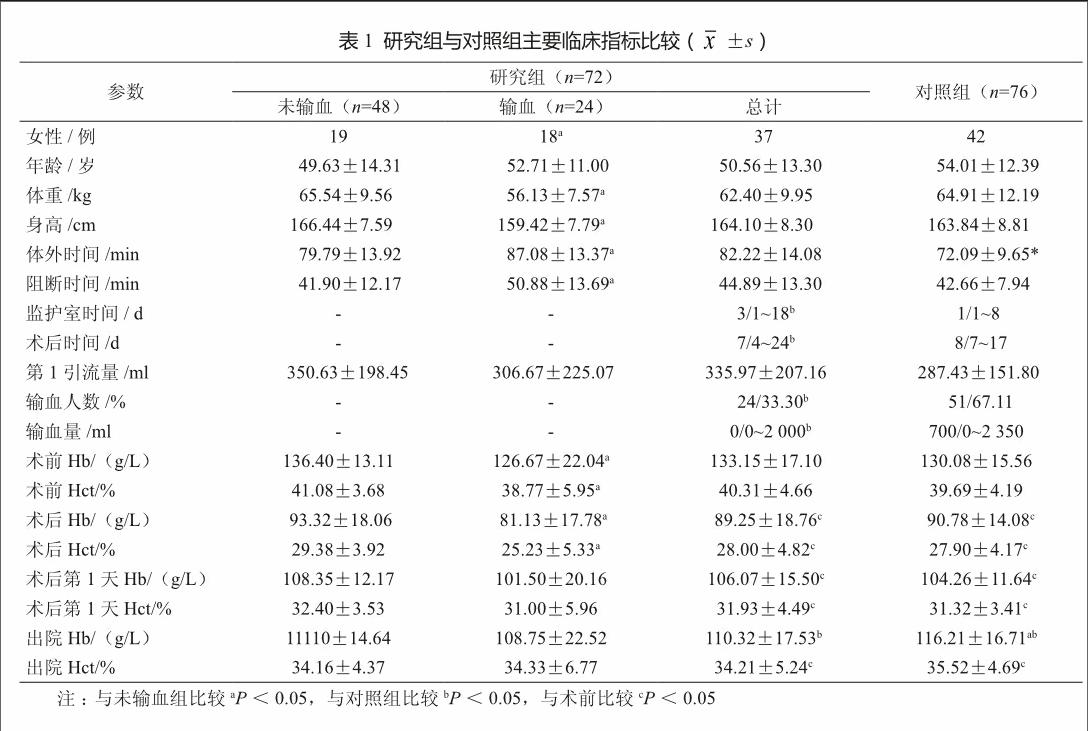
摘 要 目的:探讨应用围手术期综合血液管理方法降低心脏手术中输血量的可行性和效果。方法:收集中山医院2015年9月—2016年3月接受心脏手术患者148例,分为对照组76例,采取常规管理;研究组72例(未输血48例,输血24例),采用围手术期综合血液管理。比较两组的主要临床指标,并采用多因素回归法分析影响输血的危险因素。结果:两组均无死亡病例。研究组输血率为33.33%,平均输血量327.08 ml;对照组输血率为67.11%,平均输血量608.55 ml;两组患者输血率差异有统计学意义(P<0.05)。未输血组和输血组患者的性别、年龄、身高、体重、术前血红蛋白和血球压积、术后血红蛋白和血球压积差异均有统计学意义(P<0.05)。多因素回归分析显示体重为输血的独立危险因素(P<0.05)。结论:围手术期综合血液管理方法能有效降低心脏手术输血量。
关键词 输血 心脏手术 血液保护 血液管理
中图分类号:R457.1 文献标志码:A 文章编号:1006-1533(2016)12-0016-03
Application of integrated perioperative blood management in cardiac surgery
CHEN Zhenhang1, JIANG Mi2, SHAO Mengping1
(1. Department of Cardiac Surgery, Zhongshan Hospital affiliated to Fudan University, Shanghai 200032, China; 2. Department of Blood Transfusion, Zhongshan Hospital affiliated to Fudan University, Shanghai 200032, China)
ABSTRACT Objective: To investigate the effect and feasibility of integrated perioperative blood management in cardiac surgery to reduce the amount of blood transfusion. Methods: A total of 148 patients, who underwent cardiac surgery in Zhongshan Hospital from September 2015 to March 2016, were enrolled and divided into two groups. The control group with 76 patients underwent routine procedure management, while the study group with 72 patients underwent integrated operative blood management. In the study grouop, 24 patients received blood transfusion and 42 patients didnt. The major clinical indicators were compared between the two groups. And multi-factor regression was used to analyze the risk factors impacting on blood transfusion. Results: No perioperative death was found in both groups. The blood transfusion rate and average amount of blood transfusion was 33.3% and 327.08 ml in the study group, respectively. Meanwhile the blood transfusion rate and average amount of blood transfusion was 67.11% and 608.55 ml in the control group. There were significant differences between two groups(P<0.05).The factors such as sex, age, body height and weight, preoperative hemoglobin and hematocrit, postoperative hemoglobin and hematocrit were significantly different in non-transfusion patients and transfusion patients(P<0.05). Multi-factor logistic regression analysis suggested that the body weight was the independent risk factor related to blood transfusion(P<0.05). Conclusion: The application of integrated perioperative blood management is a beneficial approach in reducing the amount of blood transfusion.
KEY WORDS blood transfusion; cardiac surgery; blood conservation; blood management
随着我国心脏手术数量与难度的不断增加,临床用血需求量日益提高。由于血液供应经常不能满足临床需求,迫使心脏外科团队寻找能减少临床用血量的综合管理方法。本文探讨应用围手术期综合血液管理方法降低临床用血的效果。
1 资料与方法
1.1 一般资料
收集2015年9月—2016年3月在复旦大学附属中山医院心脏外科接受体外循环心脏手术患者148例,排除术前显著贫血[血红蛋白(Hb)<105 g/L]、凝血功能障碍、肝肾功能不全、再次手术或大血管手术者。将148例患者分为综合血液管理组(简称研究组)72例和常规组(简称对照组)76例。研究组中男性35例,女性37例,年龄17~79岁,平均50.56岁;接受瓣膜修复或置换术49例,先天性心脏病矫治术17例,心脏肿瘤切除术5例,冠状动脉旁路术1例。对照组中,男性34例,女性42例,平均年龄54.01岁;接受瓣膜修复或置换术61例,先天性心脏病矫治术12例,冠状动脉旁路术3例。……