脑卒中后抑郁患病率的调查及其临床特征分析
2016-03-07阮莎莎马涛戴文卓
阮莎莎 马涛 戴文卓
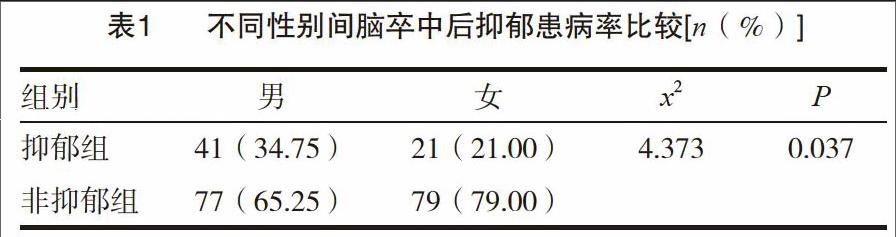
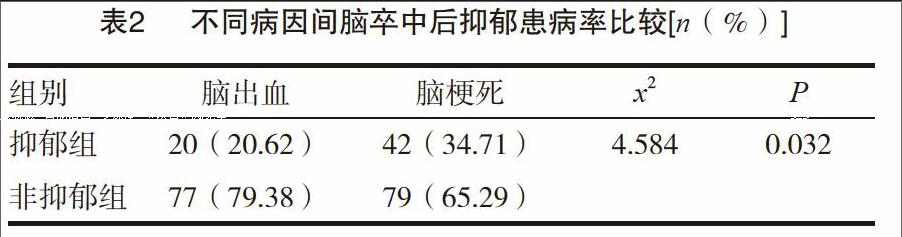
[摘要] 目的 调查脑卒中后抑郁的患病率并进一步分析其临床特性。方法 收集本地区2013年5月~2015年5月住院治疗急性脑卒中患者218例,对其临床资料进行回顾性分析,经两名精神专科医生依照ICD-10为诊断标准,筛查出满足抑郁症诊断标准的患者62例,设为抑郁组,其余156例无抑郁症状的患者设为非抑郁组,运用SPSS20.0对数据进行统计分析,研究本地区脑卒中后抑郁的发病率、年龄分布、比较男女发病率、及不同原因导致卒中后抑郁的发生率等。结果 本地区脑卒中后抑郁的患病率为28.44%,年龄58~77岁,平均(65.4±9.4)岁,高于脑卒中后非抑郁的患者(t=4.888,P<0.001)。男性脑卒中后抑郁的患病率为34.75%,女性脑卒中后抑郁的患病率为21.00%,男性的患病率高于女性(x2=4.373,P=0.037)。脑出血患者脑卒中后抑郁的患病率为20.62%,脑梗死患者脑卒中后抑郁的患病率为34.71%,脑梗死患者的患病率高于脑出血患者(x2=4.584,P=0.032)。结论 本地区脑卒中后抑郁的患病率为28.44%,高龄、男性和脑梗死可能是脑卒中后抑郁的危险因素。
[关键词] 脑卒中后抑郁;患病率;临床特征
[中图分类号] R743.3 [文献标识码] B [文章编号] 2095-0616(2015)24-182-03
[Abstract] Objective To investigate the prevalence of post-stroke depression, and to further analyze the clinical characteristic of which. Methods To select 218 patients with acute stroke, who were hospitalization in our hospital from May 2013 to May 2015, to retrospective analyze the clinical data. Through the two psychiatric special doctors according to the diagnostic criteria of ICD-10, 62 patients who were satisfied of the diagnostic criteria of depression were screened out as the depression group, and the other 156 patients without depressive symptoms were selected as non-depression group. Through the statistical analysis on the data by SPSS20.0, to study the incidence and the age distribution post-stroke depression in this area, to compare the incidence between boys and girls, and the incidence of post-stroke depression caused by different reasons, and so on. Results The incidence post-stroke depression in this area was 28.44% with the age distribution of 58 to 77(65.4±9.4) years, which in depression group was obviously higher than which in non-depression group(t=4.888, P<0.001). The incidence post-stroke depression of male(34.75%) was higher than which of female(21.00%)(x2=4.373,P=0.037). The incidence post-stroke depression in patients with cerebral infarction(34.71%) was higher than which in patients with cerebral hemorrhage(20.62%)(x2=4.584,P=0.032). Conclusion The incidence post-stroke depression in this area is 28.44%. The venerable age, male, and cerebral infarction could be the risk factors of post-stroke depression.
[Key words] Post-stroke depression; Incidence; Clinical characteristic
脑卒中患者所伴发的各种精神障碍不仅给原发病治疗的和护理带来难度,同时给患者本人的功能康复也造成了诸多不利的影响[1]。脑卒中后抑郁(post-troke depression,PSD)是脑卒中后一种比较常见精神疾病,国外有研究发现,大约有1/3的脑卒中患者,将在患病后的不同时期患上PSD[2-3]。关于脑卒中后抑郁患病率的调查及症状特点的分析,国内报道的不是很多。本研究收集整理近两年来218例住院的脑卒中患者,来调查本地区脑卒中后抑郁的患病率及其症状特点。
1 资料与方法
1.1 一般资料endprint
本研究纳入2013年5月~2015年5月在神经内科首次住院的急性脑卒中患者218例,其中男118例,女100例;年龄43~77岁,平均(61.4±8.8)岁;脑梗死121例,脑出血97例,所有患者既往均无精神疾病史和精神疾病家族史。218例急性脑卒中患者中符合抑郁症诊断标准的有62例,将其列为脑卒中后抑郁组,剩余的156例无抑郁症状的患者列为脑卒中后非抑郁组。……