校园垃圾和园林废弃物堆腐物作为花卉栽培基质可行性研究
2015-10-21李世好蒋云霞温林川杨博闻张军
李世好 蒋云霞 温林川 杨博闻 张军

摘要
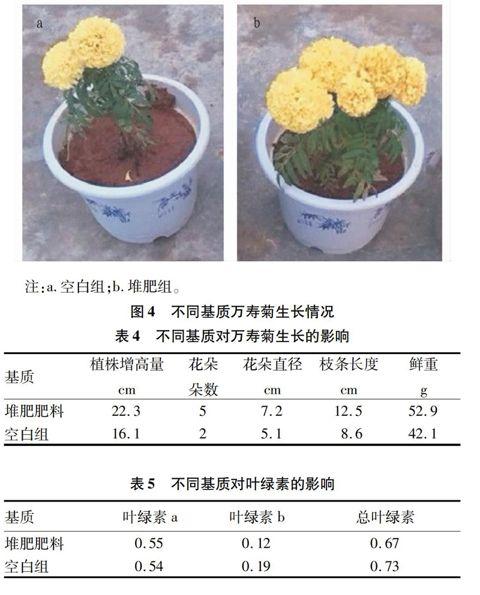
[目的]研究校园垃圾和园林废弃物堆腐物作为花卉栽培基质的可行性。[方法]应用50 L仓式高温好氧堆肥装置,以桂林理工大学的校园垃圾和园林废弃物为原料,采取氧气-温度联合反馈连续通风的控制方式进行堆肥,并测定堆肥前后堆料的含水率、VS、TP、TN和pH。并将堆肥腐熟产品和土壤按m∶m=1∶4混匀作为花卉栽培基质与原土壤(空白组)进行盆栽对比试验。[结果]通风量为80、72、48、60、72和60 L/h,氧气含量控制值为10%时,堆肥效果较好;添加堆肥产品的万寿菊各项生长指标优于空白组,且生物量增加了20.4%。[结论]校园垃圾和园林废弃物堆腐物作为花卉栽培基质具有较好的可行性和广阔的应用前景。
关键词 校园垃圾;园林废弃物;堆肥;花卉栽培基质;可行性
中图分类号 S181.3 文献标识码 A 文章编号 0517-6611(2015)03-273-04
Feasibility Study for Compostable Refuse of Campus Garbage and Garden Waste as Flower Substrate
LI Shihao1,2, JIANG Yunxia1,2, WEN Linchuan1,2, ZHANG Jun1,2* et al
(1. College of Environmental Science and Technology, Guilin University of Engineering, Guilin, Guangxi 541004; 2. Guangxi Key Laboratory of Environmental Pollution Control Theory and Technology, Guilin, Guangxi 541004)
Abstract [Objective] The research aimed to study feasibility for compostable refuse of campus garbage and garden waste as flower substrate. [Method] The experiment used campus garbage and garden waste of Guilin University of Technology as raw materials for composting with 50 L of warehouse thermophilic aerobic composting reactors under autocontrol continuous ventilation system, and moisture content, VS, TP, TN and pH for composting product before and after compost were determined. Potted plant experiments were run with the mixture composting products and soil (m∶m=1∶4) as flower substrate, and the blank experiment with native soil as the substrate. [Result] Composting quality was better when aeration volume was 80, 72, 48, 60, 72 and 60 L/h, and oxygen content was 10%. Growth indexes of marigold which was added with composting products were all better than blank group, and the biomass of marigold increased by 20.4%. [Conclusion] Compostable refuse of campus garbage and garden waste as flower substrate had good feasibility and wide application prospect.
Key words Campus garbage; Garden waste; Composting; Flower substrate; Feasibility
基金項目 国家自然科学基金项目(41161075);广西“八桂学者”建设工程专项;广西自然科学基金项目(2013GXNSFEA053002,2014GXNSFBA118210)。
作者简介
李世好(1991-),男,安徽马鞍山人,硕士研究生,研究方向:固体废弃物资源化。*通讯作者,讲师,博士,从事有机固体废弃物资源化利用研究。
收稿日期 20141205
大学校园垃圾产生量大,对环境危害比较严重。垃圾中有机物所占比例很大,填埋处理不仅费用高也未实现资源的回收利用,而堆肥作为垃圾减量和资源化的一个重要手段,目前已在很多校园中应用推广。校园垃圾具有“种类多、价值高和产量大”的特点,是一种潜在资源。2012 年我国普通高等学校在校学生人数超过3 000万人,按照人均垃圾产量0.5 kg/d计算[1],校园垃圾产量每天约为1.5万t,而且其中可利用成分含量较高,可回收类物质为15%左右,可堆肥类物质为80%左右[2]。……