高龄患者心脏永久起搏器植入术的临床效果评价
2015-08-29武凌宁
武凌宁
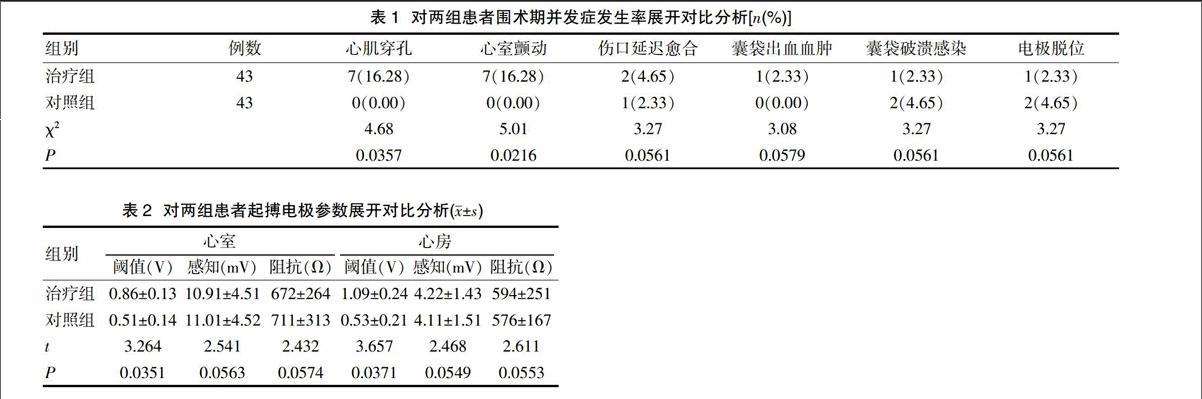
[摘要] 目的 对高龄患者心脏永久起搏器植入术的临床效果展开研究分析。方法 整群选取86例2013年1月—2015年1月间在该院通过心脏永久起搏器植入术治疗患者为研究对象,按照年龄分为治疗组和对照组,均为43例,对比治疗效果。结果 两组患者心肌穿孔并发症发生率、心室颤动并发症发生率相比,差异有统计学意义(P<0.05);治疗组患者心室起搏阈值和心房起搏阈值同对照组患者之间具有一定差异性,差异有统计学意义(P<0.05)。结论 心脏永久起搏器植入术在治疗高龄患者临床上效果较为理想,但在患者围术期应有效预防心室颤动和心肌穿孔等。
[关键词] 高龄患者;心脏永久起搏器植入术;临床效果
[中图分类号] R54 [文献标识码] A [文章编号] 1674-0742(2015)05(a)-0052-02
To Evaluate the Clinical Effect of Elderly Patients with Permanent Cardiac Pacemaker Implantation
WU Ling-ning
Daye Non-Ferrous Metals Co of Daye General Hospital Department of Cardiology,Huangshi,Hubei Province,435005 China
[Abstract] Objective The clinical effects in elderly patients with permanent cardiac pacemaker implantation expand research and analysis. Methods 86 patients with permanent cardiac pacemaker implantation by patients, according to age into treatment group and control group were 43 cases, compared to the therapeutic effect. Results Between ventricular pacing in patients treated atrial pacing thresholds and thresholds with two groups of patients in the control group of patients the incidence of complications of myocardial perforation, ventricular fibrillation incidence of complications, the difference was statistically significant (P<0.05) have some differences, the difference was statistically significant (P<0.05). Conclusion Permanent cardiac pacemaker implantation in the treatment of elderly patients with clinical effect is more ideal, but in patients with perioperative period should be effective in preventing ventricular fibrillation and cardiac perforation.
[Key words] Elderly patients; Permanent cardiac pacemaker implantation; Clinical effect
随着老龄化的到来,老年疾病发生率逐渐增加,缓慢型心律失常疾病发病率也逐渐上升,威胁患者健康和生命。心脏永久起搏器植入术为治疗缓慢型心律失常的有效方法,在一定程度上改善患者临床症状,改善患者预后[1]。同中青年患者相比,高龄患者机体功能和器官功能均显著衰退,且多数高龄患者合并其疾病,使得术后出现多种并发症,影响患者临床治疗效果[2]。为进一步了解高龄患者心脏永久起搏器植入术的临床效果展开研究分析,该研究整群选取2013年1月—2015年1月间该院收治的86例通过心脏永久起搏器植入术治疗患者为研究对象,现报道如下。
1 资料与方法
1.1 一般资料
整群选取该院86例通过心脏永久起搏器植入术治疗患者,其中,治疗组43例,患者年龄为80~92岁(86.35±3.58)岁;男30例,女13例;29例为病态窦房结综合征,10例为房室传导阻滞,4例并存病态窦房结综合征和房室传导阻滞;分析患者起搏器类型:6例为VVI,37例为DDD;对照组43例,患者年龄为41~79岁(60.28±10.05)岁;男31例,女12例;28例为病态窦房结综合征,11例为房室传导阻滞,4例并存病态窦房结综合征和房室传导阻滞;……