剖宫产产妇产后焦虑症的危险因素分析
2023-08-24李利平游意莹穆合塔尔·米尔扎提朱丹周少丽王艳玲
李利平?游意莹?穆合塔尔·米尔扎提?朱丹?周少丽?王艳玲
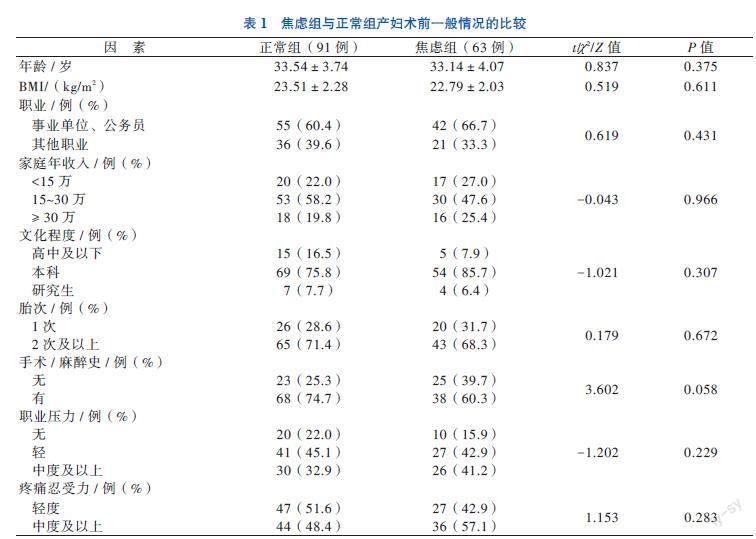
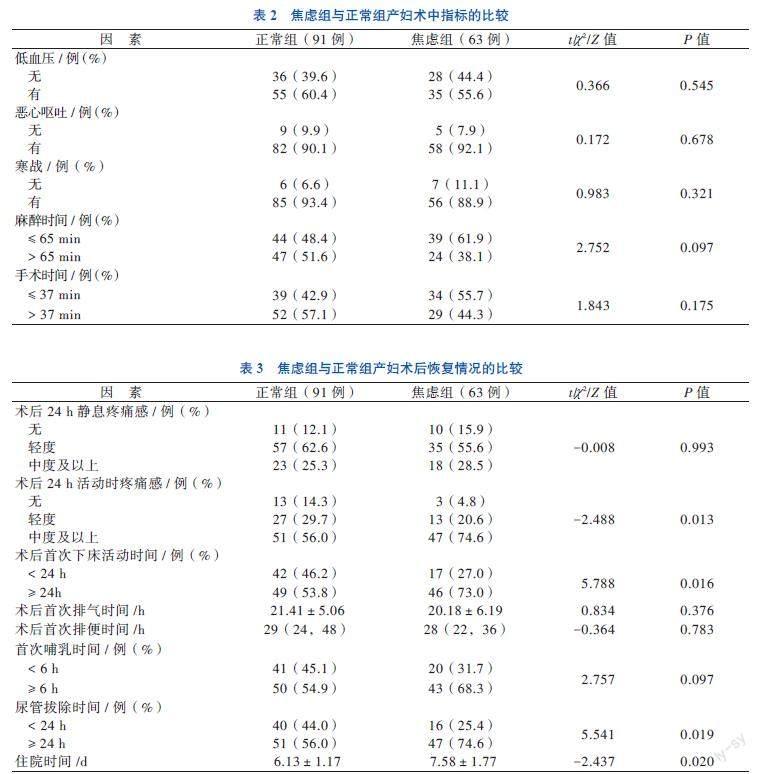
【摘要】目的 探討全面实施一对夫妇可生育2个孩子政策出台后,剖宫产产妇产后焦虑症的危险因素。方法 选取行择期剖宫产手术的154例产妇作为研究对象,于术前1日、术后第2日、术后6周收集其临床资料,于术前1日和术后6周对产妇进行焦虑自评量表(SAS)及爱丁堡产后抑郁量表(EPDS)评估。根据术后6周的SAS评分将产妇分为焦虑组和正常组,对2组的相关资料进行统计,分析焦虑症的危险因素。结果 产妇术后24 h的活动疼痛、术后首次下床时间、拔除尿管时间、住院日数、产妇对产后恢复期(月子期)总体不满意与产后焦虑症相关,差异有统计学意义(P均< 0.05)。多因素Logistic回归分析表明,月子期总体不满意(OR=7.741,95%CI:3.612~16.591,P < 0.001)是剖宫产产妇产后6周焦虑症的独立危险因素。结论 剖宫产产妇产后6周焦虑症的发病率较高,提高产妇月子期的满意度,可降低产后焦虑症的发生率。
【关键词】剖宫产;产后焦虑症;产后恢复期满意度;危险因素
Analysis of risk factors of postpartum anxiety in women undergoing cesarean section Li Liping, You Yiying, Muhetaer·Mierzhati, Zhu Dan, Zhou Shaoli, Wang Yanling. Department of Anesthesiology, the Third Affiliated Hospital of Sun Yat-sen University, Guangzhou 510630, China
Corresponding author, Wang Yanling, E-mail: wyl-5120@163.com
【Abstract】Objective To explore the incidence and risk factors of postpartum anxiety in women undergoing cesarean section after comprehensive implementation of the second child policy. Methods A total of 154 women undergoing elective cesarean section were selected. Maternal clinical data were collected at preoperative 1 d, postoperative 2 d and 6 weeks. Self-Rating Anxiety Scale (SAS) and Edinburgh Postpartum Depression Scale (EPDS) were investigated at preoperative 1 d and postoperative 6 weeks. All parturients were divided into the anxiety group and normal group according to the SAS score at postoperative 6 weeks. Univariate and multivariate Logistic regression analyses were used to explore the risk factors of postpartum anxiety. Results The activity pain at postoperative 24 h,
the time of first offbed activity after operation, the time of catheter removal, the length of hospital stay, maternal total dissatisfaction with postpartum recuperation period (doing the month) were significantly associated with postpartum anxiety (all P < 0.05). Multivariable logistic regression analysis showed that the total dissatisfaction with postpartum recuperation period (doing the month) (OR=7.741, 95%CI: 3.612-16.591, P < 0.001) was an independent risk factor for postpartum anxiety at 6 weeks after cesarean section. Conclusions The incidence of postpartum anxiety at postoperative 6 weeks is high in women undergoing cesarean section. Increasing maternal satisfaction with postpartum recuperation period can reduce the incidence of postpartum anxiety.
【Key words】Cesarean section; Postpartum anxiety; Maternal satisfaction during the postpartum recuperation period;
Risk factor
在怀孕及产后恢复期间,焦虑症是导致孕产妇和胎儿不良结局的已知风险因素,正确合理面对产妇围产期焦虑症对产妇、家庭及社会来说都是巨大的挑战[1]。研究表明,产妇孕期焦虑会增加围产期及产后长期并发症的发病率,产前焦虑会增加产妇对分娩的恐惧,进而增加对剖宫产的倾向性;产时焦虑可增加早产率和剖宫产率风险;围产期焦虑是产后抑郁的风险因素之一,产后焦虑症如果发展为产后抑郁症,则可能导致母亲对婴儿关注度不够、婴儿发育不良等严重后果[1-5]。
近年来,工作和经济压力的增加导致年轻人的生育意愿急剧下降,使得人口增长率始终低于预期。全面实施一对夫妇可生育2个孩子政策针对的是2015年10月以后可以生育二孩的9 000万名女性,据估计,目标女性中约有60%超过了35岁,50%超过了40岁[6]。……
