Resource utilization of agricultural solid waste
2021-12-07LIZhao-jun
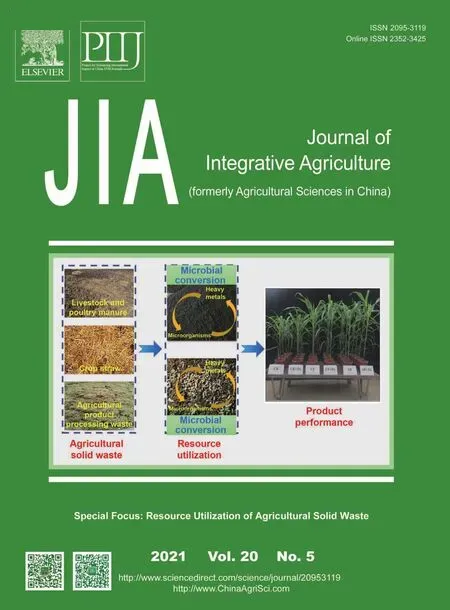
China,one of the world’s largest agricultural countries,inevitably generates a massive amount of agricultural solid waste (ASW) every year.As it is estimated,China annually produced 3.8 billion,900 million and 200 million tons of livestock and poultry manure,crop straw,and agricultural product processing waste,respectively (Conget al.2020).As an important renewable resource,ASW has great potential and value for resource utilization.Efficient utilization of ASW is not only beneficial to environmental protection,but also provides great economic benefits.Since the beginning of the 21st century,research has been fruitful on how to utilize livestock and poultry manure by microbial conversion (Chenet al.2019;Fenget al.2020).However,we have not yet fully understood the changes in microbial diversity and its interaction with different heavy metals during the microbial conversion process of crop straw and agricultural product processing waste.In addition,insectbased bioconversion (i.e.,by earthworms,black soldier flies,etc.) is an emerging and high-value method for ASW treatment.However,more research is needed to identify the factors influencing the insect-based bioconversion process,investigate the role of microorganisms,and explore the conversion mechanisms in which ASW is converted into multiple valuable commodities by insects,such as proteins,biofuels,fertilizers,etc.Therefore,in this special focus of‘Resource utilization of agricultural solid waste’,five papers,respectively contributed by Changet al.(2021),Cuiet al.(2021),Liuet al.(2021),Wanget al.(2021) and Zhanget al.(2021),showcase the latest research progress on ASW utilization.Changet al.(2021) report the dynamics of microbial diversity during crop straw composting.Cuiet al.(2021) demonstrate that the addition of phosphate rock in swine manure and maize straw composting could reduce the bioavailability of heavy metals by influencing the bacterial communities.Liuet al.(2021) evaluate the feasibility to employ stevia residue in eco-friendly fermentation ofTrichoderma guizhouense.Wanget al.(2021) investigate the changes in speciation,mobility and bioavailability of different heavy metals during the conversion process of pig manure by black soldier flies.Zhanget al.(2021) summarize the functional characteristics of microorganisms,influencing factors (such as larval density,manure temperature,type of manure and so on),and possible mechanisms during the conversion processes of livestock and poultry manure by black soldier fly larvae.It is hoped that the studies presented in this special focus could enhance our basic and applied knowledge in the field of resource utilization of ASW,and stimulate further innovative research in this area.
杂志排行
Journal of Integrative Agriculture的其它文章
- Errata regarding previously published articles
- Ultrastructural studies of seed coat and cotyledon during rapeseed maturation
- Can harvest outsourcing services reduce field harvest losses of rice in China?
- The river chief system and agricultural non-point source water pollution control in China
- An improved scheme for infectious bursal disease virus genotype classification based on both genome-segments A and B
- Exploring the genetic features and signatures of selection in South China indigenous pigs