Agricultural and environmental challenges in agroecosystems
2021-11-28XiaoyuanYAN,XuZHAO,DebJAISI
Feeding the increasing global population,preventing environmental degradation,and protecting the planet from climate change are the three most significant challenges facing agriculture and its sustainability.Agricultural practices determine the safety of agricultural products and are integral to the status of the global environment.In China,the Green Revolution has drastically increased the productivity of agriculture,similar to the trend in the Western world.However,the excess use of chemical fertilizers,herbicides,and pesticides has deteriorated the soil quality,resulting in serious agricultural and environmental problems.The severity of these issues has attracted public and media attention.The key challenge for China is to grow food for feeding a population of 1.3 billion while simultaneously decreasing the negative environmental impacts of agricultural production.In response to tremendous efforts by the government,scientific community,and stockholders in the past decade to address this challenge,current progress has made China an ideal place for discussing agro-environmental issues.
To raise awareness of the agro-environmental issues associated with food production at the international level,the International Symposium on Agriculture and the Environment was initiated in 1998 at the University of Agriculture,Faisalabad,Pakistan.It had hitherto been successfully held,every other year for 10 times in Turkey,Egypt,Italy,Netherlands,Mexico,Brazil,and USA.The past 10 symposia provided unique opportunities for thousands of scientists worldwide from universities,research institutes,government agencies,and regulatory bodies to exchange their visions and research outcomes on global and regional agro-environmental issues and ways to address them.The 11th International Symposium on Agriculture and the Environment(AgroEnviron 2018)was held in Nanjing,China(http://agr-env-2018.csp.escience.cn/dct/page/65540).The theme of AgroEnviron 2018 is“Agricultural Science Innovation Coping with Environment Changes”.For this,193 oral and poster presentations were completed by scientists from 10 countries,with a total of 420 agro-environmental enthusiasts from 80 universities and research institutes.
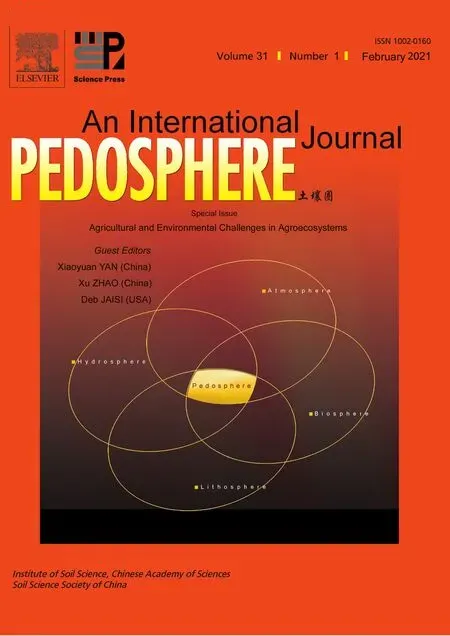
This special issue encompasses the holistic aspects of science and innovations in the agro-environment presented in the symposium.It covers a wide range of research topics,including the three pillars of plant nutrition-carbon(C),nitrogen(N),and phosphorus(P)cycling,agricultural waste management,and the remediation of contaminated soils.In a letter to the Editor about their research on soil C,N,and P cycling,Zhang et al.analyzed the global patterns of P transformation in relation to latitude,temperature,and precipitation in natural ecosystems of inland and coastal waters on the continental shelf.The study of Zhao Y et al.provided a promising outlook for mediating C cycling and sequestration under proper N management via enhancing the interactions between plants and soils under elevated CO2.The characteristics of humic acid were proposed as an indicator of the long-term sustainability of a crop management practice by Zhao N et al.Other studies investigated the effects of various agronomic practices(Jiang et al.),such as fertilizer reduction(Chen et al.,Ji et al.,and Yuan et al.)and the replacement of fertilizer with periphytic biofilm(Cai et al.and Zhao Y H et al.),on the cycling and availability of soil N and P.In an effort to quantify the environmental risks of excessive fertilization in agriculture,Wang C Y et al.used pedotransfer functions(PTFs)to predict ammonia nitrogen(-N)adsorption in irrigation districts at the regional scale.A novel diffusive gradients in thin films(DGT)technique was applied to investigate the in-situ distributions of labile P and iron(Fe)at submillimeter and millimeter spatial resolutions(Wang Y et al.).Furthermore,soil particle size distribution was studied using the laser diffraction method and was found to have a strong influence on soil physical and biological properties(Qiu et al.).
Rapid urbanization and industrialization and the application of agrochemicals have led to contamination of agricultural soils with heavy metals and toxic organic compounds.In an invited review,Ma et al.summarized the recent progress on molecular mechanisms of the accumulation of cadmium(Cd),a highly toxic heavy metal for all organisms,in cereal crops,and proposed molecular strategies for minimizing Cd accumulation in grains.Based on reviewing of the mechanisms of Cd sorption/desorption at the mineral/water interface analyzed using X-ray absorption fine structure(XAFS)spectroscopy and complementary techniques(e.g.,113Cd nuclear magnetic resonance(NMR)and molecular dynamics simulation),Mo et al.in their invited review further suggested methods for reducing Cd transfer from soils to crop grains.Emerging contaminants,such as polychlorinated organic compounds(PCOCs),have become an environmental problem with their high toxicity and persistence.Liu C Yet al.showed that the combination of urea and humic substance could provide a feasible strategy for the remediation of organochlorine pollutants in soils rich in iron oxides.Radionuclide fallout during nuclear accidents could contaminate farmland soils,surface water,and groundwater and eventually reach crop plants.In a study by Liu W Xet al.,the vertical migrations of cesium(137Cs)and cobalt(60Co)in soil were scrutinized,and the factors influencing their migration depths were highlighted.
In the area of agricultural waste management,Wang X Bet al.reviewed the literature on iron and steel slags,common silicon(Si)and P fertilizers,and soil amendment,highlighted the environmental impacts of contaminants present in these wastes,and provided a risk assessment of environmental safety for the use(disposal)of the iron and steel slags in farmlands.Meanwhile,considering soil-borne diseases in agricultural ecosystems that are linked with economic and food security issues,Ouet al.in a letter to the Editor highlighted the potential for establishing a synthetic microbial community to addressFusariumwilt disease.
We would like to express our sincere thanks to all participants around the globe for sharing their scientific outcomes and fruitful discussion during the symposium and the Soil Science Society of China(SSSC)for offering their full support in organizing the symposium.Financial supports from the State Key Laboratory of Soil and Sustainable Agriculture,China,the Key Laboratory of Soil Environment and Pollution Remediation,Institute of Soil Science,Chinese Academy of Sciences,and the Soil Science Society of Jiangsu Province,China are gratefully acknowledged.
杂志排行
Pedosphere的其它文章
- Notes to Authors
- In Commemoration of Professor Tianren YU’s 100th Anniversary
- Microbial diversity assembled from series-diluted suspensions of diseasesuppressive soil determines pathogen invasion resistance
- Global patterns of phosphorus transformation in relation to latitude,temperature and precipitation
- Chemical and spectroscopic characteristics of humic acid from a clay loam soil in Ontario after 52 years of consistent fertilization and crop rotation
- Interactive effects of elevated CO2 and nitrogen fertilization levels on photosynthesized carbon allocation in a temperate spring wheat and soil system