青光安颗粒剂含药血清对RGC5细胞损伤模型线粒体自噬及相关蛋白的影响
2021-11-21刘倩宏陈立浩时健朱冰瑶曾令聪姚小磊
刘倩宏 陈立浩 时健 朱冰瑶 曾令聪 姚小磊
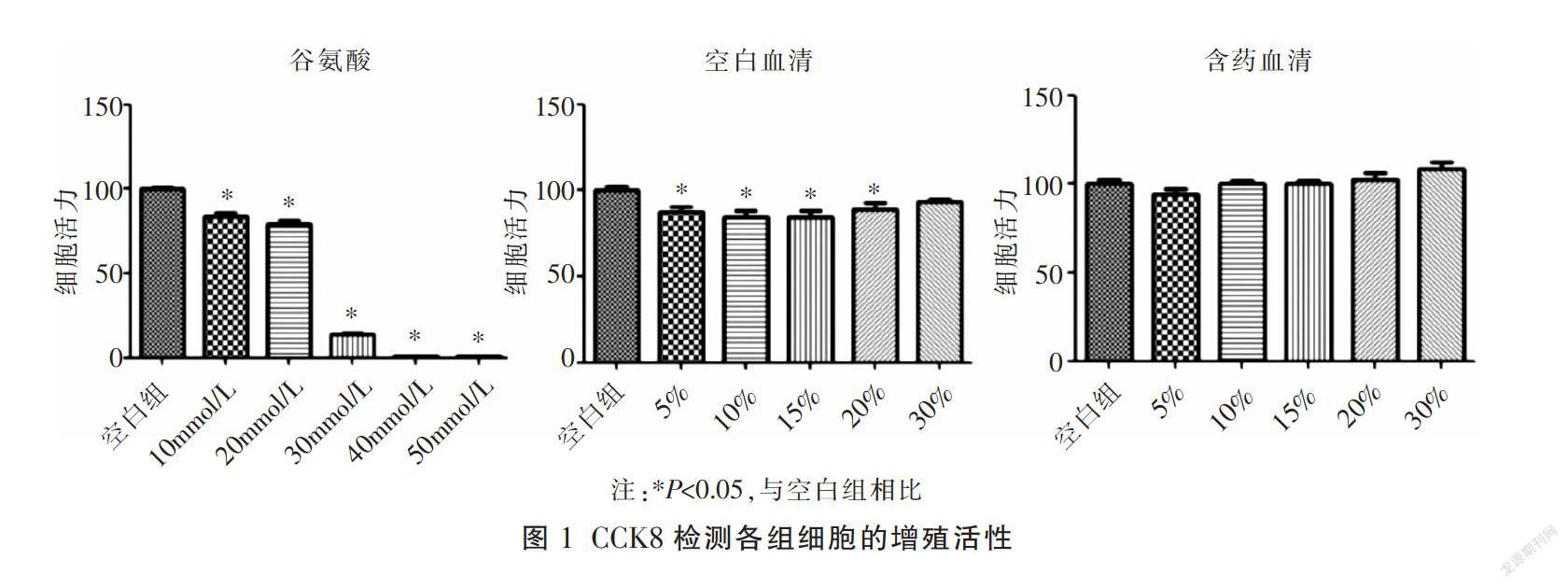
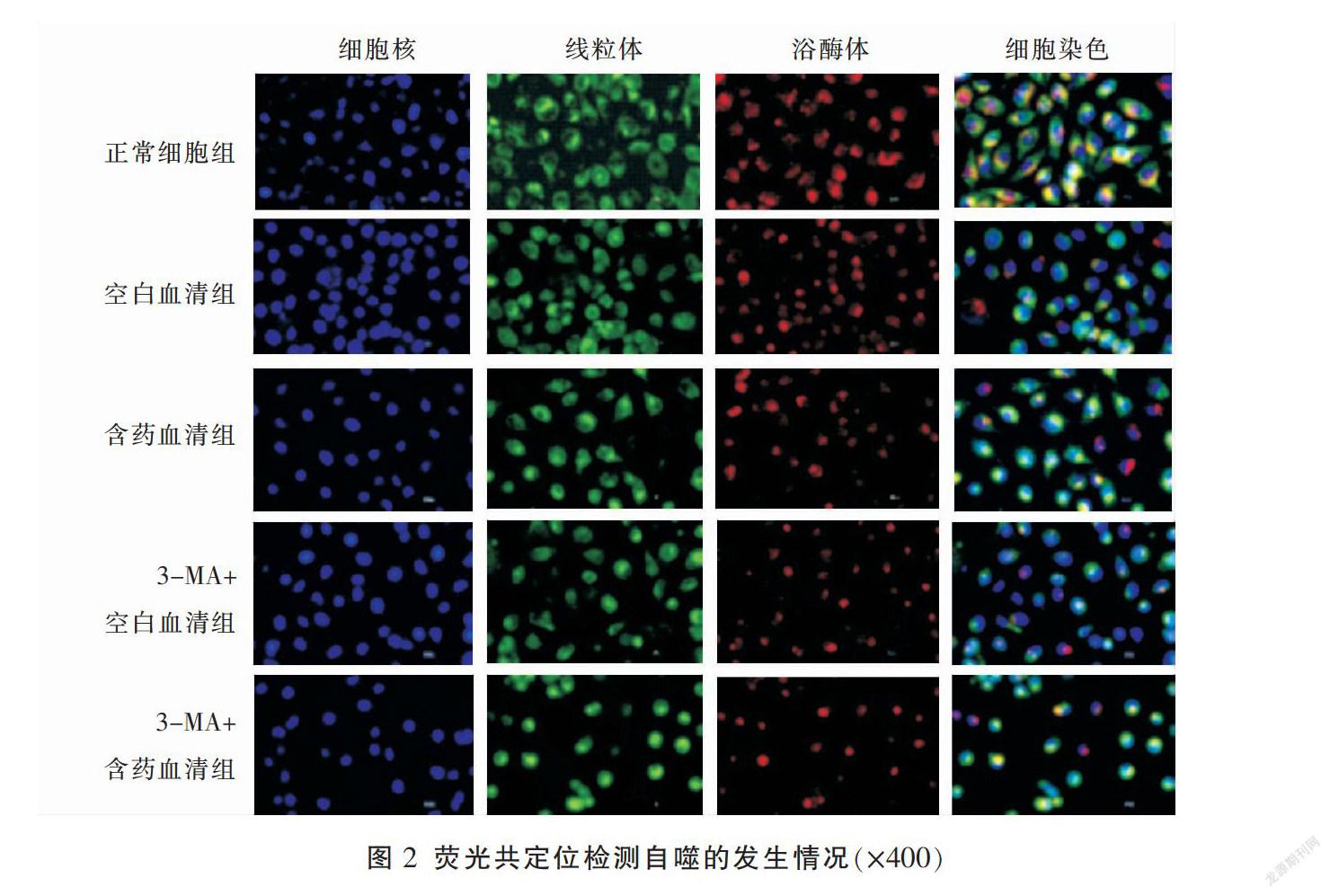
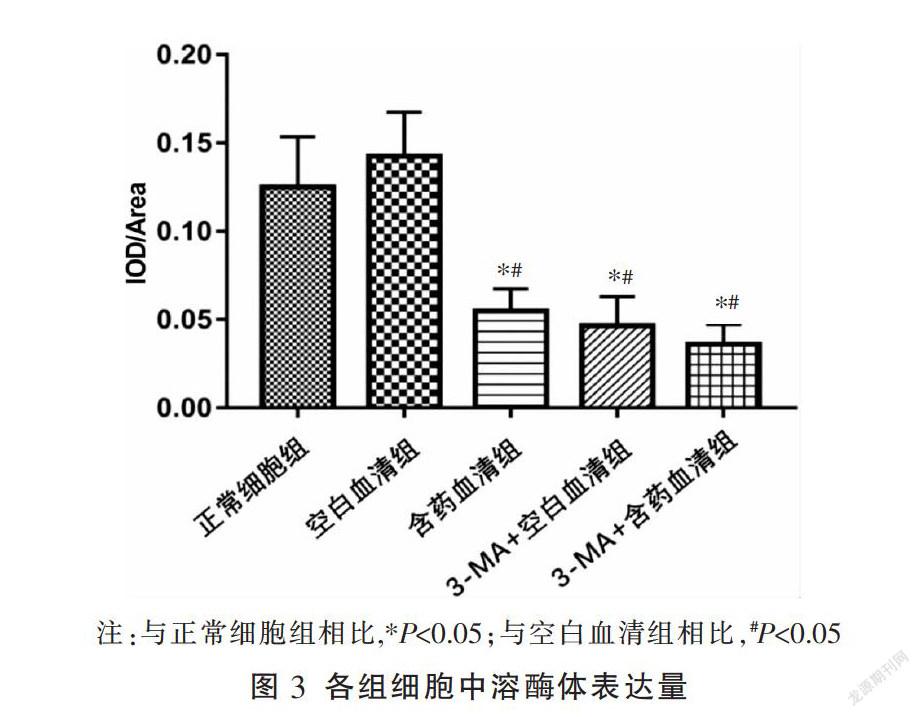
〔摘要〕 目的 觀察青光安颗粒剂含药血清对视网膜神经节细胞-5(retinal ganglion cells-5, RGC-5)损伤模型中线粒体自噬和相关蛋白的影响。方法 将14只大鼠随机分为空白对照组(3只)和青光安组(11只)。青光安组灌胃青光安颗粒剂,空白对照组灌胃同等剂量的生理盐水,1次/d,灌胃7 d,第7天灌胃后提取含药血清和空白血清。培养RGC-5细胞,用谷氨酸毒性模拟青光眼所造成的神经细胞损伤,CCK8法筛选合适的含药血清和谷氨酸浓度。细胞分组为正常细胞组、空白血清组(谷氨酸+空白血清)、含药血清组(谷氨酸+含药血清)、3-甲基腺嘌呤(3-methyladenine, 3-MA)+空白血清组(谷氨酸+3-MA+空白血清)、3-MA+含药血清组(谷氨酸+3-MA+含药血清组)。细胞培养24 h后,荧光共定位检测线粒体自噬发生情况;Western blot检测微管相关蛋白轻链3(microtubule associated protein light chain 3, LC3)中LC3-Ⅱ/LC3-I、溶酶体相关膜蛋白1(lysosome associated membrane protein1, LAMP1)蛋白的表达。结果 通过CCK8结果筛选,确定谷氨酸最佳的作用浓度为20 mmol/L,空白血清和含药血清的作用浓度均为20%。与空白血清组相比,含药血清组、3-MA+空白血清组和3-MA+含药血清组的溶酶体含量显著降低(P<0.05)。与空白血清组相比,含药血清组、3-MA+空白血清组和3-MA+含药血清组中LAMP1和LC3-Ⅱ/LC3-I蛋白表达水平均显著降低(P<0.05);与3-MA+空白血清组相比,3-MA+含药血清组中LAMP1和LC3-Ⅱ/LC3-I蛋白表达水平水平显著降低(P<0.05)。结论 青光安颗粒剂含药血清对青光眼损伤的保护作用可能通过抑制细胞的线粒体自噬,调控LAMP1和LC3-Ⅱ/LC3-I蛋白的表达,从而起到对RGCs的保护作用。
〔关键词〕 青光眼;视网膜神经节细胞;青光安颗粒剂;谷氨酸;3-甲基腺嘌呤;微管相关蛋白轻链3;溶酶体相关膜蛋白1
〔中图分类号〕R285.5 〔文献标志码〕A 〔文章编号〕doi:10.3969/j.issn.1674-070X.2021.10.008
Effects of Serum Containing Qingguangan Granule on Mitochondrial Autophagy and Related Proteins in RGC5 Cell Injury Model
LIU Qianhong1,2, CHEN Lihao1,2, SHI Jian1,2, ZHU Bingyao1,2, ZENG Lingcong1,2, YAO Xiaolei1,2,3*
(1. Hunan University of Chinese Medicine, Changsha, Hunan 410208, China; 2. Key Laboratory of Hunan Province for Prevention and Treatment of Eye, Ear, Nose and Throat Diseases with Traditional Chinese Medicine, Changsha, Hunan 410208, China; 3. The First Affiliated Hospital of Hunan University of Chinese Medicine, Changsha, Hunan 410007, China)
〔Abstract〕 Objective To observe the effect of serum containing Qingguangan Granule on mitochondrial autophagy and related proteins in retinal ganglion cells-5 (RGC-5) injury model. Methods 14 rats were randomly divided into blank control group (n=3) and Qingguang'an group (n=11). Qingguang'an group was given Qingguang'an Granule by intragastric administration, and the blank control group was given the same dose of normal saline once a day for 7 days. The drug-containing serum and blank serum were extracted after 7 days of intragastric administration. RGC-5 cells were cultivated, and glutamate toxicity was used to simulate nerve cell damage caused by glaucoma, CCK8 method was used to screen appropriate drug-containing serum and glutamate concentration. Cells were grouped into: normal cell group, blank serum group (glutamate + blank serum), drug-containing serum group (glutamate + drug-containing serum), 3-methyladenine (3-MA) + blank serum group (glutamate + 3-MA + blank serum), 3-MA + drug-containing serum group (glutamic acid + 3-MA + drug-containing serum). After the cells were cultured for 24 hours, fluorescence colocalization was used to detect the occurrence of mitochondrial autophagy; the expression levels of LC3-II/LC3-I and lysosome associated membrane protein 1 (LAMP1) in microtubule associated protein light chain 3 (LC3) were detected by Western blot. Results Through the screening of CCK8 results, it was determined that the optimal concentration of glutamic acid was 20 mmol/L, and the concentration of blank serum and drug-containing serum were both 20%. Compared with the blank serum group, the lysosome content of the drug-containing serum group, the 3-MA + blank serum group and the 3-MA + drug-containing serum group were significantly reduced (P<0.05). Compared with the blank serum group, the LAMP1 and LC3-II/LC3-I protein expression levels in the drug-containing serum group, 3-MA + blank serum group and 3-MA + drug-containing serum group were significantly reduced (P<0.05). Compared with the 3-MA + blank serum group, the LAMP1 and LC3-II/LC3-I protein expression levels in the 3-MA + drug-containing serum group were significantly lower (P<0.05). Conclusion The protective effect of serum containing Qingguangan Granule on glaucoma injury may be through inhibiting cell mitochondrial autophagy and regulating the expression of LAMP1 and LC3-II/LC3-I, thereby playing a protective effect on RGCs.
〔Keywords〕 glaucoma; retinal ganglion cells; Qingguangan; glutamate; 3-methyladenine; microtubule associated protein light chain 3; lysosome associated membrane protein 1
青光眼为累计视神经及视觉功能的一组疾病,是目前一种不可逆性致盲眼病,其中,中老年患者占据多数,且发病率逐年增高[1]。视网膜神经节细胞(retinal ganglion cells,RGCs)在青光眼的治疗与防控中起到重要作用,研究[2]表明,青光眼中多种危险因素均可启动多种凋亡相关通路,如死亡受体、内质网凋亡、线粒体凋亡通路,触发核酸内切酶活化,导致RGCs的凋亡,从而造成不可逆性损伤。……
