基于wNSA-Gauss-Seidel的Massive MIMO软输出信号检测算法研究
2021-11-17王涛
王涛
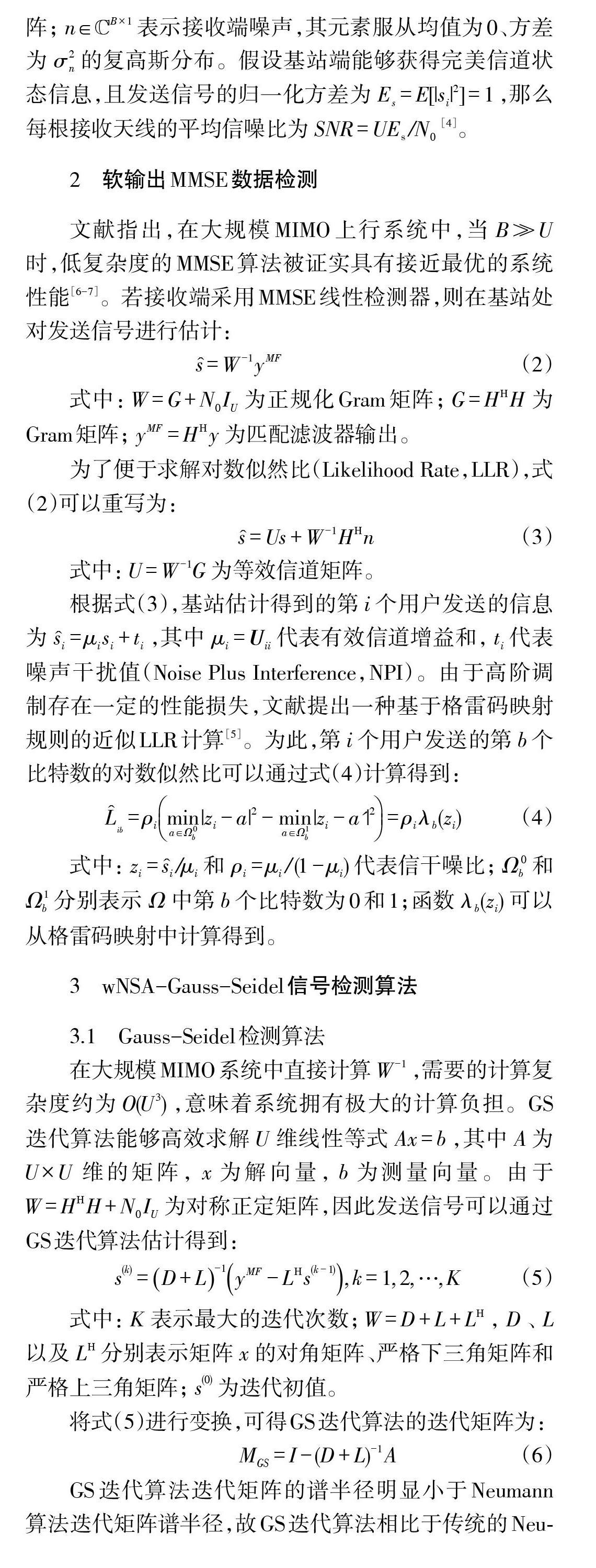
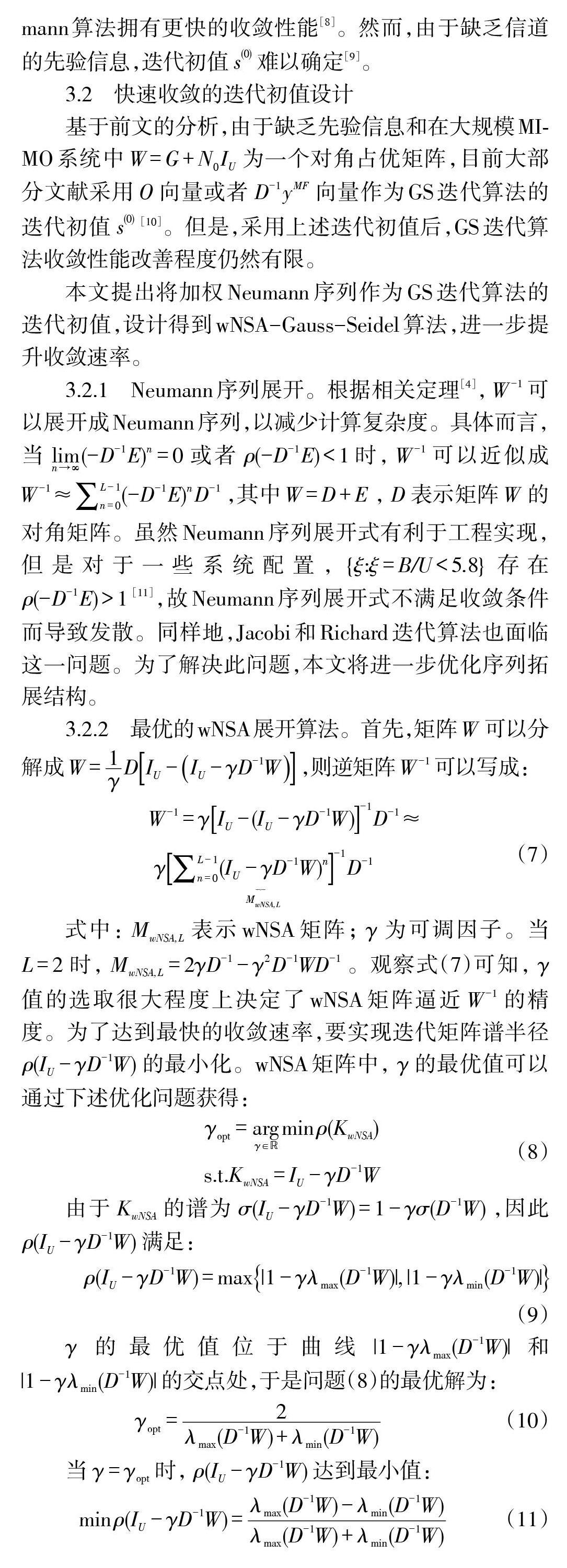
摘 要:基于高斯-赛德(Gauss-Seidel,GS)和加权Neumann序列展开式(weight Neumann Series Approximation,wNSA)相结合的方法,在大规模多输入多输出(Multiple-Input Multiple-Output,MIMO)系统中进行信号检测研究。首先,将基于GS的软输出信号检测算法作为研究对象,证实相比于传统的Neumann算法,GS迭代算法具有更优的性能。其次,在传统Neumann序列展开算法的基础上研究加权Neumann序列展开算法,并将加权Neumann序列作为GS算法的迭代初值,设计得到wNSA-Gauss-Seidel算法,显著提升收敛速率。实验结果表明,相比于现有GS迭代算法和美国国家安全局(National Security Agency,NSA)的信号检测算法,基于wNSA-Gauss-Seidel的信号检测算法不仅在性能方面具有明显优势,而且在具有挑战性的信道传播环境中能够以较低的复杂度获得接近最小均方误差(Minimum Mean Square Error,MMSE)信号检测算法的性能。
关键词:大规模多输入多输出(MIMO)系统;高斯-赛德(GS);Neumann序列;信号检测
中图分类号:TN929.5文献标识码:A文章编号:1003-5168(2021)17-0008-05
Research on Massive MIMO Soft Output Signal Detection
Algorithm Based on wNSA-Gauss-Seidel
WANG Tao
(Shenzhen Electrical Appliances Co.,Shenzhen Guangdong 518001)
Abstract: Based on the method of combining GS and wNSA, the signal detection research is carried out in the massive MIMO system. First of all, the soft output signal detection algorithm based on GS is taken as the research object, which proves that compared with the traditional Neumann algorithm, the GS iterative algorithm has better performance. Secondly, based on the traditional Neumann sequence expansion algorithm, the weighted Neumann sequence expansion algorithm is studied, and the weighted Neumann sequence is used as the initial value of the iteration of the GS algorithm, and the wNSA-Gauss-Seidel algorithm is designed to significantly improve the convergence rate. The experimental results show that, compared with the existing GS iterative algorithm and NSA signal detection algorithm, the signal detection algorithm based on wNSA-Gauss-Seidel not only has obvious advantages in performance, but also can obtain performance close to the MMSE signal detection algorithm with lower complexity in a challenging channel propagation environment.
Keywords: massive Multiple-Input Multiple-Output(MIMO) system;Gauss Seidel(GS);Neumann sequence;signal detection
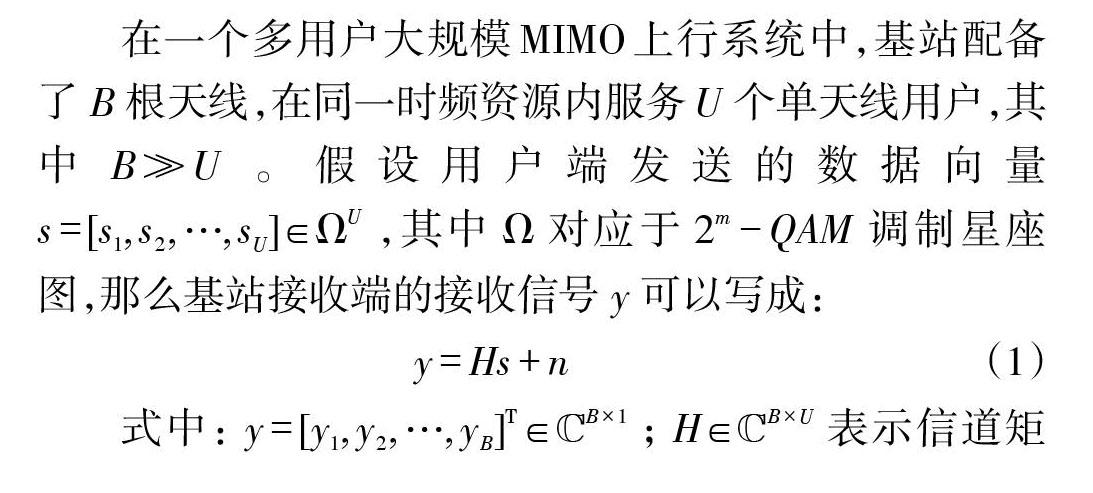
大规模多输入多输出(Multiple-Input Multiple-Output,MIMO)系统能够提供更大的系统容量、更高的频谱效率以及更加可靠的链路稳定性,是5G/B5G無线通信系统的关键技术之一[1]。相比于传统的MIMO技术在无线链路的发端和收端仅支持2~8根天线,大规模MIMO系统基站配备了成百上千根天线,能够同时同频服务几十个单天线用户[2]。然而,随着基站天线和用户数量的急剧增加,大规模MIMO信号检测在计算复杂度和硬件实现等方面面临严峻挑战。
在MIMO系统中,最优的信号检测问题实际上可以归结为非确定性多项式(Nondeterministic Polynomially,NP)问题。因此,现有的信号检测算法设计主要解决这一问题,如最大似然(Maximum Likelihood,ML)准则、最大后验概率(Maximum A Posteriori,MAP)准则等。……