轴向矫正甲缘成形术与Bilhaut-Cloquet融合术矫治Wassel Ⅰ、Ⅱ型多指畸形疗效比较
2021-11-03曾冬莲刘俊
曾冬莲 刘俊
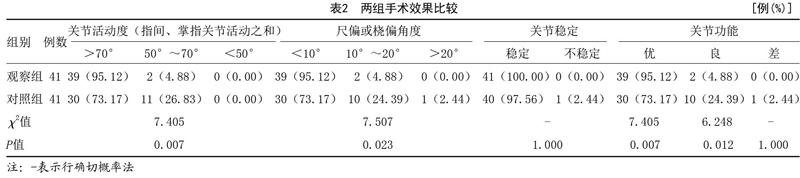
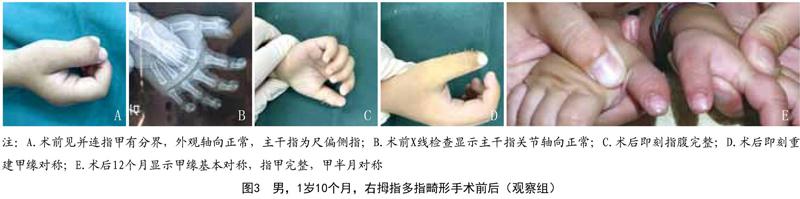

[摘要]目的:探討轴向矫正甲缘成形术与Bilhaut-Cloquet融合术治疗多指畸形WasselⅠ、Ⅱ型对美观度、关节功能的影响。方法:选取2017年1月-2018年12月笔者医院收治的82例多指畸形WasselⅠ、Ⅱ型患儿,分为两组,各41例。观察组采用轴向矫正甲缘成形术,对照组采用Bilhaut-Cloquet融合术。比较两组手术效果、手术一般情况(手术时间、术中出血量、住院时间、术后伤口愈合时间)、解剖学参数(患侧指甲宽度与健侧差值、指间关节主动屈曲、指间关节主动伸直受限、掌指关节主动屈曲、掌指关节主动伸直受限)、应激反应[C反应蛋白(C-reactive protein,CRP)、皮质醇(Cortisol,Cor)、丙二醛(Malondialdehyde,MDA)、总超氧化物歧化酶(Total superoxide dismutase,T-SOD)]、美观度及并发症情况。结果:术后1.5年观察组关节活动度、尺偏或桡偏角度分布优于对照组,关节功能优患儿占比高于对照组,差异有统计学意义(P<0.05)。观察组术中出血量低于对照组,差异有统计学意义(P<0.05)。术后1.5年观察组患侧指甲宽度与健侧差值低于对照组,指间关节主动屈曲、掌指关节主动屈曲高于对照组,差异有统计学意义(P<0.05)。观察组术后1d、3d CRP、Cor、MDA低于对照组,T-SOD高于对照组,差异有统计学意义(P<0.05)。术后1.5年观察组甲体外形、表面粗糙程度、甲宽度患侧与健侧的比值、主观满意度优于对照组,差异有统计学意义(P<0.05)。观察组瘢痕挛缩率低于对照组,差异有统计学意义(P<0.05)。结论:与Bilhaut-Cloquet融合术相比,轴向矫正甲缘成形术能有效提高多指畸形WasselⅠ、Ⅱ型患儿关节功能恢复效果,减少术中出血量,改善解剖学参数,减轻应激反应,提高美观度,降低并发症发生风险。
[关键词]轴向矫正甲缘成形术;Bilhaut-Cloquet融合术;多指畸形;WasselⅠ、Ⅱ型;美观度;应激反应
[中图分类号]R682.1+5 [文献标志码]A [文章编号]1008-6455(2021)09-0058-05
Comparison of Axial Correction of Nail Border Plasty and Bilhaut-Cloquet Fusion in the Treatment of Wassel Type Ⅰ and Ⅱ of Polydactyly
ZENG Dong-lian,LIU Jun
(Department of Hand and Foot Microsurgery,the First People's Hospital of Chenzhou City,Chenzhou 423000,Hunan,China)
Abstract: Objective To investigate the effect of axial correction of nail border plasty and Bilhaut-Cloquet fusion in the treatment of Wassel type Ⅰ and Ⅱ of polydactyly on the degree of aesthetic and joint function. Methods From January 2017 to December 2018, 82 children with Wassel type Ⅰ and Ⅱ of polydactyly were selected from our hospital and divided into two groups, with 41 cases in each group. The observation group was treated with axial correction of nail border plasty, while the control group was treated with Bilhaut-Cloquet fusion. The surgical effects and general conditions (operation time, intraoperative blood loss, hospital stay, postoperative wound healing time), anatomical parameters (the difference between the width of the affected side nail and the healthy side, limited active flexion of the interphalangeal joint and active extension of the interphalangeal joint, limited active flexion of metacarpophalangeal joint and active extension of metacarpophalangeal joint), stress response [C-reactive protein (CRP), cortisol (Cor), malondialdehyde (MDA), total superoxide dismutase (T-SOD)], degree of aesthetic, and complications were compared between the two groups. Results The distribution of joint range of motion, ulnar deviation or radial deviation angle in the observation group was better than the control group at 1.5 years after operation, and the proportion of children with excellent joint function was higher than that in the control group, the differences were statistically significant (P<0.05). The intraoperative blood loss in the observation group was lower than that in the control group (P<0.05). 1.5 years after the operation, the difference between the width of the affected side and the healthy side of the observation group was lower than that of the control group, and the active flexion of the interphalangeal joint and the active flexion of the metacarpophalangeal joint were higher than those of the control group (P<0.05). CRP, Cor and MDA in the observation group were lower than those in the control group at 1 and 3 days after operation, and T-SOD was higher than in the control group (P<0.05). 1.5 years after operation, the appearance of the nail, the degree of surface roughness, the ratio of nail width between the affected side to the healthy side, and the degree of subjective satisfaction of the observation group were better than those of the control group (P<0.05). The contracture rate of scar in the observation group was lower than that in the control group (P<0.05). Conclusion Compared with Bilhaut-Cloquet fusion, axial correction of nail border plasty can effectively improve the recovery of joint function in children with Wassel type Ⅰ and Ⅱ of polydactyly, reduce intraoperative blood loss, improve anatomical parameters, reduce stress response, improve the degree of aesthetic, and reduce the risk of complications.
Key words: axial correction of nail border plasty; Bilhaut-Cloquet fusion; polydactyly; Wassel type Ⅰ and Ⅱ; degree of aesthetic; stress response
多指畸形是儿童常见手部畸形,以拇指多指最为常见,相关数据显示,其发病率约为1.008‰~1.018‰,其中Wassel Ⅰ、Ⅱ型多指患儿多伴有多指与主干指并连[1-3]。Bilhaut-Cloquet融合术为既往临床治疗多指畸形的常用术式,可使患儿获得与健指匹配的指体容量和指甲宽度,可有效修复拇指外观、关节,但术后易出现重建指臃肿、活动度差、弱小无力、指甲畸形、对线异常、瘢痕挛缩增生等多种并发症,预后效果不理想[4]。而轴向矫正甲缘成形术是在多指切除后进行甲缘成形术,为Wassel Ⅰ、Ⅱ型多指患儿的治疗提供新方向。此外,术中操作、麻醉等均会引起一定应激反应,导致机体应激因子异常表达,可作为反映手术创伤程度的参考指标[5-8],但两种术式应激程度如何目前临床尚无报道。……