通利降浊方治疗慢性肾衰竭脾肾气虚证的临床研究
2021-10-13任志强曹国强
任志强 曹国强


【摘要】目的:观察通利降浊方治疗慢性肾衰竭(CRF)脾肾气虚证的临床疗效。方法:选取脾肾气虚证CRF患者40例,随机分两组各20例,中药组予以通利降浊方+金水宝胶囊,对照组予以金水宝胶囊,用药4周。两组患者治疗前后临床疗效、中医证候比分、血肌酐(SCr)、尿素氮(BUN)和血尿酸(UA)水平的比较。结果:两组患者临床疗效比较,中药组的显效率明显优于对照组,差异有统计学意义(P<0.05);两组患者治疗前后SCr、BUN和UA水平的比较,中药组治疗后明显优于治疗前,差异有统计学意义(P<0.05);中药组治疗后明显优于对照组治疗后,差异有统计学意义(P<0.05)。结论:通利降浊方可改善临床症状,保护肾脏功能,值得临床应用。
【关键词】慢性肾衰竭;通利降浊方;脾肾气虚证
[Abstract]Objective:To observe the clinical effect of Tongli Jiangzhuo decoction on chronic renal failure (CRF) with syndrome of spleen- kidney qi deficiency. Methods: Forty CRF patients with spleen-kidney qi deficiency syndrome were randomly divided into two groups, 20 cases in each group. The Chinese medicine group was treated using Tongli Jiangzhuo decoction plus Jinshuibao capsule, and the control group was treated using Jinshuibao capsule alone for 4 weeks. Comparison of clinical efficacy, TCM syndrome score, serum creatinine (SCr), blood urea nitrogen (BUN) and blood uric acid (UA) levels was performed between two groups before and after treatment. Results: In terms of the clinical efficacy, the Chinese medicine group was significantly better in excellence rate than the control group (P < 0. 05). As to the level of SCr, BUN and UA, the Chinese medicine group was significantly better after treatment than before treatment (P < 0. 05); The Chinese medicine group was significantly better than the control group after treatment, the difference was statistically significant (P < 0. 05). Conclusion: Tongli Jiangzhuo decoction can improve clinical symptoms, protect renal function, and is worthy of clinical application.
[Key words] Chronic renal failure; Tongli Jiangzhuo decoction; spleen-kidney qi deficiency syndrome
【中图分类号】R692 【文献标识码】A 【文章编号】2026-5328(2021)09--02
慢性肾衰竭( chronic renal failure,CRF)是慢性肾脏病(chronic kidney disease,CKD)发展到后期的一种临床综合征,并发症多,严重影响患者的生活质量和寿命。因此,如何延缓CRF进展、减轻并发症危害、减少尿毒症发生和提高患者生活质量,具有重要的学术价值和社会意义。本研究在常规治疗基础上加服中药通利降浊方治疗CRF脾肾气虚证,取得了较好临床效果。现报道如下。
1 临床资料
1.1一般资料
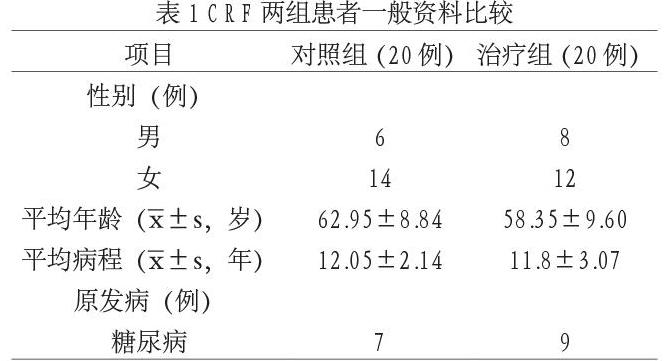
所选病例均来自于2019年1月-2021年1月北京市通州区中西医结合医院內科门诊患者40例,采用随机数字表法分为中药组和对照组,各20例,观察过程中两组均无病例脱落。对照组男性6例、女性14例,年龄45-75岁,病程8-15年;中药组男性8例、女性12例,年龄48-76岁,病程6-17年。组间性别、年龄和病程比较差异均无统计学意义(P>0.05),具有可比性(表1)。……