女贞褐斑病病原菌的生物学特性及寄主范围测定
2021-09-13杨迪,郑雪玲,黎鹏,徐东亚,杜婵娟,黄思良,付岗
杨迪,郑雪玲,黎鹏,徐东亚,杜婵娟,黄思良,付岗
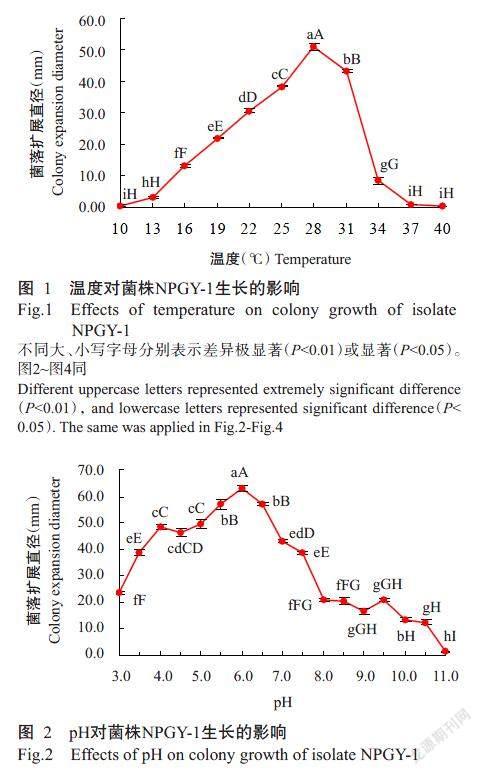
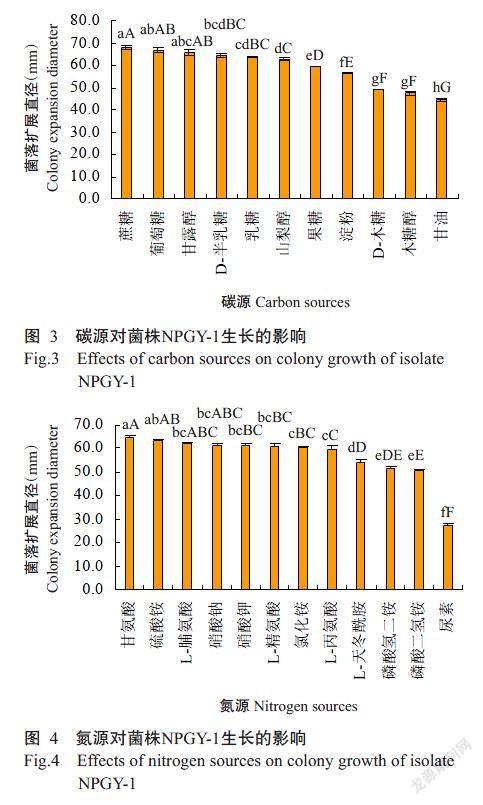
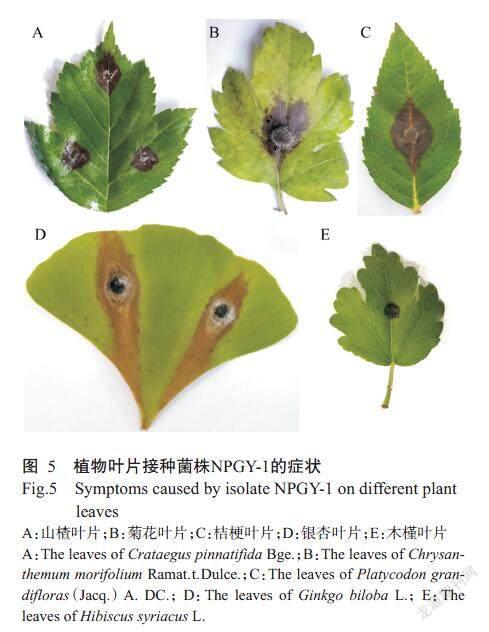
摘要:【目的】明确环境因子对女贞褐斑病病原菌小新壳梭孢(Neofusicoccum parvum)生长的影响及该病菌对不同种类植物的致病性,为女贞褐斑病的科学防控提供理论基础。【方法】以前期研究鉴定的女贞褐斑病病原菌小新壳梭孢NPGY-1为材料,采用菌落生长速率法研究不同温度、pH及碳氮源条件对菌株NPGY-1生长的影响;采用离体叶片接种法测定菌株NPGY-1对不同种类植物的致病性,测定其寄主范围。【结果】菌株NPGY-1的最适生长温度和pH分别为28 ℃和6.0,在PDA培养基上培养3 d的菌落扩展直径分别为50.7和62.9 mm。最适碳源为蔗糖、葡萄糖和甘露醇,最适氮源为甘氨酸和硫酸铵。对49科73种植物的致病性测定结果显示,有44科66种供试植物在试验观察期内出现不同程度的发病症状,5科(锦葵科、唇形科、海桐花科、堇菜科和葫芦科)7种植物未发病。【结论】引起女贞褐斑病的病原菌小新殼梭孢对环境的适应性较强,且对多种植物有潜在致病性。在园林绿化植物配置时,应选取抗性程度不同的植物进行搭配,有利于减轻该病的发生流行。
关键词: 女贞;褐斑病;小新壳梭孢;生物学特性;寄主范围
中图分类号: S435.672 文献标志码: A 文章编号:2095-1191(2021)09-2482-07
Biological characteristics and host range of the pathogen causing brown spot on Ligustrum lucidum Ait.
YANG Di1, ZHENG Xue-ling2, LI Peng2, XU Dong-ya2, DU Chan-juan1,
HUANG Si-liang2*, FU Gang1*
(1Institute of Plant Protection Research/Guangxi Key Laboratory of Biology for Crop Diseases and Insect Pests, Guangxi Academy of Agricultural Sciences, Nanning 530007, China; 2School of Life Science and Agricultural Engineering, Nanyang Normal University, Nanyang, Henan 473061, China)
Abstract:【Objective】This study was aimed to understand the effects of environmental factors on the growth of Neofusicoccum parvum and clarify its pathogenicity to different plant species, so as to provide a theoretical basis for the effective control of the disease. 【Method】The N. parvum NPGY-1 of Ligustrum lucidum Ait. brown spot identified in previous studies was used as test strain, and the effects of temperature, pH, carbon and nitrogen sources on the growth of the pathogen were measured by colony growth rate method. To determine the host range, the pathogenicity of the pathogen to different kinds of plants was determined by in vitro leaf inoculation. 【Result】The results of biological characteristic tests showed that the optimum growth temperature and pH of the pathogen were 28 ℃ and 6.0, the expanded diameters of colonies cultured on PDA medium for 3 d were 50.7 and 62.9 mm, respectively. The optimum carbon sources were sucrose, glucose and mannitol, and the optimum nitrogen sources were glycine and (NH4)2SO4. Based on the pathogenicity tests of 73 plant species coverring 49 families, a total of 66 plant species belonging to 44 families showed symptoms on their ino-culated leaves at various degrees. Seven plant species[Abelmoschus Manihot (L.) Medicus, Hibiscus syriacus L., Mentha canadensis Linnaeus, Perilla frutescens (L.) Britt., Pittosporum tobira (Thunb.) Ait., Trichosanthes kirilowii Maxim. and Viola verecund A. Gray] covering five families (Cucurbitaceae, Malvaceae, Labiatae, Pittosporaceae and Viola-ceae) were symptomless during the tests. 【Conclusion】N. parvum, the pathogen causing the brown spot disease of L. lucidum, has strong adaptability to the environment and has potential pathogenicity to many plant species. In landscaping plant configuration, plants with different resistance levels should be selected to match, which is conducive to reducing the occurrence and prevalence of the disease.
Key words: Ligustrum lucidumn Ait.; brown spot; Neofusicoccum parvum; biological character; host range
Foundation item: Guangxi Science and Technology Plan Project(Guike AD19245202); Basic Scientific Research Project of Guangxi Academy of Agricultural Sciences (Guinongke 2020YM96,Guinongke 2020ZX10)
0 引言
【研究意义】女贞(Ligustrum lucidum Ait.)是木樨科女贞属亚热带常绿灌木,其耐寒性好,喜光耐荫,在亚欧大陆均有分布(中国科学院中国植物志编辑委员会,1989)。因其根系发达、株型美观、耐寒性强等特点,常作为园林绿化植物在国内外城市中普遍种植(杨相甫和范红军,2010;刘智能等,2016;Lei et al.,2016)。……
