不同抚育方式对油松人工林生态效益的影响
2021-09-12杨延玲
杨延玲
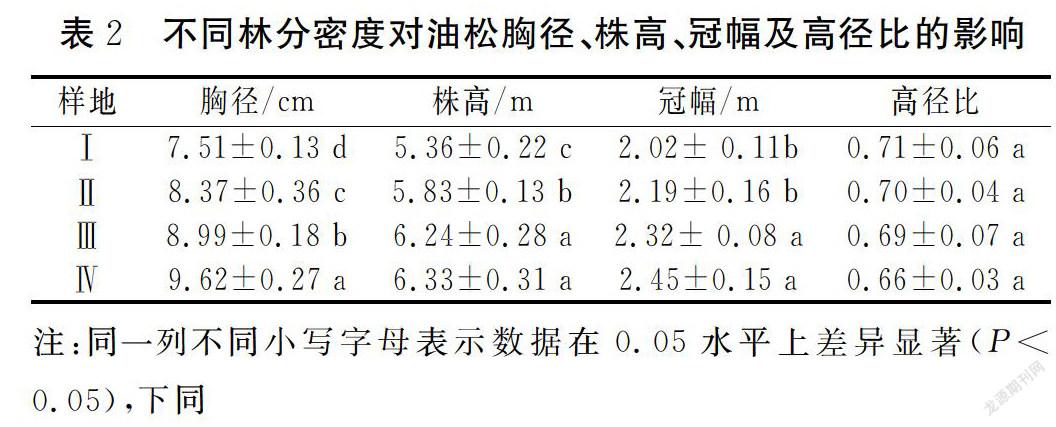

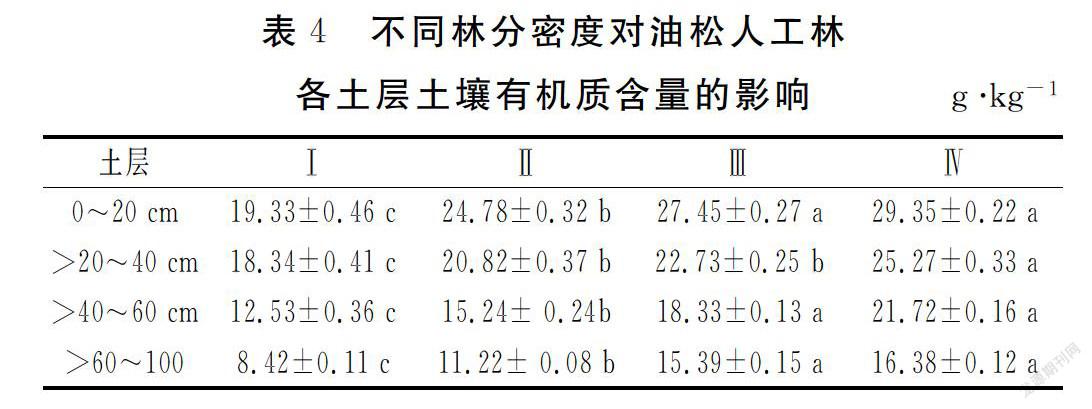
摘 要 为探索抚育方式对油松人工林生长和生态效益的影响,选取经不同程度抚育间伐后的4种林分密度下的油松人工林标准样地,并对样地及样方内的林木生长、林下生物多样性及土壤有机质等进行调查和测定,结果表明:油松人工林油松胸径、树高和冠幅均随着林分密度的增加而减少,以抚育间伐后林分密度为2 280~2 660株 hm-2的油松生长最好,林分密度对高径比无明显影响。林分密度为3 120株 hm-2时,林下物种数量最多,丰富度指数、辛普森指数、香农-威纳指数和均匀度指数均为最大,植被生物多样性稳定,但不利于土壤养分的积累。在林分密度为2 280~2 660株 hm-2时,土壤有机质含量高,利于土壤养分的积累。油松人工林林分密度为2 280~2 660株 hm-2更适合林木的生长及土壤养分蓄积,有助于形成良好的生态效益。
关键词 抚育方式;林分密度;油松人工林;生态效益
中图分类号:S753.7 文献标识码:A doi:10.13601/j.issn.1005-5215.2021.02.005
Abstract In order to explore the influence of tending methods on the growth and ecological benefits of Pinus tabuliformis plantations,standard plots of Pinus tabuliformis plantations under four forest densities after different degrees of tending and thinning were selected,and the plots and plots The survey and measurement of forest growth,understory biodiversity and soil organic matter showed that the DBH,height and crown of Pinus tabuliformis plantation forest decreased with the increase of forest density,in order to cultivate the thinned forest. Pinus tabuliformis with a density of 2 280-2 660 trees hm-2 grows optimally,and the forest density has no significant effect on the height-to-diameter ratio. When the stand density is 3 120 trees hm-2,the number of understory species is the largest,and the richness index,Simpson index,Shannon-Wiener index and evenness index are all the largest. The vegetation biodiversity is stable,but it is not conducive to the accumulation of soil nutrients. When the stand density is 2 280-2 660 trees hm2,the soil organic matter content is high,which is conducive to the accumulation of soil nutrients. Therefore,the stand density of Pinus tabuliformis plantation is 2 280-2 660 trees hm-2,which is more suitable for tree growth and soil nutrient accumulation,and helps to form good ecological benefits.
Key words tending method;stand density;Pinus tabuliformis plantation;ecological benefit
油松(Pinus tabuliformis)是松科(Pinaceae)松屬(Pinus)针叶型常绿乔木,是我国特有树种,具有重要的生态和经济价值[1]。其具有耐干旱、耐贫瘠,生长迅速,根系发达,水土保持能力强,涵养水源作用大,改良土壤能力强等特点[2],是我国西部地区实施退耕还林、改善生态环境最常见的树种之一。油松在我国自然分布较广,是我国西北、华北及东北南部的主要造林树种之一。林分密度是指单位面积林地上林木的数量[3],林分密度控制作为人工林抚育的重要措施,对维持林地生态作用和实现林业可持续发展具有重要意义[4]。……