基于双层树状支持向量机的观点挖掘与倾向分析
2021-08-09孙红黎铨祺赵娜
孙红 黎铨祺 赵娜

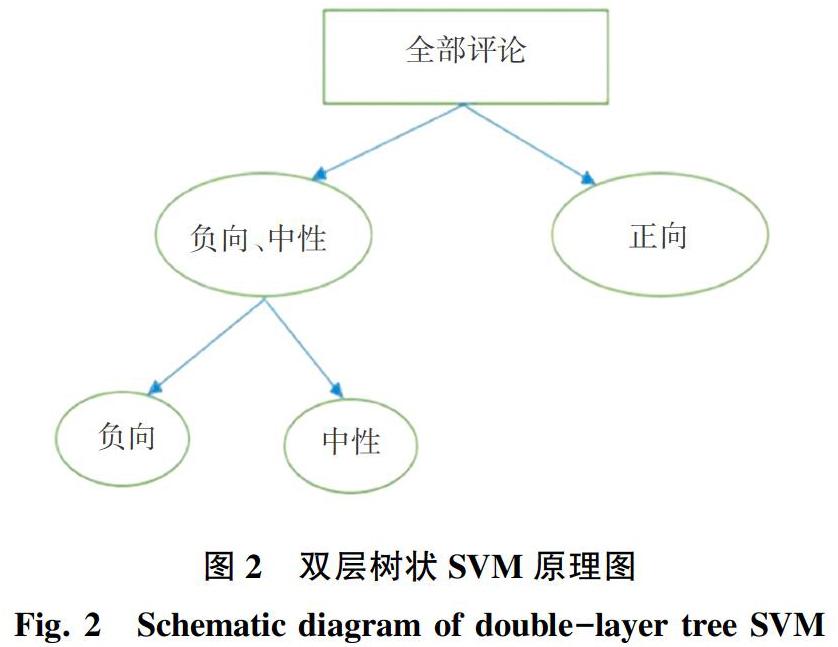

摘 要: 本文通过进行大量预处理工作,将经过词袋模型和Word2Vec两种不同向量化方法处理后的文本数据分别输入到SVM和LSTM模型中,训练出可以识别文本情感倾向的模型。进而对新产生的评论进行分类。根据实际数据量的倾斜状况,基于传统机器学习算法支持向量机(SVM),本文提出双层支持向量机,采用2种不同的方法分别训练模型并预测。最后再使用深度学习算法长短时记忆模型(LSTM)再次训练并预测,并对这3种方法做出比较和总结。结果显示,双层SVM比单层SVM的准确度提高了8个百分点;而LSTM比单层SVM低了2个百分点,比双层SVM低了接近10个百分点。
关键词: 商品评论; 网络爬虫; SVM; LSTM; 情感分类; 数据挖掘
文章编号: 2095-2163(2021)03-0044-04 中图分类号:TP181 文献标志码:A
【Abstract】In this paper, a large amount of preprocessing work is carried out, and the text data processed by the following two different vectorization methods as the word bag model and Word2Vec are input into the SVM and LSTM models, respectively to train a model that can recognize the emotional tendency of the text. Further the newly generated comments are classified. According to the tilt of the actual data volume, based on support vector machine (SVM) that is the traditional machine learning algorithm,this paper proposes a two-layer support vector machine,using two different methods to train the model and predict. Thus,the deep learning algorithm long-term memory model (LSTM) is used to train and predict again, and the three methods are compared and summarized. The results show that the accuracy of the two-layer SVM is 8 percentage points higher than that of the single-layer SVM; while the LSTM is two percentage points lower than the single-layer SVM, which is nearly 10 percentage points lower than the double-layer SVM.
【Key words】 product reviews; Web crawler; SVM; LSTM; emotion classification; data mining
0 引 言
根據2020年9月第47次的《中国互联网络发展状况统计报告》[1]显示,截至2020年6月,国内网民规模达9.40亿,相较于上半年增长了3 625万,普及率达67.0%,较2020年上半年提升2.5个百分点。互联网时代,人们普遍喜欢通过社交网络分享自己的生活和表达自己的观点,比如在朋友圈中表达日常生活中的快乐或者忧郁等情绪;在某个新闻App上发表自己对某件事情的看法;在购物网站上发表对某物品的使用感受。因此,在互联网中每天都会产生大量的用户评论,并且储存在互联网数据库中。如果能够充分地利用并挖掘这些信息,必然可以实现多种有效目的。但是,如果仅通过人工来对这些数据进行浏览和分析,则无疑会耗费大量人力资源,并且不能保证结果的准确性和可用性。……