新型太阳能复合相变蓄能炕的性能研究
2021-08-09王慧马秀琴陈月胡明月朱琳
王慧 马秀琴 陈月 胡明月 朱琳

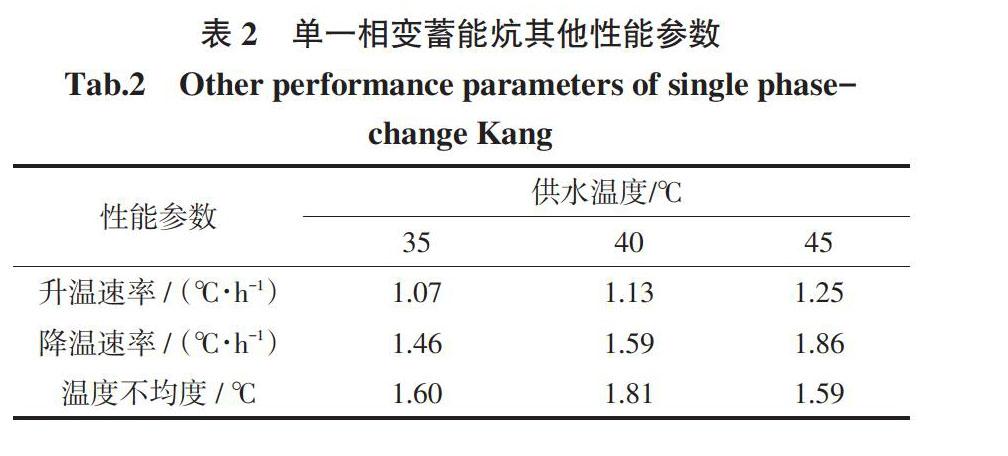

摘要 针对北方冬季燃煤供暖造成环境污染、能耗大等问题,结合太阳能供暖和相变材料的蓄热性能设计了一种膨胀珍珠岩-石蜡复合相变蓄能炕。太阳能供水温度分别取35 ℃、40 ℃和45 ℃时,通过与石蜡单一相变蓄能炕的炕面平均温度、热流密度、炕面升温速度、炕面降温速度和炕面温度不均度进行对比分析。结果表明:单一相变蓄能炕和复合相变蓄能炕的最佳供水温度分别为40 ℃和35 ℃,睡眠炕面平均温度为30.35 ℃和31.85 ℃,升温速度为1.13 ℃/h和1.23 ℃/h,降温速度为1.59 ℃/h和1.26 ℃/h,炕面温度不均度分别为1.81 ℃和1.07 ℃。复合相变蓄能炕较单一相变蓄能炕睡眠炕面平均温度高,升温速度快,导热性好,降温速度慢,炕面温度均匀,整体性能优于单一相变蓄能炕。此外,将供水温度35 ℃的复合相变蓄能炕与传统火炕进行对比,复合相变蓄能炕优势更明显,性能更佳。
关 键 词 太阳能供热;新型蓄能炕;复合相变材料;热性能分析;热舒适
中图分类号 TU111;TU882 文獻标志码 A
On the performance of a new type solar energy composite phase-change Kang
WANG Hui, MA Xiuqin, CHEN Yue, HU Mingyue, ZHU Lin
(School of Energy and Environmental Engineering, Hebei University of Technology, Tianjin 300401, China)
Abstract An expanded perlite-paraffin composite phase change materials (PCMs) energy storage Kang is designed based on the heat storage performance coupling with solar energy for heating and PCMs because of the environmental pollution and high energy consumption caused by coal-fired heating in northern China. As solar water temperature reaches 35 ℃,40 ℃ and 45 ℃, respectively, comparisons of surface average temperature, heat flux, heating speed, cooling speed and Kang surface temperature variability are analyzed for the composite Kang and the mono-paraffin PCM energy storage Kang. The results show that for the mono-paraffin PCM energy storage and composite PCMs energy storage, the best water supply temperature is of 40 ℃ and 35 ℃, an average temperature of the Kang sleeping surface is of 30.35 ℃ and 31.85 ℃, heating speed is 1.13 ℃/h and 1.23 ℃/h, cooling speed is 1.59 ℃ / h and 1.26 ℃/ h, Kang uneven surface temperature is of 1.81 ℃ and 1.07 ℃, respectively; Compared with mono-paraffin PCM energy storage Kang, composite PCMs energy storage Kang has higher average temperature, faster heating speed, better thermal conductivity, slower cooling speed, uniform surface temperature and better overall performance. In addition, the comparison has been made between the traditional coal-fired Kang and composite PCM storage Kang in the condition of supply temperature 35 ℃. It is shown that the composite PCM storage Kang has more advantages obviously and the performance is better, too.
Key words solar heating; energy storage Kang; composite PCMs; thermal performance analysis; heating comfort
0 引言
在我国的北方农村地区,冬季供暖主要依靠的是燃烧煤、秸秆和天然气。这种传统的供暖方式,不仅消耗着不可再生能源,而且严重污染环境。可再生能源可以降低能耗和减少环境污染,因此,可再生能源的有效利用成为农村供暖的新型趋势[1]。太阳能作为典型的可再生能源,目前已有很多学者对此进行了研究,王博渊[2]将太阳能和水相结合,形成多能源耦合的供暖系统,改善和提高供热系统稳定性。杨林等[3]对太阳能与燃气互补的供热系统进行了实验研究。……