Mesenchymal stem cells therapy for acute liver failure:Recent advances and future perspectives☆
2021-07-02YulingLunXioniKongYuFeng
Yuling Lun,Xioni Kong,Yu Feng,*
a Department of General Surgery,Shuguang Hospital Affiliated to Shanghai University of Traditional Chinese Medicine,Shanghai,China
b Central Laboratory,Shuguang Hospital Affiliated to Shanghai University of Traditional Chinese Medicine,Shanghai,China
Keywords:Mesenchymal stem cells (MSCs)Treatment Acute liver failure (ALF)Stem cell transplantation Mechanism
ABSTRACT Acute liver failure (ALF) is a life-threatening disease characterized by the rapid development of hepatocyte death and a systemic inflammatory response,which leads to high mortality.Despite the prevention of ALF complications,therapeutic effectiveness remains limited because of the rapid disease progression.Thus,there is a need to explore various therapeutic approaches.Currently,the only effective treatment is liver transplantation;However,the lack of donors,surgical complications,immunosuppression,and high medical costs limit its clinical application.Recently,mesenchymal stem cells (MSCs)have been found to exert hepatoprotective effects in ALF through suppression of inflammation,immunoregulation,promotion of mitosis,anti-apoptosis effects,and alleviation of the metabolic and oxidative stress imbalance.In this review,we summarize the advantages and disadvantages of MSCs from different sources and their molecular mechanisms in ALF treatment,along with future perspectives that may provide guidance to improve the current status of MSCs therapy for ALF.
1.Introduction
Acute liver failure (ALF) is a life-threatening clinical syndrome characterized by rapid liver cell death accompanied by a systemic inflammatory response and severe liver dysfunction,which lead to severe complications,such as coagulation dysfunction,hepatic encephalopathy,and jaundice.1Liver transplantation is the most effective treatment for this disease,but it is difficult to widely apply because of the lack of donors,immune rejection,and other complications.2Thus,there is an urgent need for new therapies of ALF.Accumulating studies have shown that stem cells are effective for the treatment of ALF.
Mesenchymal stem cells (MSCs) have a multidirectional differentiation potential and self-renewing capability,which are able to differentiate into a wide range of cell lineages.Additionally,MSCs have various therapeutic effects including suppression of inflammation,immunoregulation,and alleviation of metabolic and oxidative stress by releasing soluble factors.3More importantly,compared with other types of stem cells,MSCs are easy to obtain and have fewer ethical issues.4They are also safer in terms of tumorigenesis.These characteristics make them more suitable for clinical use.In recent years,studies of MSCs in ALF animal models and patients have shown that MSCs improve liver functions and regeneration.However,different types of MSCs have unique advantages and disadvantages,which are summarized in Table 1.The therapeutic effects and mechanisms of MSCs from different sources in ALF are also different and summarized in this review to provide a basis for clinical application of MSCs for ALF treatment.

Table 1 The unique advantages and disadvantages of different types of MSCs.
2.Therapeutic effects of MSCs from different sources in ALF
2.1.Bone marrow mesenchymal stem cells (BMSCs)
Bone marrow is the first and most characteristic source of MSCs.BMSCs are a stem cell population with a high self-renewal ability and multidirectional differentiation potential.5As a typical stem cell type,BMSCs exert an immunomodulatory effect by inhibiting natural killer T(NKT)cells in the liver and inhibiting inflammatory signals.5,6BMSCs also increase expression of liver heme oxygenase-1(HO-1)through nuclear factor erythroid 2-related factor 2(Nrf2)and inhibit hepatocyte necrosis by promoting liver cell proliferation.7,8BMSCs also effectively promote liver regeneration and reduce liver injury in post-hepatectomy liver failure models with up to a 90% hepatectomy by increasing glycogen synthesis and affecting the AKT/GSK-3β/β-catenin pathway.9Controversial studies have shown that BMSCs transdifferentiate into hepatocytes or hepatocyte-like cells (HLCs) to promote liver regeneration during ALF.10-12Mechanistic studies have shown that the therapeutic effects of BMSCs are mediated through soluble paracrine factors and cytokines that inhibit inflammatory responses and promote hepatocyte proliferation and regeneration.13BMSCs-derived exosomes act as important paracrine factors that promote autophagy and reduce hepatocyte apoptosis in ALF by increasing the expression of autophagy marker proteins microtubule-associated protein light chain 3 (LC3) and Beclin-1.14Although BMSCs partially improve liver functions and reduce liver damage through different mechanisms,MSCs still support liver functions during ALF.Therefore,the combination of liver cells and MSCs has been reported as a new effective treatment for ALF.Conditioned medium from BMSCs cocultured with hepatocytes significantly improves the survival rate of ALF by preventing liver injury and promoting recovery of the liver structure.15Compared with single-use hepatocyte transplantation or single-use BMSCs,cotransplantation of hepatocytes and BMSCs appears to have a better treatment effect on ALF.16
Although BMSCs provide a promising option for ALF patients,20% of BMSCs are in a quiescent state under physiological conditions.They also require an invasive technique for collection and are easily contaminated.17The application of autologous BMSCs is restricted to patients with underlying diseases and average adult bone marrow contains only 1 BMSC per 100,000 nucleated cells.Moreover,the number of MSCs gradually decreases with age.18Therefore,improving the application efficiency of BMSCs is very important.BMSCs are inherently sensitive to the oxygen concentration because of the hypoxic environment of bone marrow.Proteins produced by BMSCs cultured in a low oxygen concentration have better therapeutic effects on ALF,which indicates that the therapeutic effects of BMSCs can be improved by appropriate O2and CO2levels.19Downregulation of microRNA(miR)-214 improves the therapeutic effects of BMSCs by increasing the expression of proviral integration site for Moloney murine leukemia virus-1(PIM-1) in ALF.20Overexpression of c-Met also improves the effectiveness of BMSCs for the treatment of ALF by promoting the homing of BMSCs to the damaged liver site in an ALF rat model.21Regenerated silk fibroin (RSF) promotes angiogenesis and BMSCs differentiation into HLCs.Moreover,compared with an RSF scaffold,a BMSCs-RSF construct has significant therapeutic effects on liver damage in a mouse ALF model.22Additionally,compared with uncoated nanoparticles,nanoparticles coated by an erythrocyte membrane and carrying beneficial growth factors from BMSCs promote hepatocyte proliferation in vitro,which have lower internalization by macrophages.These features greatly improve the stability of their transmission and application efficiency.23
2.2.Adipose tissue-derived stem cells (ADSCs)
Adipose tissue is now considered an ideal source of MSCs.ADSCs are MSCs with a multidirectional differentiation ability,which can differentiate into HLCs in vivo and in vitro.24-26Compared with other MSCs,ADSCs can be easily obtained without ethical issues,have low immune rejection,and can be allogeneically applied.27,28The most significant advantages of ADSCs include minimally invasive procedures to collect,large quantities to harvest,higher potential immunomodulation,and a rapid proliferation ability.29,30The rate of successful ADSC separation is 100% and the colony formation rate is also very high.Compared with the treatment effects of BMSCs in ALF,ADSCs have more effects by reducing aspartate aminotransferase (AST) and alanine aminotransferase(ALT)at some time points and producing more liver-related growth factors,such as hepatocyte growth factor (HGF) and vascular endothelial growth factor (VEGF).29,31,32Therefore,it appears that ADSCs are a more appropriate choice for cell therapy.
ADSCs can be injected into experimental animals through intravenous and splenic routes with similar effects,but tail vein injection appears to be more convenient.33ADSCs enhance liver repair and regeneration in ALF by regulating Nrf2 and cytochrome P450 expression to perform their antioxidant functions or inhibiting downstream mitogen-activated protein kinase (MAPK) signal activation and the production of inflammatory cytokines.34,35They also play an immunomodulatory role by inhibiting NKT cells in the liver.34,36ADSCs can differentiate into hepatocytes with a characteristic hepatocyte expression profile upon differentiation.37Many studies have also shown that ADSCs promote angiogenesis and endothelial cell proliferation by secreting abundant growth factors and cytokines in a paracrine manner and these soluble factors also exert an anti-inflammatory effect.38-41Additionally,ADSCs promote liver regeneration and improve the symptoms of liver injury in ALF mice.42Moreover,ADSCs reduce the level of liver injury by secreting interleukin-35(IL-35)and IL-35 gene-modified MSCs(IL-35-MSCs)reduce the level of interferon-gamma(IFN-γ)in liver mononuclear cells through the JAK1-STAT1/STAT4 signaling pathway.43Although rodent models are common in ADSC research,the results from rodents and non-rodent animals in terms of liver regeneration are different.In an ischemia-reperfusion (IR) injuryinduced porcine ALF model,ADSCs alleviate the sequelae of ALF caused by IR and prolong survival by homing and differentiating into hepatocytes in the sub-acute stage,maintain liver function homeostasis,and rescue reactive oxygen species(ROS)in the acute phase.44
Although ADSCs have promising therapeutic effects for the treatment of ALF,there are limitations in terms of stem cell homing to target organs and poor transplantation efficiency.Lipidconjugated heparin-coated ADSCs effectively alleviate these deficiencies and increase the therapeutic effects of ADSCs on liver diseases by enhancing ADSC homing to the liver and secretion of cytokines or growth factors.45,46Small molecule zeaxanthin dipalmitate activates the PKC/Raf-1/MAPK/NF-кB pathway and maintains miR-210 at a reasonable level to improve the transplantation efficiency of ADSCs.47Because of a very low risk of complications,such as pulmonary embolism and tumorigenesis of injected cells,conditioned medium of MSCs has been studied intensively.29,48-50There are various functional proteins related to growth,regeneration,and immunity in ADSCs-conditioned medium,which effectively improve the liver functions of ALF and provide a new research direction for the application of ADSCs.51
2.3.Umbilical cord mesenchymal stem cells (UCMSCs) and umbilical cord blood mesenchymal stem cells (UCB-MSCs)
UCMSCs are isolated from the umbilical cord (UC).They can be obtained readily with a minimally invasive method and are not affected by underlying diseases.They also have low immunogenicity.52,53Compared with other sources of MSCs,UCMSCs have a higher proliferation potential because of the longer and higher activity of telomerase and telomerase reverse transcriptase.54-57Additionally,UC cells are likely exempt from incorporated mutations when compared with juvenile or adult donor cells such as skin fibroblasts or keratinocytes.58
UCMSCs can be injected into animal models intravenously or through the liver lobe and the therapeutic effects are similar using these two methods,but the former is easier to perform.59Transplanted UCMSCs have several liver-protective effects including induction of oval cell activation and proliferation,stimulating host hepatocyte regeneration,and activation of the Wnt/β-catenin signaling pathway through paracrine factors.60,61UCMSCs can also differentiate into HLCs with partial hepatic functions,but compared with MSC-derived HLCs,UCMSC-derived HLCs express lower levels of hepatocyte growth factor and have impaired immunosuppression.Therefore,undifferentiated MSCs may be more suitable for the treatment of liver diseases than HLCs.62Research on UCMSC treatment effects in primate ALF showed that human UCMSCs inhibit mononuclear cell activation and greatly improve liver functions in monkeys by blocking the inflammatory cascade and inhibiting IL-6 production in circulating monocytes.63Single donor cells-derived liver organoids (SDC-LOs) from the UC can differentiate into organoids with stronger liver functions than endothelial cells-human induced pluripotent stem cell (hiPSC)-derived hepatoid cells.64These functional SDC-LOs quickly restore liver functions and improve the survival rate of ALF mice when transplanted into the renal subcapsules of ALF mice.64Additionally,ectopic expression of HGF in UCMSCs protects animals from acetaminophen (APAP)-induced ALF through anti-apoptosis and antioxidation mechanisms.65A study on the therapeutic effects of UCs showed that P5 human UCs stimulate endogenous liver regeneration and inhibit hepatocyte apoptosis in rats and homing to the recipient liver was superior to P10 human UCs because of higher levels of c-Met.66
However,despite the obvious efficacy of UCMSCs for treatment of ALF,their clinical application still has many challenges including the need for a large number of cells,low viability in vivo,and twodimensional (2D) culture resulting in loss of the main original characteristics.Traditional three-dimensional (3D)-spheroid culture mimics in vivo conditions,improves cell yield,and maintains the stemness of stem cells.67However,the large size of the sphere is not conducive for direct injection and may lead to internal cell death.Recently,a new method has been developed by combining a single cell chip model with 3D culture to form single cell-derived spheres (SCDS) of UCMSCs.Compared with 2D and traditional 3D culture methods,SCDS culture has several advantages including a small size,strong survival and migration abilities,strong hypoxia tolerance,and stemness.Moreover,SCDS culture promotes the generation of xenografted blood vessels and has a greater potential for treatment of ALF in vivo.68A recent study has also shown that extracts from traditional Chinese medicine improve MSC application efficiency by affecting their proliferation,differentiation,apoptosis,autophagy,and other biological activities.69Icaritin has an anti-apoptotic effect by upregulating the HGF/c-Met pathway and improving the therapeutic effect of MSCs on ALF.70Human UCMSC-derived exosomes (hUCMSC-EXOs) have provided a new strategy for ALF treatment.hUCMSC-EXOs play important roles in regulation of the immune system and inflammation by reducing the expression of the nucleotide-binding oligomerization domain-,leucine-rich repeat-and pyrin domain-containing 3 (NLRP3)inflammasome and its downstream inflammatory factors in ALF.71UC blood is also an effective source of MSCs.Increasing evidence has shown that UCB-MSCs are a potential candidate for stem cellbased therapies.UCB-MSCs and BMSCs have similar cell characteristics and multidirectional differentiation abilities.72,73UCBMSCs also have unique advantages in clinical application.They are acquired non-invasively,have a low risk of viral contamination,and insignificant immune responses.74Moreover,they can be used for autogenetic transplantation without ethical issues,which is of great significance for the clinical application of stem cell therapy.75UCB-MSCs effectively reduce the mortality of ALF,migrate to an injured liver,differentiate into HLCs,improve the structure of the damaged liver,and reduce the degree of liver injury.76,77However,the expansion and colonization of UCB-MSCs are slow.78Thus,their repair efficiency for the damaged liver is limited.To improve the application efficiency,combined application of granulocyte colonystimulating factor (G-CSF) and UCB-MSCs inhibits ALF-induced proinflammatory cytokine secretion,oxidative stress,hepatocyte apoptosis,and malondialdehyde (MDA) activation,which protects liver functions from damage and improves the therapeutic efficiency of UCB-MSCs for ALF.79
2.4.Menstrual blood-derived mesenchymal stem cells (MenSCs)
MenSCs are a novel type of adult MSC derived from menstrual blood.MenSCs have a strong ability to proliferate in vitro and the doubling time is only about 19 h,which is more than twice as fast as that of BMSCs at 40-45 h.80,81Moreover,they have the advantages of long-term culture without genetic abnormalities for more than 10 passages,easy access,non-invasive collection,safety,and no ethical issues.82,83MenSCs have the ability to transdifferentiate into different lineages,83-87but most studies have focused on mesoderm differentiation to meet the minimum standards for the MSC status.80,88,89MenSCs can differentiate into HLCs with mature functions under conditional culture induction,which can be used for subsequent treatment of ALF.90An in-depth study of their mechanism found that MenSCs protect against liver injury by reducing the expression of miR-122 to alleviate ALF injury.91Moreover,exosomes derived from MenSCs have significant therapeutic effects on ALF.These exosomes significantly reduce ALT and AST levels by inhibiting the expression of apoptotic factors and preventing accumulation of inflammatory cells in the liver of ALF mice.92These studies have shown that MenSCs have therapeutic effects on ALF.
MenSCs have many advantages and a strong proliferation ability,and the proliferation ability of MenSCs is not affected by the donor age when cultured in vitro at less than 10 passages.93It has been reported that the proliferation ability of MenSCs from donors over 40 years of age decreases significantly.A recent study has shown that MenSCs cause no obvious adverse reactions.No evidence of tumorigenicity or toxicity has been found when MenSCs are injected into nude mice.94And MenSCs even have significant inhibitory effects on tumor growth in mouse glioma models.95Therefore,the application of MenSCs is considered safe.However,because of the lack of effective monitoring approaches and followup observations,the efficacy of MenSCs should be studied further and confirmed.
2.5.Amniotic fluid mesenchymal stem cells (AF-MSCs) and placenta-derived mesenchymal stem cells (PD-MSCs)
AF-MSCs come from second-trimester amniocentesis.96-101They are typical multipotent stem cells and can be differentiated into multiple lineages.100,102Compared with BMSCs,they have stronger self-renewal,proliferation,and hepatocyte differentiation abilities.103AF-MSCs have good clinical application prospects because they are easy to obtain,do not have ethical issues,and are amenable to transfection with exogenous genes.104A study on the therapeutic effects of AF-MSCs on ALF found that AF-MSCs engraft in the damaged liver and secrete Annexin-A1 and other beneficial cytokines to effectively alleviate the degree of liver damage and promote liver repair and regeneration.105,106Transfusion of IL-1-receptor antagonist (IL-1Ra)-expressing AF-MSCs enhances the therapeutic effects in ALF rats by inhibiting excessive immune inflammation and promoting regeneration after cell transplantation.107PD-MSCs can be obtained from the placenta with a wide range of sources and are not affected by age or environmental factors.PD-MSCs maintain a high proliferation capacity for at least 20 passages,which produce a large number of cells in a short period of time.This reduces the risk of cell aging and mutation caused by cell passaging.108-111Compared with other MSC types,PD-MSCs have a stronger ability to differentiate into hepatocytes,which makes them an allogeneic source for ALF treatment.112PD-MSCs accumulate in damaged sites through vascular cell adhesion molecule-1 (VCAM-1) and very late antigen-4 (VLA-4) adhesion molecules.113,114PD-MSCs are involved in repairing the damaged liver through cell-cell contacts and the release of growth factors,such as HGF and VEGF.115,116Moreover,PD-MSCs have an immunomodulatory effect by reducing liver inflammation and liver cell apoptosis and repairing the damaged liver by inhibiting the activation of T cells,natural killer(NK)cells,and B cells,which reduces the production of tumor necrosis factor-alpha (TNF-α),IFN-γ,and IL-10.106
2.6.MSCs from other sources
Dental pulp-derived mesenchymal stem cells(DP-MSCs)can be obtained from teeth and human deciduous teeth are the optimal source of DP-MSCs because they can be obtained through minimally invasive methods during normal human growth and development.As a kind of MSC,DP-MSCs have strong proliferation and differentiation abilities.117The liver differentiation ability of DPMSCs is similar to or even exceeds that of BMSCs because the gene and protein expression levels of hepatocyte markers in DPMSCs are higher than those in BMSCs.118,119DP-MSCs can be transdifferentiated into hepatocytes to restore liver functions in a rat liver injury model,but some studies have shown that only conditioned medium of DP-MSCs inhibits hepatocyte apoptosis by inducing anti-inflammatory M2 macrophages that promote hepatocyte proliferation and significantly improve the survival rate of ALF rats.120Therefore,the therapeutic effects of conditioned medium or intracellular vesicles on liver diseases require further exploration.
Human minor salivary gland mesenchymal stem cells (hMSGMSCs)are derived from the human minor salivary gland,which are abundant and easily obtained from donors without damage.121,122Compared with stem cells from other sources,hMSG-MSCs are ideal adult stem cells to reduce liver damage by differentiating into HLCs with partial liver functions in a short period of time.123Moreover,hMSG-MSCs transplanted into a hepatectomy ALF mouse model improve survival by expressing hepatocyte markers,such as alpha-fetoprotein (AFP) and keratin 18 (KRT18) as well as hepatocyte-related proteins,which indicates that hMSG-MSCs may be an ideal cell source for stem cell therapy.124
Liver-derived human mesenchymal stem cells(LHMSCs)can be isolated from fetal livers with general MSC morphology,differentiation abilities,and immunoregulatory functions.Compared with other MSCs,LHMSCs have stronger anti-inflammatory,antiapoptotic,and angiogenic effects,and secrete protective factors.Furthermore,compared with exogenous MSCs derived from other donors,autologous MSCs are more suitable for the specific microenvironment of this organ.125-127Studies have confirmed that LHMSCs effectively improve the survival rate of ALF mice through paracrine effects.128
Human embryonic stem cell-derived mesenchymal stem cells(ESC-MSCs)can be generated in large numbers from a single donor with early expansion in vitro at a high growth rate,which appear to be another option for regenerative cell therapy.Studies have confirmed that ESC-MSC-conditioned medium significantly improves the survival rate of primary hepatocytes and increases immunomodulatory IL-10 secretion,which provides a new approach for the treatment of inflammatory conditions in ALF.129
3.Therapeutic mechanisms of MSCs
There are commonalities in the treatment of ALF among MSCs from different sources.ALF is mainly treated through the following mechanisms.(i)MSCs migrate to the damaged liver.With their selfrenewal and multidirectional differentiation potential,MSCs differentiate into hepatocytes with liver functions to exert a therapeutic effect.It is also possible to protect host cells from apoptosis by reprogramming host cells to express stem cell-specific genes.130(ii) Interactions between cells.MSCs affect the proliferation,migration,and differentiation of host cells through gap junctions,tight junctions,and desmosomes,thereby exerting a therapeutic effect.131(iii)MSCs secrete beneficial factors,such as VEGF and basic fibroblast growth factor (bFGF) through paracrine effects,which provides more growth factors for host cells,promotes the regeneration of blood vessels and liver cells,and inhibits programmed death of host cells to exert a therapeutic effect.132,133Immunoregulatory functions also play an important role.MSCs release prostaglandin E2,indoleamine 2,3-dioxygenase (IDO),and other soluble cytokines,which reduces the cytotoxicity of NK cells,inhibits T cells and dendritic cells,and reduces B cell activation,proliferation and IgG secretion to adjust inherent and adaptive immunities.134-139For treatment of ALF,MSCs reduce the infiltration and activation of liver CD4+T cells through secretion of prostaglandin E2,which inhibits T helper(Th)1 cells and NKT cells in an IDO-dependent paracrine manner to regulate systemic immunity.136MSCs also reduce liver inflammation by promoting the production of Treg cells with anti-inflammatory effects,reducing Th17 cells,and reducing lymphocyte proliferation,thereby reducing liver inflammation and performing immunoregulation.In ALF treatment,MSCs also inhibit activation of neutrophils in the liver and peripheral blood by upregulating M2-type macrophages that secrete IL-10 and other factors,which exerts an inhibitory effect on inflammation.140After MSC treatment,IL-10 and transforming growth factor-beta(TGF-β)increase significantly in serum.Simultaneously,CD8+T cells and TNF-α decrease,which facilitates the repair of liver damage and improves prognosis.135
Stem cells from different sources have different characteristics(Table 1).For example,AF-MSCs have a stronger liver differentiation ability than BMSCs.141ADSCs produce more growth factors for liver cells and promote liver cell proliferation,thereby enabling effective disease treatment.142-144Thus,there are differences in the treatment of ALF (Table 2).

Table 2 Therapeutic mechanisms and effects of MSCs from different sources for ALF.
4.Conclusion
MSCs can differentiate into mesodermal tissues(bone,cartilage,and fat)and unrelated embryonic layer cells,such as nerve and liver cells.Additionally,they have low immunogenicity and immunomodulatory properties that allow them to evade host immune surveillance.Although MSCs are transient in damaged organs,which ranges from a few hours to a few days,they exert complex paracrine and endocrine effects by secreting growth factors and cytokines to support or reprogram damaged cells and promote liver repair.MSCs also have a strong homing ability.The ability of MSCs to preferentially home to inflammatory sites is thought to be critical for successful treatment of damaged organs.In general,intravenous or intra-arterial injection of MSCs initially results in administration of cells in the capillary bed of the organ,especially in the lung and liver.In an uninjured state,intravenously administered MSCs tend to migrate to the bone marrow.However,MSCs preferentially migrate to a site of inflammation and enter an injured tissue and are driven by different interactions between chemokines released by the injured tissue after injury and chemokine receptors expressed by MSCs.Homing of MSCs to damaged inflammatory organs facilitates the treatment of severe inflammation in ALF.
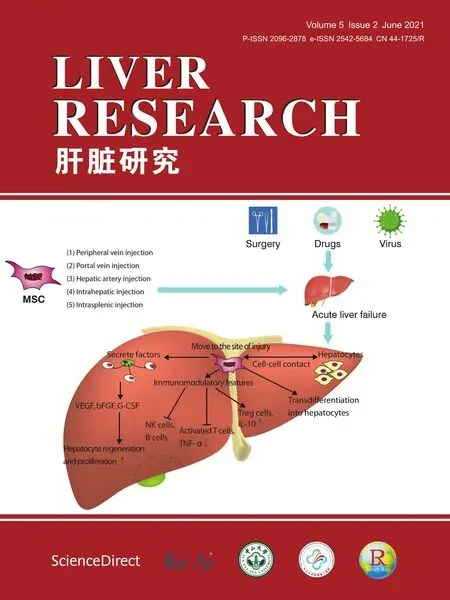
In conclusion,MSCs treat ALF by transdifferentiating into hepatocytes to improve dysfunction of the liver and secrete antiinflammatory and immunomodulatory cytokines that affect tissue repair (Fig.1).MSCs provide a new treatment method for ALF.However,this method has the following problems that need to be resolved to promote its clinical application.(i) The functions of MSCs might be changed after leaving their original tissue.Therefore,maintaining their biological functions needs to be improved.(ii)There are controversial studies on the effects of pretreatment or genetic modification of MSCs for transplantation.Therefore,the influence or side effects of pretreatment or modification of MSCs need to be clarified further.(iii) Different sources,doses,administration routes,and operating temperatures of MSC treatments may influence their effects.Therefore,the optimal application of MSC treatment needs to be further investigated.(iv) Although metaanalysis has shown that MSC treatment has no obvious adverse consequences,whether MSCs will malignantly transform or enhance existing tumor risk needs to be studied further.(v) The current MSC research is mainly based on animal and in vitro experiments and there is a great need for clinical trials and a large number of non-human primate studies to evaluate their effectiveness and safety to promote clinical application of MSCs.Therefore,although MSCs have great potential for the treatment of ALF,they require further research before clinical application.

Fig.1.MSCs exert effects on the treatment of ALF.
Authors’ contributions
Y.Feng contributed to the conception of this study.Y.Luan drafted the manuscript.X.Kong revised the manuscript.All authors read and approved the final manuscript.
Declaration of competing interest
The authors declare that they have no conflict of interest.
Acknowledgements
This work was supported by the National Natural Science Foundation of China (81873582 to X.Kong).
杂志排行
Liver Research的其它文章
- Expert consensus on perioperative management of liver transplantation in adults with acute-on-chronic liver failure☆,☆☆,☆☆☆
- Ulcerative colitis triggered by pegylated interferon alpha-2b in a patient with chronic hepatitis B:A case report and literature review☆
- Hsa-miR-637 inhibits human hepatocyte proliferation by targeting Med1-interacting proteins☆
- Liver-specific deletion of mechanistic target of rapamycin does not protect against acetaminophen-induced liver injury in mice☆
- Novel organoid model in drug screening:Past,present,and future☆
- Vitamins and non-alcoholic fatty liver disease:A molecular insight☆