解磷菌PSBHY-3的发酵培养工艺参数优化
2021-06-30胡晓娟许云娜徐创文杨铿文国樑曹煜成
胡晓娟 许云娜 徐创文 杨铿 文国樑 曹煜成
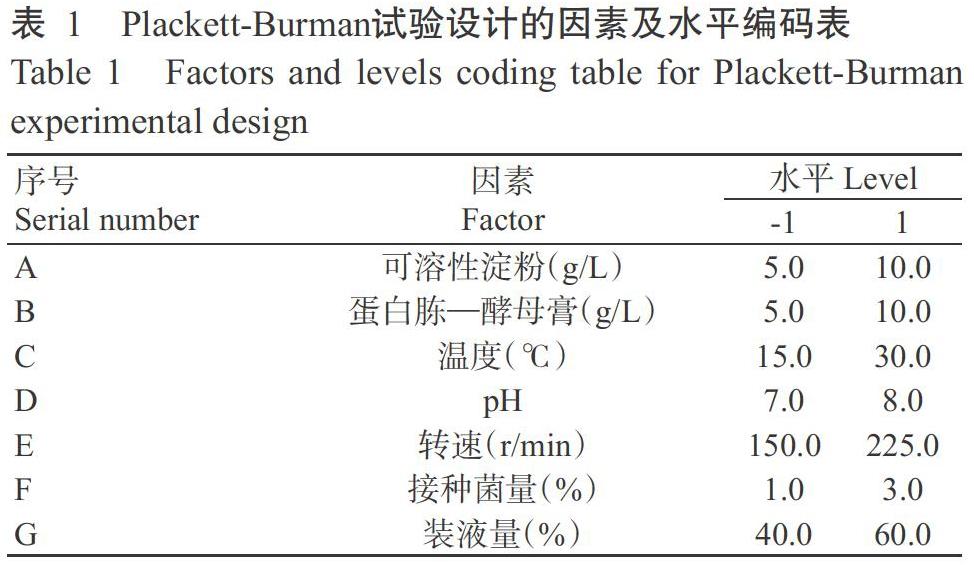

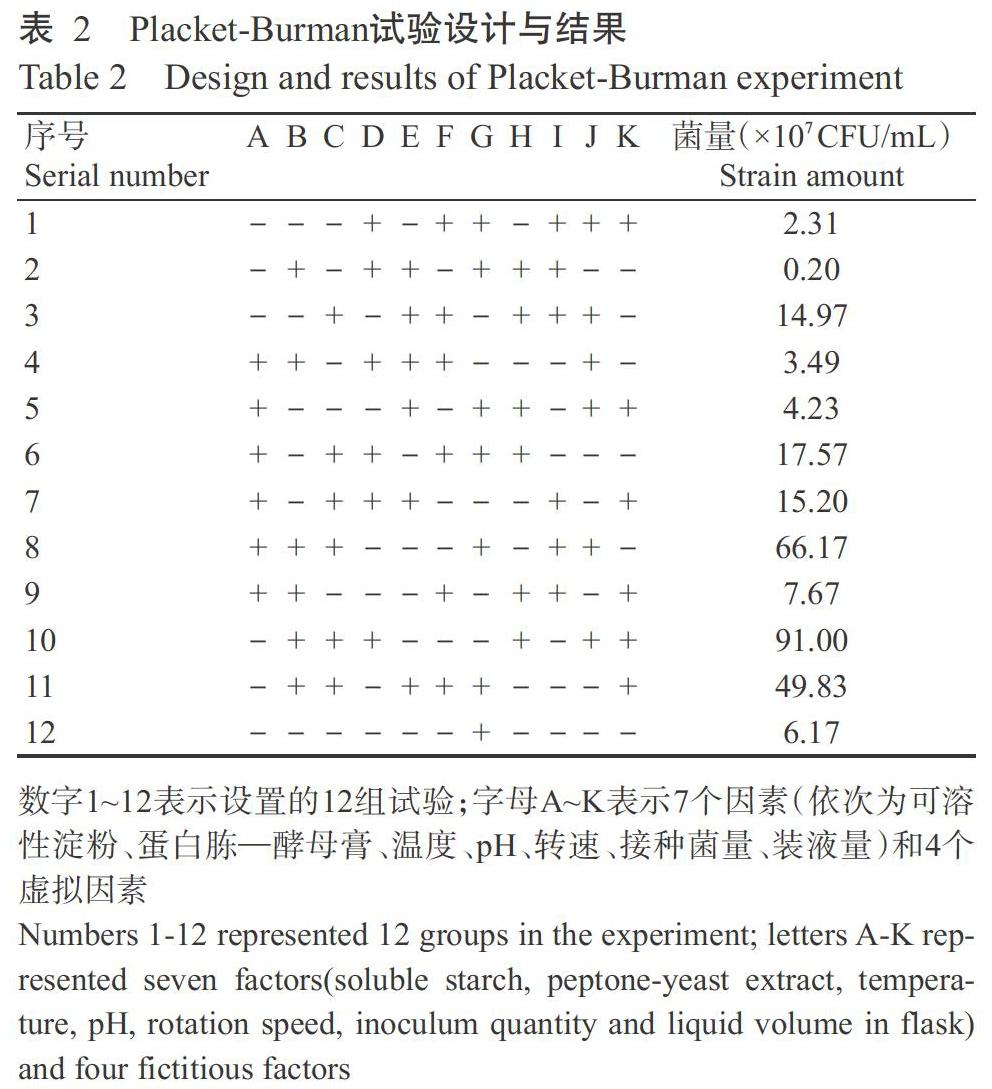
摘要:【目的】優化解磷菌PSBHY-3的培养参数,为水产养殖专用解磷菌的工业化发酵生产提供技术支持。【方法】通过单因素试验筛选适合解磷菌菌株PSBHY-3生长的发酵培养基碳氮源及其含量;采用Plackett-Burman试验筛选获得对菌量影响最显著的3个因子;通过最陡爬坡试验和Box-Behnken试验确定显著因子的最佳水平,建立主要培养参数的回归方程,得出优化后显著因子的最佳值及预测菌量;通过摇瓶试验验证,检验模型方程的准确性。【结果】菌株PSBHY-3的最佳碳源、氮源分别为可溶性淀粉和蛋白胨—酵母膏(1∶1)。以温度(A)、蛋白胨—酵母膏(B)和转速(C)为因素变量,菌株PSBHY-3的菌量为响应值,拟合得到二次多元回归方程Y=17.10-0.88A+0.55B+1.27C+0.24AB+0.34AC-0.24BC-3.57A2-2.78B2-6.13C2。优化得到的解磷菌菌株PSBHY-3最佳发酵培养参数为:可溶性淀粉10.0 g/L,蛋白胨10.18 g/L,酵母膏10.18 g/L,氯化钠3.0 g/L,硫酸镁1.0 g/L,pH 7,培养温度35.54 ℃,转速164 r/min,接种量1%,装液量60%(V/V)。在最佳发酵培养条件下,菌量实际值为1.81×109 CFU/mL,与理论菌量(1.72×109 CFU/mL)间无显著差异(P>0.05),但显著高于优化前采用营养肉汤培养的菌量(1.90×108 CFU/mL)(P<0.05)。【结论】通过单因素试验、Plackett-Burman试验、最陡爬坡试验和Box-Behnken试验等优化了菌株PSBHY-3的发酵参数,显著提高了目的菌量,回归方程预测准确,优化后的发酵参数可用于水产养殖专用解磷菌的工业化发酵生产。
关键词: 解磷菌;解淀粉芽孢杆菌;发酵;培养参数
中图分类号: S917.1;Q178.1 文献标志码: A 文章编号:2095-1191(2021)02-0475-08
Abstract:【Objective】The cultivation parameters of phosphate solubilizing bacteria PSBHY-3 were optimized, in order to provide technical support for its industrial fermentation production of phosphate solubilizing bacteria preparations for aquaculture. 【Method】Based on single-factor experiment, the optimal carbon and nitrogen source and their contents for the growth of phosphate solubilizing bacteria for phosphate solubilizing bacteria PSBHY-3 were screened. Then, three significant factors affecting the amount of bacteria were determined with the Plackett-Burman experiment. The optimal level of significant factors was determined with the steepest ascent and Box-Behnken experiment, the regression equation of culture parameters was established. Then the optimal values of the significant factors after optimization and the predicted bacterial amount were obtained. Finally, the validity of the model equation was verified with the shake flask experiments.【Result】The results showed that the optimal carbon source and nitrogen source of PSBHY-3 were soluble starch and pe-ptone-yeast extract(1∶1), respectively. The temperature(A), applied amount of yeast extract-peptone(B), and rotation speed (C) were selected as the factor variables, and amount of strain PSBHY-3 was selected as the response variable. The quadratic multiple regression equation was proposed as follow:Y=17.10-0.88A+0.55B+1.27C+0.24AB+0.34AC-0.24BC-3.57A2-2.78B2-6.13C2. The optimum fermentation parameters of strain PSBHY-3 were as follows:soluble starch 10.0 g/L, peptone 10.18 g/L, yeast extract 10.18 g/L, sodium chloride 3.0 g/L, magnesium sulfate 1.0 g/L, pH 7, temperature 35.54 ℃, rotation speed 164 r/min, inoculum quantity 1%, liquid volume in flask 60%(V/V). Under the above optimum conditions, the amount of bacteria was 1.81×10⁹ CFU/mL, which was not significantly different with the theoretical prediction(1.72×10⁹ CFU/mL)(P>0.05). But it was significantly higher than that cultured by nutrient broth without optimization(1.90×10⁸ CFU/mL)(P<0.05). 【Conclusion】Through single-factor test, Plackett-Burman test, steepest ascent test and Box-Behnken test, the fermentation parameters of strain PSBHY-3 are optimized, which significantly increases the target bacterial amount. The prediction of regression equation is accurate. The optimized fermentation parameters can be used in the industrial fermentation of phosphorus preparation for aquaculture.
Key words: phosphate solubilizing bacteria; Bacillus amylolyticus; fermentation; cultivation parameters
Foundation item: Basal Research Fund of Chinese Academy of Fishery Sciences(2020TD54); Central Public-Interest Scientific Institution Basal Research Fund of South China Sea Fisheries Research Institute, Chinese Academy of Fishery Sciences(2019TS06); Modern Agriculture Industry Technology System Construction Project(CARS-48); Guangdong Provincial Special Fund for Modern Agriculture Industry Technology Innovation Teams(2019KJ149)
0 引言
【研究意义】磷元素既是养殖池塘微藻生长的必需元素之一,也是限制池塘初级生产力的重要元素之一(胡晓娟等,2010)。在养殖水体中,大量磷肥和含磷饵料进入池塘后多沉积于底泥中,转化为难溶性磷,水体中可供浮游微藻利用的活性磷相对缺乏(胡百文等,2014),不仅易使水体呈磷限制潜在富营养化,还会导致水体营养失衡和池塘底质污染等问题(刘孝竹等,2009)。研究……