甘蔗液泡膜二羧酸转运蛋白基因ScTDT克隆与表达分析
2021-06-30冯小艳王俊刚赵婷婷彭李顺王文治冯翠莲沈林波张树珍
冯小艳 王俊刚 赵婷婷 彭李顺 王文治 冯翠莲 沈林波 张树珍
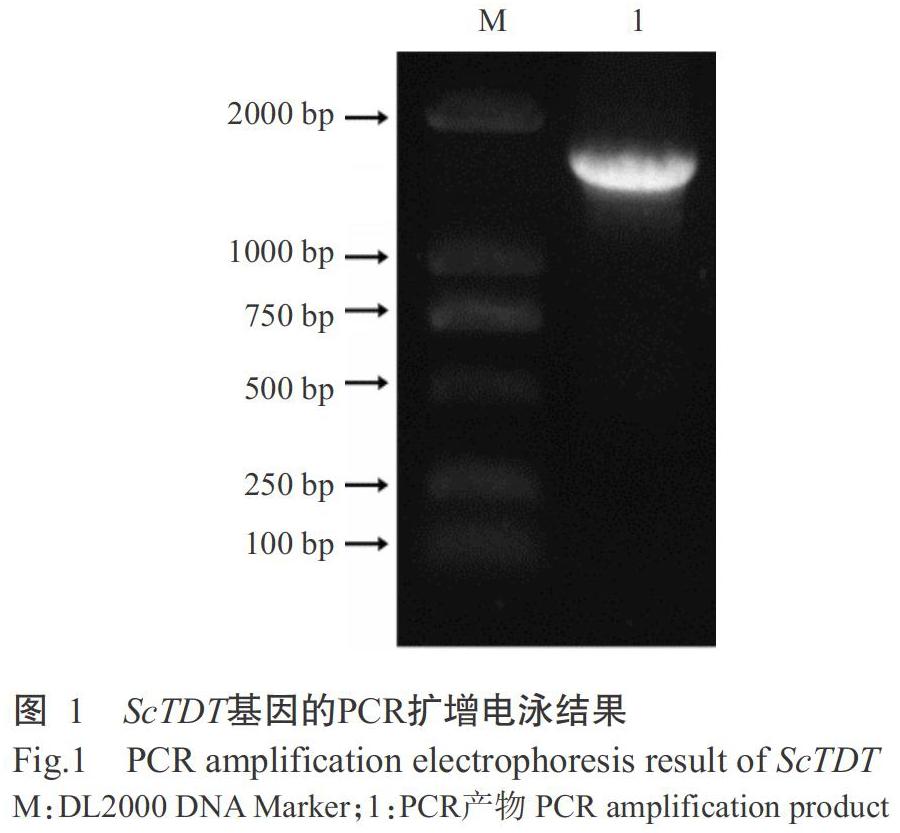
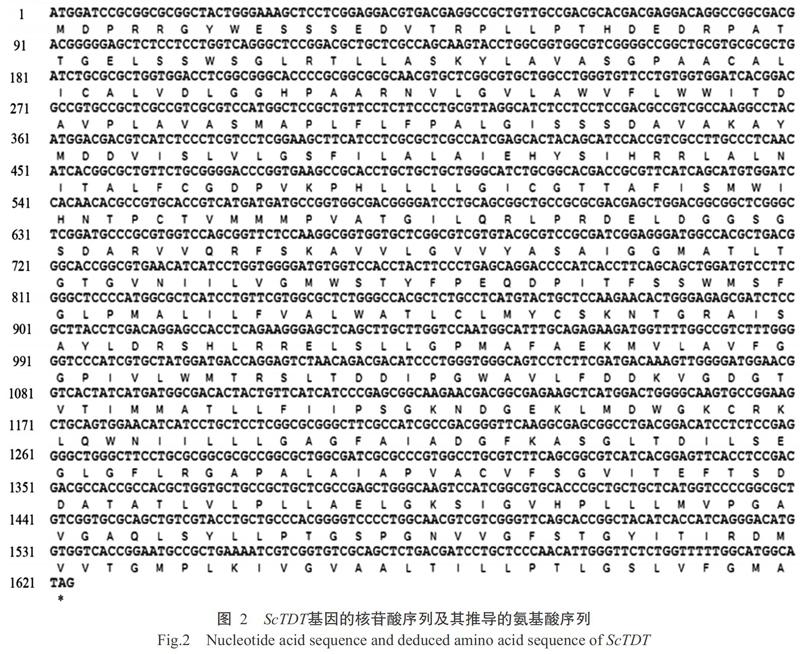
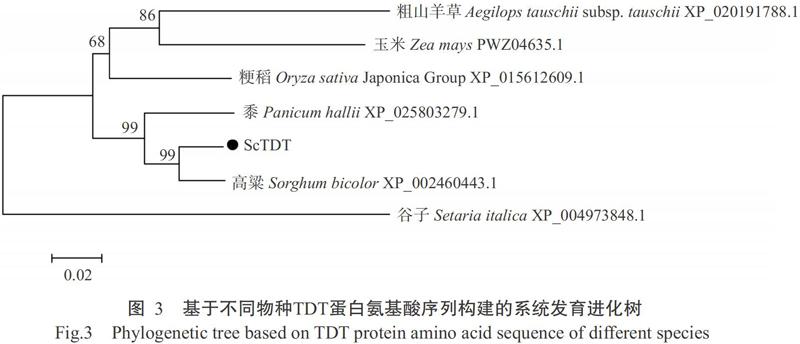
摘要:【目的】克隆甘蔗液泡膜二羧酸轉运蛋白基因(ScTDT),并分析其在甘蔗不同组织及在铝胁迫下的表达模式,为深入研究该基因功能及抵抗铝胁迫的分子机制提供理论依据。【方法】利用同源克隆技术从甘蔗品种ROC22中克隆ScTDT基因,利用生物信息学软件进行序列分析,采用实时荧光定量PCR技术检测该基因在甘蔗不同组织(根、茎和叶)及在铝胁迫(0、10和20 μmol/L Al3+)下的表达水平。【结果】克隆获得的ScTDT基因,开放阅读框(ORF)全长1623 bp,编码540个氨基酸残基,蛋白相对分子量57.34 kD,理论等电点(pI)5.77,为不稳定的疏水蛋白,可能定位于质膜、液泡和/或高尔基体,其氨基酸序列与高粱(XP_002460443.1)、水稻(XP_015612609.1)和玉米(PWZ04635.1)的TDT氨基酸序列具有高度相似性,其中与高粱的TDT氨基酸序列相似性最高,达96.30%,说明ScTDT与高粱TDT的亲缘关系最近。ScTDT基因在甘蔗根、茎和叶中均有表达,但根中表达量显著高于茎和叶(P<0.05,下同)。在铝胁迫处理下,3个甘蔗品种(ROC22、柳城05-136和中糖1202)的根中ScTDT基因表达量较对照组(0 μmol/L Al3+)均显著升高,尤其是柳城05-136和中糖1202随着营养液中Al3+浓度增加,ScTDT基因的表达量呈显著升高趋势,说明高浓度Al3+胁迫更能诱导ScTDT基因高效表达。3个甘蔗品种中,以中糖1202的ScTDT基因表达量变化最大,柳城05-136次之,以ROC22的变化最小。【结论】克隆获得的ScTDT基因表达具有组织特异性,在根中高效表达可能与甘蔗抵抗铝胁迫相关,即植株通过上调根中ScTDT基因表达,从而加快液泡中苹果酸的释放,促使苹果酸从根中分泌到土壤与Al3+反应,从而减少铝毒害,表明ScTDT基因可能参与甘蔗抵抗铝胁迫,且不同甘蔗品种的抗铝胁迫能力有所不同。
关键词: 甘蔗;液泡膜二羧酸转运蛋白(TDT);基因克隆;组织;铝胁迫
中图分类号: S566.106.53 文献标志码: A 文章编号:2095-1191(2021)02-0325-07
Abstract:【Objective】To clone the sugarcane tonoplast dicarboxylate transporter gene(ScTDT) and analyze its expression pattern in different tissues of sugarcane and under aluminum stress, so as to provide a theoretical basis for in-depth study of the gene function and the molecular mechanism of sugarcane resistance to aluminum stress. 【Method】Homologous cloning technology was used to clone ScTDT from sugarcane variety ROC22. Bioinformatics software was used to analyze the gene sequence. Real-time fluorescence quantitative PCR was used to detect the gene expression levels in di-fferent sugarcane tissues(root, stem and leaf) and under aluminum stress(0, 10 and 20 μmol/L Al3+). 【Result】 The cloned ScTDT gene had an open reading frame(ORF) of 1623 bp, encoding 540 amino acid residues with a relative molecular weight of 57.34 kD and a theoretical isoelectric point (pI) of 5.77. ScTDT protein was an unstable hydrophobin and may be located in plasma membrane, vacuole and/or Golgi. The amino acid sequence of ScTDT was highly similar to the amino acid sequence of TDT in sorghum(XP_002460443.1), rice(XP_015612609.1) and maize(PWZ04635.1). Among them, the TDT amino acid sequence of sorghum had the highest similarity, reaching 96.30%, indicating that ScTDT had the closest genetic relationship with TDT of sorghum. The ScTDT gene was expressed in sugarcane roots, stems and leaves, and the expression level in roots was significantly higher than that in stems and leaves(P<0.05, the same below). Under aluminum stress, the expression of ScTDT gene in the roots of the three sugarcane varieties(ROC222, Liu-cheng 05-136 and Zhongtang 1202) was significantly higher than that of the control group(0 μmol/L Al3+), especially in Liucheng 05-136 and Zhongtang 1202. With the increase of Al3+ concentration in the nutrient solution, the expression of ScTDT gene in these two varieties showed a significant increase trend, indicating that high-concentration Al3+ stress could induce the high-efficiency expression of ScTDT gene. Among the three sugarcane varieties, Zhongtang 1202 had the lar-gest change in ScTDT gene expression, followed by Liucheng 05-136, and ROC22 had the smallest change. 【Conclusion】The cloned ScTDT gene is tissue-specific, and its high expression in roots may be related to the resistance of sugarcane to aluminum stress. That is, plants can up-regulate the expression of ScTDT gene in roots to accelerate the release of malate from vacuoles, and then promote the secretion of malate from the roots into the soil to react with Al3+, thereby reducing the toxicity of aluminum, which indicates that the ScTDT gene may be involved in sugarcane resistance to aluminum stress. Different sugarcane varieties have different resistance abilities to aluminum stress.
Key words: sugarcane; tonoplast dicarboxylate transporter(TDT); gene cloning; tissue; aluminum stress
Foundation item: National Key Research and Development Program of China(2018YFD1000503); Basal Research Fund of Chinese Academy of Tropical Agricultural Sciences(1630052020013)
0 引言
【研究意义】甘蔗(Saccharum spp.)是我国最重要的糖料作物,经提汁、清净、蒸发、结晶、分蜜和干燥等工序制成食糖。全国约90%的食糖(王明强等,2010;牛俊奇等,2018)来源于甘蔗。蔗区土壤酸化引发的铝毒害是目前制约我国甘蔗生产的主要障碍(敖俊华等,2010;卢颖林等,2016;曾巧英等,2017)。研究发现,铝胁迫下植物根系会分泌出苹果酸等有机酸阴离子与土壤中的Al3+反应形成无毒害的复合物,从而保护植株不受铝毒害(Delhaize et al.,2007;Ma,2007;Yang et al.,2013)。液……