突发性耳聋患者cVEMP振幅、前庭冷热试验、纯音测听结果分析及与疗效的关系分析
2021-05-06谢展飞
谢展飞
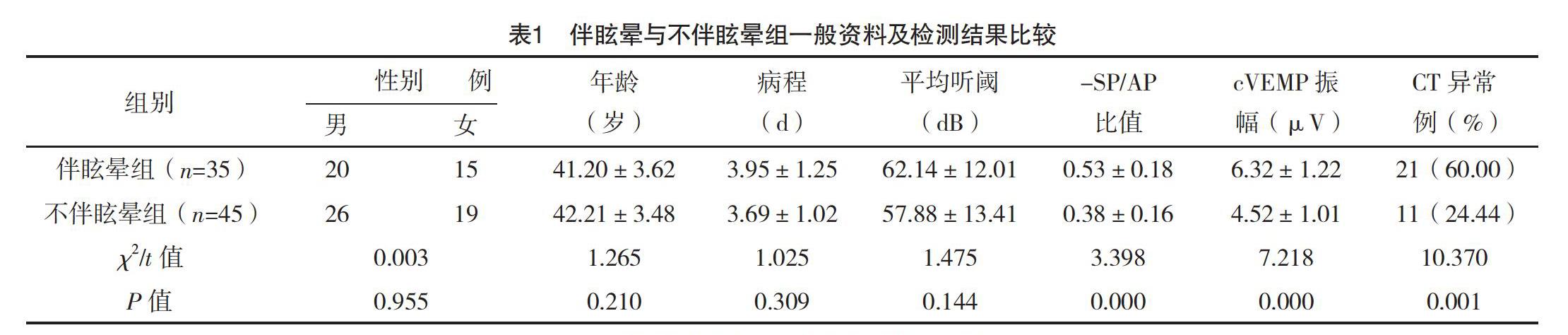


【摘要】 目的:分析突發性耳聋(SSHL)患者颈性前庭诱发肌源性电位(cervical vestibular-evoked myogenic potential,cVEMP)振幅、冷热试验(caloric test,CT)、纯音测听结果以及与疗效的关系。方法:选取2018年7月-2020年1月本院收治的80例SSHL患者的临床资料进行回顾性分析。所有患者入院后均进行的纯音听阈测试、耳蜗电图(electrocochleography,ECochG)测试、cVEMP检测及CT。比较伴眩晕/不伴眩晕、不同听阈水平、耳蜗电图正常/异常患者的cVEMP振幅、CT试验及纯音测听结果,比较不同类型分组患者的预后情况。结果:伴眩晕组-SP/AP比值、cVEMP振幅、CT异常率均高于不伴眩晕组(P<0.05),而两组平均听阈比较差异无统计学意义(P>0.05)。高频下降型组、平坦下降型组、全聋型组的平均听阈、cVEMP振幅与CT异常率均高于低频下降型组(P<0.05),平坦下降型组与全聋型组的平均听阈高于高频下降型组,且全聋型组高于平坦下降型组(P<0.05);而高频下降型组、平坦下降型组、全聋型组的cVEMP振幅与CT异常率比较,差异均无统计学意义(P>0.05)。耳蜗电图正常组平均听阈、-SP/AP比值、cVEMP振幅及CT异常率均低于耳蜗电图异常组(P<0.05)。伴眩晕组治疗总有效率为48.57%低于不伴眩晕组的73.33%(P<0.05),不同听阈水平各组治疗总有效率、耳蜗电图正常组与耳蜗电图异常组治疗总有效率比较,差异均无统计学意义(P>0.05)。结论:SSHL伴有眩晕患者的耳蜗功能、前庭功能损伤较不伴眩晕患者严重,不同听阈水平、耳蜗电图异常与患者前庭功能有关,并且SSHL伴有眩晕影响患者治疗效果,听阈水平及耳蜗功能对SSHL患者预后影响较小。
【关键词】 突发性耳聋 cVEMP振幅 冷热试验 纯音测听
Analysis of cVEMP Amplitude, Vestibular Caloric Test, Pure Tone Audiometry in Patients with Suddensen Sorineural Hearing Loss and Its Relationship with Curative Effect/XIE Zhanfei. //Medical Innovation of China, 2021, 18(07): 00-009
[Abstract] Objective: To analyze the amplitude of cervical vestibular-evoked myogenic potential (cVEMP), the results of caloric test (CT) and pure tone audiometry in patients with suddensen sorineural hearing loss (SSHL) and their relationship with curative effect. Method: The clinical data of 80 patients with SSHL admitted to our hospital from July 2018 to January 2020 were retrospectively analyzed. All patients were performed after admission of pure tone hearing threshold test, electrocochleography (ECochG) test, cVEMP detection and CT. The cVEMP amplitude, CT test and pure tone audiometry results of patients with vertigo/without vertigo, different hearing threshold levels, normal/abnormal electrocochlear electrography were compared, and the prognosis of patients with different types of groups was compared. Result: The -SP/AP ratio, cVEMP amplitude and CT abnormality rate in the vertigo group were higher than those in the without vertigo group (P<0.05), while there was no significant difference in the average hearing threshold between the two groups (P>0.05). The average hearing threshold, cVEMP amplitude and CT abnormality rate of the high frequency descending group, flat descending group and total deafness type group were higher than those of the low frequency descending group (P<0.05). The average hearing threshold of the flat descending group and total deafness type group were higher than those of the high frequency descending group, and the total deafness type group was higher than that of the flat descending group (P<0.05). There was no significant difference between cVEMP amplitude and CT abnormality rate in the high frequency descending group, flat descending group and total deafness group (P>0.05). The average hearing threshold, -SP/AP ratio, cVEMP amplitude and CT abnormality rate in the ECochG normal group were lower than those in the ECochG abnormal group (P<0.05). The total effective rate of the vertigo group was 48.57%, which was lower than 73.33% of the without vertigo group (P<0.05). There was no statistical significance in the total effective rate of the groups with different hearing threshold levels, the total effective rate of the group with ECochG normal and the ECochG abnormal group (P>0.05). Conclusion: The impairment of cochlear function and vestibular function in patients with SSHL accompanied by vertigo is more serious than that in patients without vertigo. Different hearing threshold levels and abnormal ECochG are related to the vestibular function of patients. In addition, the presence of vertigo in SSHL affects the treatment effect of patients, and hearing threshold level and cochlear function have little influence on the prognosis of SSHL patients.
[Key words] Suddensen sorineural hearing loss cVEMP amplitude Caloric test Pure tone audiometry
First-authors address: Huizhou Third Peoples Hospital, Huizhou 516000, China
doi:10.3969/j.issn.1674-4985.2021.07.002
突发性耳聋(suddensen sorineural hearing loss,SSHL)是耳鼻喉科常见急诊,是指患者在72 h内突然发生、原因不明确的听力下降,患者耳部传音结构无明显破坏,主要表现为感音神经性听力损失,纯音测听检查结果显示两个相邻频率听力下降≥20 dB HL[1-3]。SSHL的发病机理尚不清楚,多数认为与病毒感染、炎症、内耳循环障碍以及自身免疫因素等有关。多项研究表明SSHL患者还伴有耳闷、耳鸣临床症状,部分患者伴有眩晕症状,由此表明SSHL的病变范围可能累及前庭功能[4-6]。……
