咀嚼改善PS子代大鼠抑郁样行为的作用机制
2021-03-25周长文王芹春
周长文 王芹春
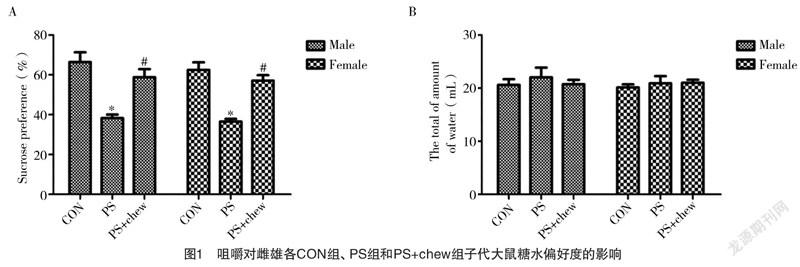
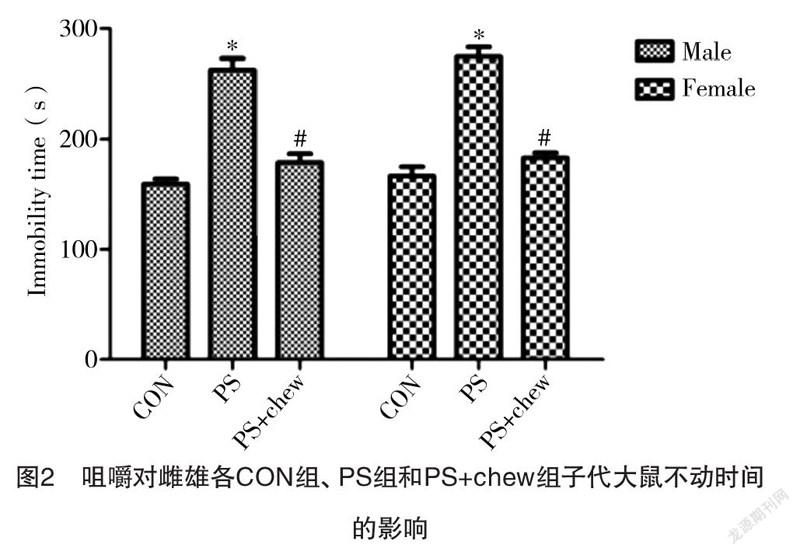
【摘要】 目的:研究咀嚼對PS子代大鼠抑郁样行为的作用机制。方法:利用束缚应激建立产前应激大鼠(prenatal stress,PS)模型,首先采用行为学实验观察咀嚼对PS子代大鼠抑郁样以及焦虑样行为的影响,最后利用RT-PCR和Western Blot观察子代大鼠海马GluA1 mRNA和蛋白表达的变化。结果:雌雄PS子代大鼠的糖水偏好度均低于CON组(P<0.01),强迫游泳的不动时间均高于CON组(P<0.01);而咀嚼可明显提高PS子代大鼠的糖水偏好度,缩短不动时间(P<0.01),在高架十字迷宫实验中,雌雄PS子代大鼠在中央区的时间明显少于CON组,咀嚼可提高PS子代大鼠中央区的时间(P<0.05)。通过RT-PCR实验发现,PS可抑制雌雄子代大鼠海马区GluA1 mRNA的表达(P<0.05),咀嚼则可逆转PS所致对GluA1 mRNA的抑制作用。结论:咀嚼可有效逆转PS导致的子代抑郁样行为,并部分改善焦虑样行为。抑郁样行为的发生与PS抑制海马区GluA1的表达有关,咀嚼可通过提高GluA1的表达有效改善PS子代的抑郁样行为。
【关键词】 咀嚼 产前应激 抑郁样行为 谷氨酸受体
Mechanism of Chewing to Improve Depression-like Behavior in PS Offspring Rats/ZHOU Changwen, WANG Qinchun. //Medical Innovation of China, 2021, 18(15): 00-007
[Abstract] Objective: To study the mechanism of chewing on depression-like behavior in PS offspring rats. Method: The model of prenatal stress (PS) was established by restraint stress. First, the effects of chewing on depression-like and anxiety-like behaviors of PS offspring rats were observed by behavioral experiments. Finally, the expression of GluA1 mRNA and protein in hippocampus of offspring rats were observed by RT-PCR and Western Blot. Result: Both male and female PS offsprings sugar water preference were lower than those of CON group (P<0.01), and the immobility time of forced swimming was higher than that of CON group (P<0.01). However, chewing could significantly improve the sugar preference of PS offspring and shorten immobility time (P<0.01). In the elevated plus maze experiment, male and female PS progeny rats spent significantly less time in the central area than that of CON group, chewing can improve the time of the central area of PS progeny rats (P<0.05). Through RT-PCR experiments, it was found that PS can inhibit the expression of GluA1 mRNA in the hippocampus of male and female offspring rats (P<0.05), and chewing can reverse the inhibitory effect of PS on GluA1 mRNA. Conclusion: Chewing can effectively reverse the depression-like behaviors of the offspring caused by PS and partially improve the anxiety-like behaviors. The occurrence of depression-like behavior is related to PS inhibiting the expression of GluA1 in the hippocampus. Chewing can effectively improve the depressive-like behavior of PS offspring by increasing the expression of GluA1.
[Key words] Chewing Prenatal stress Depressive behavior Glutamate receptor
First-authors address: Heze Medical College, Heze 274000, China
doi:10.3969/j.issn.1674-4985.2021.15.001
越来越多的证据表明,产前时期是神经发育的关键时期,对大脑的发育产生长期的影响,从而引起学习记忆能力下降和抑郁焦虑等情绪障碍。这严重影响了人们的生活质量和健康水平,尤其目前孕期的不良心理状态已经成为导致疾病发生的重要诱因之一。产前应激(prenatal stress,PS)是指母体在怀孕期间受到外界某些不良的非特异性应激反应,可造成子代行为及精神方面如抑郁、焦虑等的异常表现。临床研究表明孕妇在应激影响下,如慢性和普通生活压力等,可增加其后代有行為和情感问题的发生率[1],发生潜在心理精神疾病的风险大大增加[2]。
众所周知,海马是Papez情感环路的重要组成部分之一,同时也是介导应激反应重要的脑区。海马通过整合应激过程所产生的信息,调控神经内分泌及行为作用,从而影响负性情绪调节和学习认知等[3]。有报道在易复发的抑郁症患者中发现,其海马体积小于正常人[4]。但经过治疗后,比未经过治疗的患者海马体积有所增加[5]。还有研究发现PS可导致海马DG区(齿状回)的神经发生[6]。……