3种不同土壤的理化性质及其对Cu2+的吸附行为研究
2021-03-10赵大洲
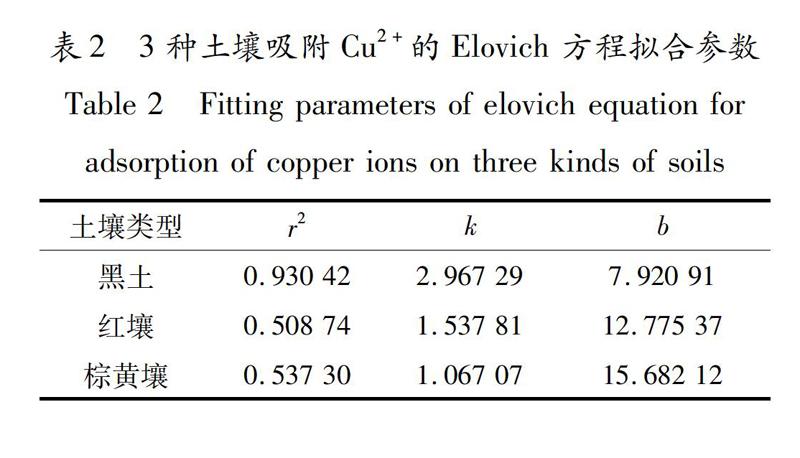
摘要:对不同地区3种土壤的水浸pH值、有机质含量、游离氧化铁含量、土壤机械组成、阳离子交换量等基本理化指标进行测定,并对3种土壤吸附废水中Cu2+的动力学进行研究,结果表明:红壤呈酸性,其游离氧化铁含量最高;黑土呈中性,其阳离子交换量最高;棕黄壤呈中性,其有机质含量最高.与红壤和棕黄壤相比,黑土对Cu2+的吸附过程更符合二级动力学方程,更适合作为Cu2+的吸附材料.
Abstract:The basic physical and chemical indicators such as pH value,organic matter content,free iron oxide content,soil mechanical composition,cation exchange capacity of the three kinds of soils in different regions were measured,and the kinetics of the three kinds of soils adsorbing Cu2+ in wastewater were studied.The results showed that red soil was acidic and had the highest free iron oxide content,black soil was neutral and its cation exchange capacity was the highest,brown soil was neutral and its organic matter content was the highest;compared with red soil and brown yellow soil,the adsorption process of black soil on Cu2+ was more in line with the second-order kinetic equation and more suitable for Cu2+ adsorption material.
0 引言
據中华人民共和国水利部2017年的水资源公报显示,我国水质总体评价情况较差[1].水质优良的测量站数量偏低,而较差的测量站超过半数,且部分地区水资源存在重金属污染问题[2-3].近年来,随着重金属矿物的开采、冶炼、加工等活动的不断增加,水体中重金属离子的种类和含量急剧上升,长期排放含重金属的污水使得排污口的生态系统不断恶化.重金属离子不能被生物降解且具有一定的生物积累性,主要通过食物链聚集在人体内,严重威胁着人类的身体健康.因此,重金属离子污染问题成为亟待解决的环境污染问题之一.据估算,全球每年进入到水体中的重金属高达数百万吨,其中铜为14.7×10⁴ t,砷为12.5×10⁴ t,镉为3.9×10⁴ t,汞为1.2×10⁴ t,且呈逐年上升的趋势[4].由于铜的排放量占比最大,故水体中重金属Cu2+的去除显得尤为重要.
去除重金属离子最常用的方法是吸附法[5-7].土壤具有胶体性质,其较大的比表面积和大量的表面反应位点对有机农药、重金属、放射性核素等污染物具有良好……